


















Lesson 47 of 47 · Projects and Practice
Further Study: Where to Go Next in Behavioral Economics
A guide to what to read, which skills to build and which related tracks to study next, plus a checklist for judging new behavioral economics research critically.
You now know the vocabulary, the main experiments and the main models of behavioral economics, and you have run a few simulations of your own. Where next? The answer depends on what you want to do: read the classics, build the data and statistics skills to run your own studies, or connect the ideas to neighboring fields such as game theory, microeconomics or psychology. This lesson gives a map for each route and ends with a checklist for reading new research, which is the skill that will serve you longest, because new studies appear every week and not all of them hold up.
What you will learn
- Which books and papers to read next, and in what order.
- Which skills and related tracks on this site fit each goal.
- A checklist for reading behavioral research critically.
Key terms
Primary source: the original paper or book that reports a result, not a summary of it.
Replication: repeating a study to see whether the result holds.
External validity: whether a result generalizes beyond the setting where it was found.
Preregistration: publicly recording the plan before collecting data.
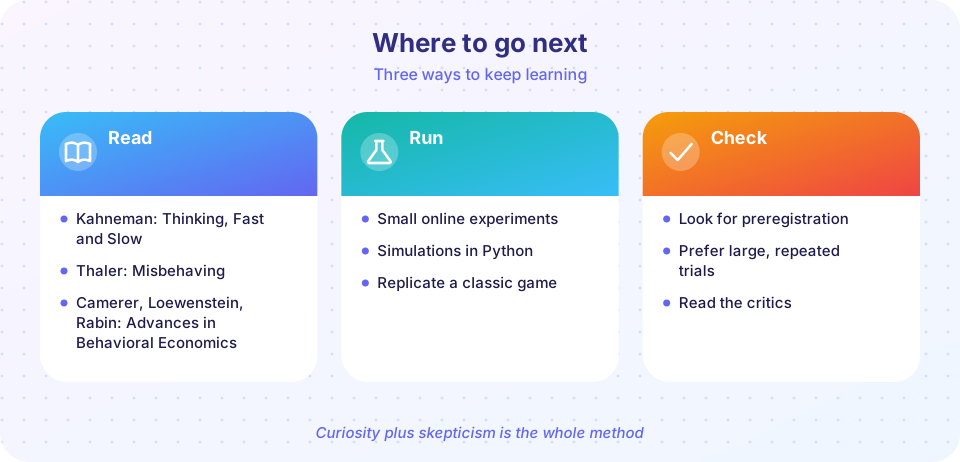
Route 1: read
Start with accessible books and then move to papers.
- Daniel Kahneman, Thinking, Fast and Slow (2011). A tour of judgment and decision research by a founder of the field. Read it with care: some of the studies in its chapter on priming have not replicated well, and Kahneman acknowledged that.
- Richard Thaler, Misbehaving (2015). The story of how behavioral economics grew inside economics, told through anecdotes and the experiments behind them.
- Richard Thaler and Cass Sunstein, Nudge (2008). The origin of the nudge idea; read it alongside the evidence in chapter 7.
- Erik Angner, A Course in Behavioral Economics. A textbook that covers the field systematically and works well after this course.
- Colin Camerer, George Loewenstein and Matthew Rabin (eds.), Advances in Behavioral Economics (2004). A collection of key papers; best after you are comfortable with the formal models.
Papers worth finding once you have the vocabulary: Kahneman and Tversky (1979) on prospect theory; Laibson (1997) on quasi-hyperbolic discounting; Rabin (2000) on small-stakes risk aversion; Fehr and Schmidt (1999) on inequity aversion; Madrian and Shea (2001) on automatic enrollment; Barber and Odean (2000) on trading; DellaVigna and Linos (2022) on nudge units. Read the introduction and conclusion first, then the design and results, and look at the figures before the formulas.
Route 2: run
Behavioral economics rests on data, so build the skills to produce and analyze it.
- Statistics and probability. Confidence intervals, tests and power are used in every lesson of the nudge chapter. The tracks Statistics and Probability and Bayesian Statistics extend what you used here.
- Experiments and causal reasoning. A/B Testing covers the practical side of randomized tests, and Causal Inference explains how to learn about cause and effect when you cannot randomize.
- Python and data analysis. The simulations in this course used Python; the Python and Data Science tracks teach the language and the analysis tools.
- Game theory. The games in chapter 6 are special cases of strategic situations; Game Theory gives the theory behind them, including the money-only predictions used as baselines.
A simple way to practice: replicate a classic result in a small way. Run an ultimatum game in a class, simulate a savings default with your own assumptions, or design (and preregister on paper) an experiment like the one in the project lesson. Predict the result before you see it.
Route 3: connect
- Microeconomics. Microeconomics provides the standard model that behavioral economics modifies, from utility maximization to markets.
- Macroeconomics. Macroeconomics shows where behavioral ideas such as expectations and sticky choices enter models of the whole economy.
- Personal finance. Personal Finance applies saving, borrowing and investing ideas to everyday life.
- Psychology. Introduction to Psychology, Cognitive Psychology and Social Psychology cover the mind processes behind biases, heuristics and social influence; Research Methods in Psychology teaches how studies are designed.
Behavioral economics has also influenced fields such as marketing, public health, law, design and product management. If you work in one of them, read how its professionals apply behavioral research and compare with the evidence you learned here.
A checklist for reading new research
When you read a paper or a news report about a behavioral finding, ask:
- What exactly was measured? An actual behavior, a stated intention or a questionnaire?
- Who took part and how many? Students, a representative sample, a company's customers? A study with 40 participants can show large effects by chance.
- Was assignment random? If not, what else might explain the difference?
- How large is the effect, and what is the interval? Beware reports that give only "significant".
- Was it preregistered? Did the authors say in advance what they would test?
- Has it been replicated, ideally by independent teams and in larger samples? Many classic results have been tested again, with mixed outcomes.
- Does it generalize? Would the result hold in other countries, at larger stakes, over longer periods?
- Who gains from the result? Conflicts of interest do not make a study wrong, but they call for extra scrutiny.
A single study rarely settles anything. Look for several studies that point the same way, preferably megastudies and meta-analyses that account for publication bias.
Common misconceptions
"If a famous book says it, it is established." Popular accounts sometimes present early results that were later revised. Check for replications.
"Skepticism means rejecting behavioral economics." The aim is to separate solid findings (such as defaults, present bias and fairness concerns) from fragile ones.
"You need advanced mathematics to continue." Basic statistics and clear thinking take you far; formal models become important only for the theory-focused route.
Try it
First, a path finder. Choose what interests you most and see a suggested next step and a project to try. It is a simple lookup, not personalized advice.
Second, a scorer for the reading checklist. Answer true or false for each question about a study you are reading and the function returns a rough confidence label. It is a thinking aid: real judgment needs more than a score.
Press Run (or Ctrl + Enter) to see the console output here.
No output.
Check your understanding
Quick check · 4 questions
of 4 answered You scored / 4 · perfect!
-
1. Why should you read a primary source rather than only a summary?
The details of the study let you judge how strong the evidence is. -
2. Which track would help most with running and analyzing randomized tests?
A/B testing covers randomized design and analysis in practice. -
3. What does it mean if a study has been replicated?
Replication tests whether a finding is reliable. -
4. Which of these is a warning sign when reading a behavioral study?
Without an effect size and interval, you cannot judge how large or how uncertain the effect is.
Summary
- Read primary sources, starting with the classics, and read popular books with attention to replications.
- Build skills in statistics, experiments, causal reasoning and Python to run your own studies.
- Connect to microeconomics, game theory, psychology and finance for a fuller picture.
- Use the checklist on every new study: measurement, sample, randomization, effect size, preregistration, replication, generalization and incentives.
Use the glossary and the cheat sheet to keep the ideas fresh, and return to any lesson when you need it.
Track your progress
Create a free account to tick off lessons and pick up where you left off on any device.
of Behavioral Economics lessons completed