


















Lesson 29 of 47 · Social Preferences and Fairness
Ultimatum and Dictator Games
Explore the ultimatum and dictator games, the money-only prediction, what people really do across cultures, and why giving in dictator games is fragile.
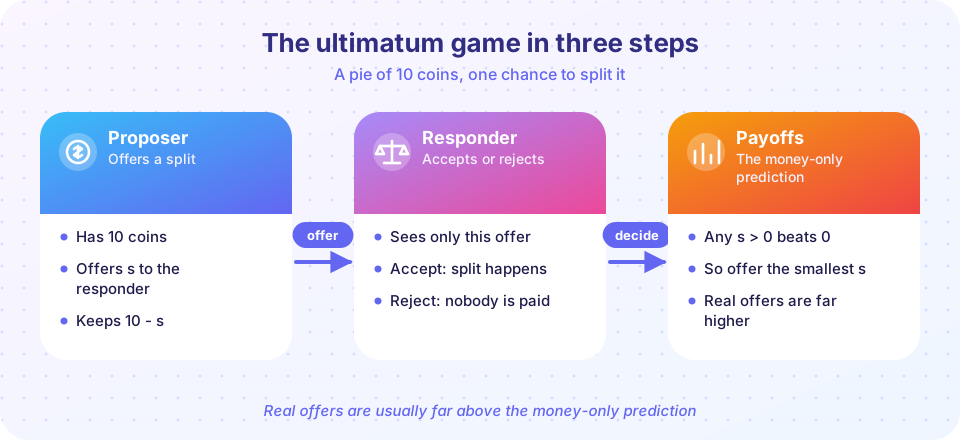
Two strangers are given 10 coins to share. One, the proposer, offers a split. The other, the responder, can accept it or reject it, and if she rejects it, both get nothing. What should the proposer offer? A self-interested responder should accept any positive amount, because something beats nothing, so a self-interested proposer should offer the smallest amount allowed. Yet when people play this game, they do not behave like that, and the way they deviate tells us a lot about fairness.
What you will learn
- How to derive the money-only prediction in the ultimatum and dictator games by backward reasoning.
- What typical results look like and how they vary with culture, stakes and framing.
- Why a purely selfish proposer might still make a generous offer.
- What the dictator game adds, and why its results are fragile.
Key terms
Ultimatum game: a proposer offers a split of a pie; the responder accepts (split happens) or rejects (both get zero).
Dictator game: the same split, but the recipient has no say; the dictator decides alone.
Backward induction: solving a game from its last move back to the first.
Strategic fear: offering more because you fear rejection, not because you care.
Moral wiggle room: an excuse that allows a person to act selfishly without feeling or looking unfair.
The money-only prediction
Solve by backward induction. At the last move the responder compares s (the offer) with 0 (the rejection payoff). Any s > 0 is better, so she accepts. Knowing that, the proposer chooses the smallest possible s, say one coin out of ten, or the smallest unit the experimenter allows. The prediction is a very lopsided split, like 9 to 1, with no rejections.
What people do
Beginning with the 1982 study of Güth, Schmittberger and Schwarze, hundreds of experiments have found a different pattern:
- Proposers' offers cluster around 40 to 50 percent of the pie, far above the minimum.
- Very low offers are often rejected. In many studies offers of about 20 percent or less are rejected roughly half the time.
- Rejections are not rare mistakes: responders give up real money to punish what they see as unfair.
Rejecting a low offer is a costly punishment: the responder pays (the money she gives up) so that the proposer earns nothing.
Is this universal?
Joseph Henrich and a large team ran ultimatum games in 15 small-scale societies, from foragers to herders to farmers, in a 2001 study titled "In search of homo economicus". They found no society that played like the money-only model, but average offers varied widely, from about a quarter of the pie in some groups to more than half in others. Societies where people depended on cooperation in daily life and on markets made higher offers. In some societies, very generous offers were also rejected, perhaps because accepting creates an obligation. Alvin Roth and colleagues (1991) had earlier compared students in Israel, Japan, Slovenia and the United States and found similar modal offers, with differences in how often low offers were refused.
What about stakes? You might think rejecting 20 percent of a trivial amount is cheap, but rejecting it is costly when the pie is a month's wages. Studies in Indonesia and Slovakia with large stakes found that rejection of low offers falls somewhat as stakes rise, but does not vanish, and proposers do not cut their offers much.
Why would a selfish proposer offer 40 percent?
Not all of the generosity needs fairness preferences. A proposer who expects some responders to reject low offers will rationally offer more. The code below makes this concrete: suppose a responder's minimum acceptable offer is spread around 3 coins with some variation. Then the proposer's expected payoff from offering s is (10 − s) × P(accept s). Offering 3 gets accepted only about half the time and pays 3.5 on average; offering 4.5 is accepted about 84 percent of the time and pays about 4.6. A purely self-interested proposer who simply believes in rejection chooses a generous offer. This is strategic fear.
But this does not explain why the responder rejects in the first place. Only a preference about fairness or reciprocity can explain that, and we can tell the two proposer motives apart with the dictator game.
The dictator game
In the dictator game the recipient cannot reject, so there is no strategic reason to give. Money-only prediction: give nothing. Robert Forsythe and coauthors (1994) compared the two games and found that dictators gave less than proposers, but many still gave something. In a review of more than a hundred dictator-game studies, Christoph Engel (2011) reported an average gift of roughly 28 percent of the pie, with a large share of dictators giving nothing and a smaller group splitting equally. Daniel Kahneman, Jack Knetsch and Richard Thaler found earlier (1986) that when students could choose only between an equal split and a very lopsided one, about three quarters chose the equal split.
So there is real giving. But how deep does it go?
Fragile giving
Dictator-game giving responds strongly to small changes in the setup:
- Taking. John List (2007) allowed dictators to take money from the recipient as well as give. Giving fell sharply, and many dictators took. The "give" behavior was partly the consequence of a narrow set of allowed actions.
- Anonymity and image. James Andreoni and Douglas Bernheim (2009) built a version in which the dictator's choice might be overridden by a random zero allocation. Equal splits fell, suggesting that people sometimes split 50-50 to look fair, not because they want an equal outcome.
- Wiggle room and exit. Jason Dana, Daylian Cain and Robyn Dawes (2006) let dictators opt out of the game by paying a small fee, in which case the recipient never learned a game was happening. Many paid to leave. Giving was partly to avoid feeling bad in the presence of the recipient.
- Intentions. In a "mini-ultimatum" game Armin Falk, Ernst Fehr and Urs Fischbacher (2003) showed that responders reject the same lopsided split more often when the proposer could have chosen a fair alternative than when the alternatives were worse. Blame for an unfair choice matters, not just the numbers.
These results suggest that fairness behavior mixes caring about outcomes, concern for one's image and moral self-image, and attention to the other's intentions. A single "fairness parameter" will not capture all of it, as the next lessons show.
Common misconceptions
"The ultimatum game shows that people are irrational." Rejecting a low offer is irrational only if money is the only goal. If people care about fairness, the choice is consistent with their goals.
"High offers prove that proposers are fair." Offers can be driven by fear of rejection. The dictator game helps separate the motives, and even there giving can reflect image concerns.
"Results are the same everywhere." Cross-cultural studies find substantial variation in average offers and rejection rates.
Try it
First, the proposer's problem. This simulation assumes responders' minimum acceptable offers are spread around 3 coins with a standard deviation of 1.5, which is an assumption for illustration. It shows how the best offer for a purely self-interested proposer rises above the minimum.
Press Run (or Ctrl + Enter) to see the result here.
Program input · what you'd type while the program runs
Type the answers before you press Run, one per line. Each time the program reads a line (with input()), it gets the next line from this box.
Second, a dictator-game giving distribution. This small simulation draws 1,000 dictators from an assumed mix of types (a third give nothing, a fifth split equally, the rest give small to moderate shares) and then adds a "take option" that moves some of them. The percentages are assumptions chosen to illustrate the shift in List's design; they are not data.
Press Run (or Ctrl + Enter) to see the console output here.
No output.
Check your understanding
Quick check · 5 questions
of 5 answered You scored / 5 · perfect!
-
1. In the ultimatum game with money-only players, what offer does backward induction predict?
The responder accepts anything above zero, so the proposer keeps as much as possible. -
2. Which finding is typical of ultimatum games?
Modal offers are close to half and offers around 20 percent or less are frequently rejected. -
3. How can the dictator game separate fairness from strategic fear?
Without a veto, any generosity is not a strategic response to a threat of rejection. -
4. What did List (2007) find when dictators could also take?
The set of allowed actions shaped behavior, suggesting giving is partly context dependent. -
5. What did the mini-ultimatum game of Falk, Fehr and Fischbacher show?
Rejection depends on what the proposer could have chosen, not only on the final split.
Summary
- Money-only theory predicts tiny offers that are always accepted; experiments show offers near 40 to 50 percent and frequent rejection of low offers.
- Part of proposers' generosity is strategic fear of rejection, and part reflects fairness preferences.
- Dictator-game giving is real but fragile: it falls when taking is allowed, when anonymity increases or when an exit is offered.
- Intentions, image concerns and culture all matter.
Next: Trust and public goods
Track your progress
Create a free account to tick off lessons and pick up where you left off on any device.
of Behavioral Economics lessons completed