


















Lesson 31 of 47 · Social Preferences and Fairness
Inequity Aversion and Other Models of Social Preferences
Learn the Fehr-Schmidt inequity aversion model with worked ultimatum and dictator examples, and compare it with reciprocity, warm glow and image concerns.
Experiments tell us what people do. To predict behavior in new situations, we need models: compact rules that say what people care about. The most influential model of fairness concerns is inequity aversion, proposed by Ernst Fehr and Klaus Schmidt in 1999. It adds just two parameters to the standard utility function, yet it can explain rejections in the ultimatum game, generosity in some games and cooperation with punishment. This lesson works through the model with numbers, then looks at alternatives that stress intentions and feelings.
What you will learn
- The Fehr-Schmidt utility function and its two parameters.
- How to compute a responder's minimum acceptable offer and a proposer's best offer.
- When the model predicts an equal split in the dictator game.
- What reciprocity, warm glow and image models add and where each is tested.
Key terms
Inequity aversion: a dislike of unequal outcomes, stronger when you are behind than when you are ahead.
Envy parameter α: how much utility is lost per unit of disadvantageous inequality.
Guilt parameter β: how much utility is lost per unit of advantageous inequality (0 ≤ β ≤ α, β < 1).
Reciprocity: rewarding kind intentions and punishing unkind ones.
Warm glow: utility from the act of giving itself.
The Fehr-Schmidt model
In a two-person setting, let your payoff be x and the other person's payoff y. The utility function is
U = x − α · max(y − x, 0) − β · max(x − y, 0)
The second term penalizes being behind, the third penalizes being ahead. The authors assumed α ≥ β (being behind hurts more than being ahead) and 0 ≤ β < 1, so that a person never prefers to burn her own money just to reduce a lead. A person with α = β = 0 is purely selfish.
The responder in the ultimatum game
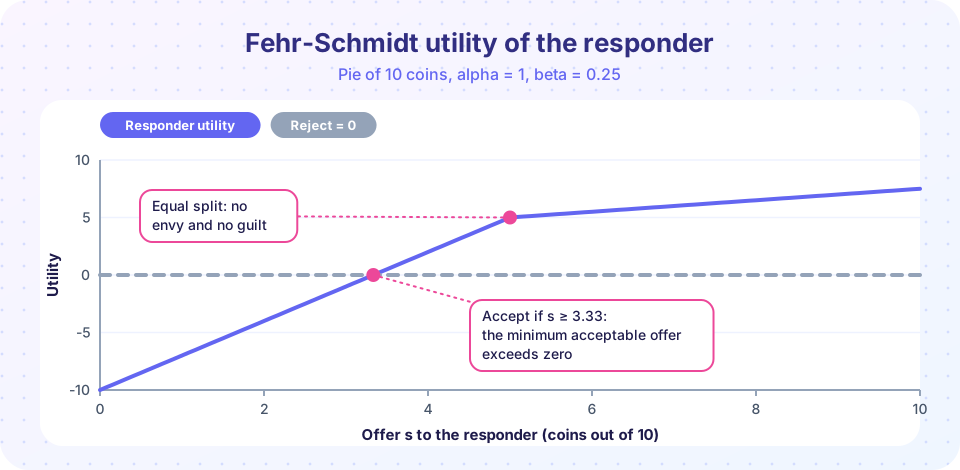
Suppose the pie is 10 and the proposer offers s to the responder. If s < 5, the responder is behind by 10 − 2s, so accepting gives
U(accept) = s − α · (10 − 2s)
Rejecting gives both players zero, so U(reject) = 0. She accepts when s − α(10 − 2s) ≥ 0, that is,
s ≥ 10α / (1 + 2α)
For α = 1 this is 10/3 ≈ 3.33. For α = 0.5 it is 2.5, for α = 2 it is 4 and for α = 4 about 4.44. As α rises toward infinity the threshold approaches 5: no one rejects an equal split. The graph at the top of this lesson plots the responder's utility for α = 1 and β = 0.25.
The proposer
The proposer may be selfish or inequity averse. Take an inequity-averse proposer whose own β applies when she keeps more than the responder. If she keeps 10 − s and s < 5, her utility is
U = (10 − s) − β · (10 − 2s) = 10(1 − β) − s(1 − 2β)
The coefficient on s is −(1 − 2β). If β < 0.5, utility falls as s grows, so she offers as little as she can get accepted. If β > 0.5, utility rises with s and she offers the equal split. This threshold at β = 0.5 is a neat prediction: strong guilt leads to equal splits, weak guilt to minimal acceptable offers.
Mixed populations
Fehr and Schmidt did not assume everyone has the same parameters. They proposed a distribution consistent with experiments: roughly 30 percent with α = 0, 30 percent with α = 0.5, 30 percent with α = 1 and 10 percent with α = 4 (with a distribution of β too). With such a population the proposer's expected payoff from an offer s is (10 − s) × (share of responders whose threshold is at most s). Thresholds are 0, 2.5, 3.33 and 4.44, so the cumulative acceptance shares are 30, 60, 90 and 100 percent. Comparing offers:
| Offer | Accepted by | Expected payoff to a selfish proposer |
|---|---|---|
| 2.5 | 60% | 7.5 × 0.6 = 4.5 |
| 3.33 | 90% | 6.67 × 0.9 = 6.0 |
| 4.44 | 100% | 5.56 |
The best offer for a money-maximizing proposer is about 3.33. Real proposers often offer more (40 to 50 percent), which the model explains by adding proposers with a strong guilt parameter β, and by fear of rejection. The same model predicts that dictators who are not strongly guilt-averse give nothing, as there is no threat. Some give half. That mixture fits the dictator game data in which giving is bimodal. It also helps explain cooperation with punishment in the public goods game: free riding creates inequality that conditional cooperators dislike.
Competing and complementary models
Inequity aversion is not the only way to formalize social preferences.
- Bolton and Ockenfels (2000), the ERC model, make utility depend on your own payoff and your share of the total. People like their share to equal an equal share. It explains many of the same games with a different functional form.
- Rabin (1993) models reciprocity: utility depends on the kindness of the other's intentions. If you believe someone treated you kindly, you want to be kind back. This is how the mini-ultimatum finding (the same split is rejected more when a fairer option was available) is explained. Later versions by Dufwenberg and Kirchsteiger and by Falk and Fischbacher extend this to sequential games.
- Warm glow (Andreoni, 1990) adds the joy of giving, independent of its effect on others. A dictator might give because the act itself feels good.
- Charness and Rabin (2002) combine concern for the total surplus, for the worst-off person and for reciprocity, and fit data from several games.
- Image and social norms. Andreoni and Bernheim (2009) and others model people who want to be seen as fair, or who follow a norm because of the cost of violating it.
What to check when comparing models
- Do intentions matter? Pure outcome models like Fehr-Schmidt predict that the same split is treated the same way whoever chose it. Experiments show some dependence on intentions, which favors reciprocity models.
- Is it about shares or differences? ERC compares shares, Fehr-Schmidt compares differences. Games with a different pie size separate them.
- How general? The Fehr-Schmidt model's parameters can be fitted to one game, then tested on another. Critics (for example Ken Binmore and Avner Shaked, 2010) argued the model fits less well than claimed and that its parameters change from game to game; Fehr and Schmidt replied with additional evidence. The debate illustrates a recurring problem: flexible models can fit many results, so predictions across games are the real test.
- Is it preferences or beliefs and learning? Some behavior in repeated games reflects learning rather than stable preferences.
What the models imply
For policy and business, the main implication is that procedures and wages are judged for fairness. A firm that cuts pay unfairly may find that workers respond by cutting effort. Fehr and others have documented gift exchange in labor experiments: workers paid higher wages tend to provide more effort, though the effect weakens in the field with repeated interaction. Equally, public programs are easier to sustain when they are perceived as fair, and prosocial behavior can be encouraged by making contributions visible.
Common misconceptions
"Inequity aversion means people like equality." In the model people dislike inequality in their own pairing, and mostly when behind. Many people accept large inequalities between strangers they are not involved with.
"A good model must fit every game." The point of a model is to predict a new game. A model with many free parameters can describe past data without being useful.
"Warm glow and fairness are the same." Warm glow is utility from the act of giving, regardless of what the recipient ends up with; inequity aversion depends on the final allocation.
Try it
First, compute thresholds and the proposer's best offer under the Fehr-Schmidt population described above, and plot the proposer's expected payoff. The weights are the ones proposed in the 1999 paper as an illustration; the output is a model calculation.
Press Run (or Ctrl + Enter) to see the result here.
Program input · what you'd type while the program runs
Type the answers before you press Run, one per line. Each time the program reads a line (with input()), it gets the next line from this box.
Second, an interactive utility explorer. Set your own payoff, the other person's payoff and the two parameters, and the widget computes the Fehr-Schmidt utility and draws the utility of an offer from 0 to 10.
Check your understanding
Quick check · 5 questions
of 5 answered You scored / 5 · perfect!
-
1. In U = x − α·max(y − x, 0) − β·max(x − y, 0), what does α capture?
α penalizes disadvantageous inequality (the other has more than you). -
2. A responder with α = 0.5 faces a pie of 10. What is the minimum offer she accepts?
10α/(1+2α) = 5/2 = 2.5. -
3. When does an inequity-averse dictator in this model give an equal split?
Utility from keeping 10 − g and giving g < 5 is 10(1 − β) − g(1 − 2β), which rises in g when β exceeds 0.5. -
4. Which model puts intentions at the center?
Rabin (1993) makes utility depend on the kindness of others' intended actions. -
5. What is the main risk of flexible fairness models?
The test of a model is prediction across games, not post-hoc fit.
Summary
- Fehr-Schmidt utility is
x − α·max(y − x, 0) − β·max(x − y, 0); a responder accepts offers of at least10α/(1 + 2α). - A dictator gives half only if guilt
βexceeds 0.5; a mixed population produces the bimodal giving seen in experiments. - Other models emphasize shares (ERC), intentions (Rabin), the joy of giving (warm glow) and image concerns.
- Compare models on predictions for new games and on whether intentions matter.
Next: Chapter 6 review
Track your progress
Create a free account to tick off lessons and pick up where you left off on any device.
of Behavioral Economics lessons completed