


















Lesson 35 of 47 · Nudges and Choice Architecture
The Choice Architecture Toolkit
Learn the main tools of choice architecture: simplification, attention, social norms, timing and commitment, with the EAST framework, evidence and caveats.
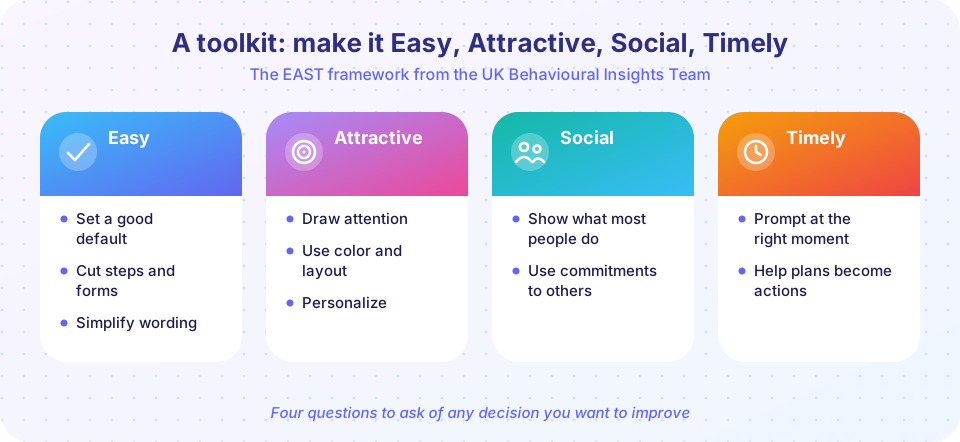
Defaults are the strongest single tool, but a choice architect has many others. A good design asks four questions: is the desired action easy, does it attract attention, does it feel normal among peers, and does it come at a moment when people can act? This lesson walks through the toolkit with the best-known evidence, including a few results that did not hold up as well as people hoped. It also shows how to test whether your own nudge works, which matters at least as much as having ideas for nudges.
What you will learn
- The EAST framework and the tools under each heading.
- Key evidence for social norms, simplification, reminders and planning prompts.
- Why choice overload is a more mixed story than a famous jam study suggests.
- How to evaluate a nudge with a simple randomized comparison.
Key terms
EAST: a framework from the UK Behavioural Insights Team: make it Easy, Attractive, Social and Timely.
Descriptive norm: information about what most people do.
Implementation intention: a specific plan of when, where and how you will act.
Choice overload: the idea that too many options can reduce the likelihood of choosing or the satisfaction with the choice.
Randomized controlled trial (RCT): random assignment of people to the nudge or to a control group.
Easy: remove friction
People often fail to do things that would benefit them because the process is hard: forms are long, steps are unclear, deadlines are hidden. Each extra step loses some people. The first TryIt below models a funnel with five steps in which 80 percent pass each one: only about a third complete. Cutting two steps raises completion to about half without changing anyone's motivation.
A well-known field test of this idea comes from Eric Bettinger and coauthors (2012). Low- and moderate-income families received help completing the long US college financial aid form (the FAFSA) while having their taxes prepared. Those given help were more likely to complete the form and more likely to enroll in college than families who received only information. Simplification of the process mattered more than a message about its benefits.
Other tools in this category are defaults (previous lesson), pre-filled forms, plain-language wording and automatic enrollment in services.
Attractive: draw attention
Attention is scarce. A nudge can make the desired option salient: a clear label, a bright color, a personal message. Anne Thorndike and colleagues (2012) used traffic-light labels and placement in a hospital cafeteria so that healthy items were easier to spot, and healthy purchases rose. Personalization, such as including the recipient's name or a specific reason, often makes messages more effective, although the effects vary and are sometimes small.
Salience can also help in finance: showing the full cost of a choice at the point of decision (for example total interest for a loan) reduces the chance that costs go unnoticed.
Social: show what others do
People are strongly influenced by what others do. Noah Goldstein, Robert Cialdini and Vladas Griskevicius (2008) tested messages in hotel rooms: a standard environmental message resulted in towel reuse by about 35 percent of guests, and a message saying that most guests reuse towels raised it to about 44 percent. Hunt Allcott (2011) evaluated home energy reports that compared a household's electricity use with its neighbors'. Averaged over large programs, they reduced energy use by about 2 percent, a small percentage per household but meaningful when applied to millions of homes.
Social messages need care. In an earlier study, Wesley Schultz and colleagues (2007) found a boomerang effect: households that used less energy than the average increased their use after being told the average. Adding an approving smiley face to the below-average households (an injunctive norm, signaling what is approved) prevented the increase. The lesson is that a norm message tells everyone, including those already doing better, where the middle is.
Timely: choose the moment
Behavior depends on when you ask. Reminders work because attention lapses. Katherine Milkman and coauthors (2011) asked employees at a firm to write down when they planned to get a flu shot; the planning prompt raised vaccination by about four percentage points compared with a control group, a modest but cheap effect. Hengchen Dai, Milkman and Jason Riis (2014) documented a fresh start effect: people are more likely to start goals after temporal landmarks such as the beginning of a week, month or year, with measurable spikes in gym attendance and searches for diets.
Other timing tools are well-timed prompts after a paycheck arrives, and commitment features (see the present bias lesson in chapter 5), which turn good intentions into binding plans.
Choice overload: a cautionary tale
Sheena Iyengar and Mark Lepper (2000) set up a display of jams in a supermarket: 24 flavors or 6. More shoppers stopped at the large display, but only about 3 percent of them bought a jam versus about 30 percent at the small display. The result became a staple of popular books: "too much choice paralyzes". Later work complicates it. A meta-analysis of dozens of experiments by Benjamin Scheibehenne, Rainer Greifeneder and Peter Todd (2010) found an average effect close to zero with large variation: sometimes more choice reduced purchases, sometimes it increased them. Alexander Chernev, Ulf Böckenholt and Joseph Goodman (2015) identified conditions where overload is more likely: complex option sets, no dominant option, unclear preferences and the goal of minimizing effort. So the practical rule is not "always give fewer options" but "reduce complexity, organize the options, and help people sort them".
Testing a nudge
A design that sounds clever may not work. The most reliable test is a randomized controlled trial: assign people at random to control or treatment, measure the outcome you care about, and compare. The JS TryIt below computes the difference in proportions, its standard error and an approximate 95 percent confidence interval for a two-arm test. With 1,000 people per arm and conversion rates of 20.0 and 23.6 percent, the difference is 3.6 percentage points but the z-statistic is about 1.95, just short of the usual 1.96. The honest summary is "probably positive, but not conclusive". Decide the sample size before the experiment, and report the interval, not only whether it passed a threshold.
Common misconceptions
"A social norm message always works." It can backfire for those already above the norm, unless paired with approval.
"Fewer options always increase choice." Meta-analyses find an average effect near zero, with large variation by context.
"A nudge that works in one study will work everywhere." Effects depend on population, setting and implementation; test locally.
Try it
First, model a five-step process in which each step is passed by 80 percent of those who reach it, then see what happens when you cut steps or make each easier. This is a model with assumed pass rates.
Press Run (or Ctrl + Enter) to see the result here.
Program input · what you'd type while the program runs
Type the answers before you press Run, one per line. Each time the program reads a line (with input()), it gets the next line from this box.
Second, an A/B test calculator. It reports the difference in conversion, the standard error, a z-statistic and an approximate 95 percent confidence interval. The numbers are the example from the lesson; change them to see how sample size matters.
Press Run (or Ctrl + Enter) to see the console output here.
No output.
Check your understanding
Quick check · 5 questions
of 5 answered You scored / 5 · perfect!
-
1. What does the E in EAST stand for?
EAST stands for Easy, Attractive, Social, Timely. -
2. In the towel-reuse study, a message that most guests reuse towels changed reuse from about 35 percent to about what?
The descriptive norm message raised reuse by roughly nine percentage points. -
3. What is the boomerang effect in social norm messages?
Telling an above-average performer the average can make her relax, unless the message also conveys approval. -
4. What did the meta-analysis of choice overload experiments find on average?
Scheibehenne and coauthors (2010) found large heterogeneity and a mean near zero. -
5. Why use a randomized trial to test a nudge?
Randomization makes the groups comparable on average.
Summary
- EAST organizes nudges: make the action Easy, Attractive, Social and Timely.
- Simplification, social norms, reminders and planning prompts have evidence behind them, usually with modest effects.
- Social norms can backfire for those above the norm, and choice overload depends on context.
- Test nudges in randomized trials and report effect sizes with intervals.
Track your progress
Create a free account to tick off lessons and pick up where you left off on any device.
of Behavioral Economics lessons completed