


















Lesson 37 of 47 · Nudges and Choice Architecture
Chapter 7 Review: Nudges and Choice Architecture
Review chapter 7 with a one-picture summary, a recap table of nudge tools and evidence, and a ten-question quiz on defaults, EAST, effect sizes, ethics and sludge.
Chapter 7 followed an idea from a bold definition to a more careful practice. A nudge changes the choice architecture without removing options or changing prices; defaults are the strongest tool; social norms, simplification and reminders add more; and the evidence suggests that effects at scale are modest and that designers owe the people they nudge transparency and an easy way out. This review ties these points together.
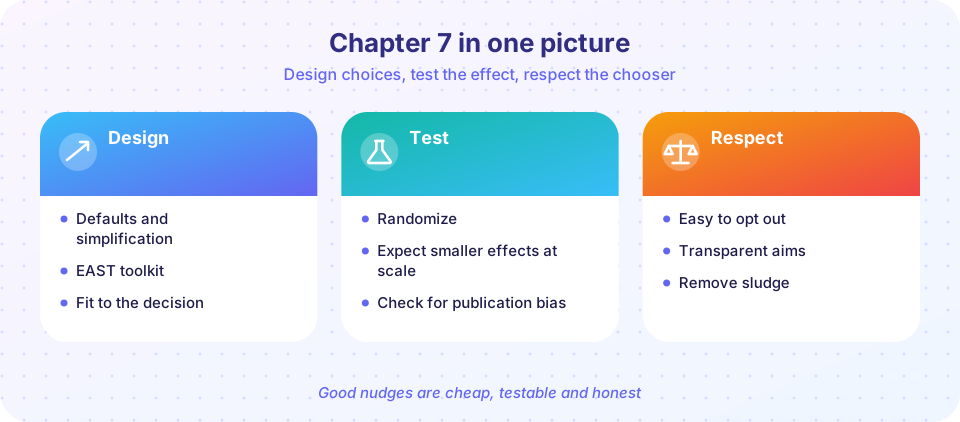
What you will learn
- A one-page summary of tools, evidence and ethics.
- A cost-effectiveness view of small effects.
- A self-test across all four lessons.
Recap table
| Topic | Key point |
|---|---|
| Definition | Changes behavior via choice architecture; preserves options and incentives |
| Defaults | Participation 37 percent to 86 percent in a 401(k) study; work through effort, endorsement, reference point |
| Inertia model | Opt-in w·a; opt-out w + (1 − w)(1 − a); active choice w |
| EAST | Easy, Attractive, Social, Timely |
| Social norms | Towel reuse about 35 to 44 percent; boomerang effect for those above the norm |
| Choice overload | Mean effect near zero in meta-analysis; depends on context |
| Evidence | 8.7 points (academic) versus 1.4 points (nudge units); publication bias |
| Ethics | Transparency, easy opt-out, serving the chooser, fairness |
| Sludge and dark patterns | Friction and pressure against users |
| Boosts | Build competence instead of steering |
Try it
First, a toolkit with the chapter's formulas: participation under three default designs, the sample size for a two-arm test and a z-statistic.
Press Run (or Ctrl + Enter) to see the console output here.
No output.
Second, a cost-effectiveness calculator. If a letter costs 0.50 per person and moves behavior by a given number of percentage points, what does each extra successful outcome cost? It shows why a small effect can still be good value, and why a big effect on a costly intervention might not be. The costs are assumptions.
Press Run (or Ctrl + Enter) to see the result here.
Program input · what you'd type while the program runs
Type the answers before you press Run, one per line. Each time the program reads a line (with input()), it gets the next line from this box.
Check your understanding
Quick check · 10 questions
of 10 answered You scored / 10 · perfect!
-
1. Which is the best description of a nudge?
That is the Thaler and Sunstein definition. -
2. Under opt-out with w = 0.6 and a = 0.4, what share participates?
0.6 + 0.4 × 0.6 = 0.84. -
3. Which channel of the default effect is about the default being read as advice?
People infer that the default reflects a considered recommendation. -
4. In the EAST framework, what does T stand for?
Timely: prompt people at the moment they can act. -
5. What is the boomerang effect?
Adding approval for below-average users prevented the effect in the energy study. -
6. What do DellaVigna and Linos's results suggest about published academic nudge effects?
8.7 versus 1.4 points, with selective publication a main reason. -
7. Which is a dark pattern?
Pre-ticked paid add-ons use defaults against the user. -
8. What is a boost?
Boosts aim to improve competence rather than steer. -
9. Why test a nudge with random assignment?
Randomization makes the groups comparable on average. -
10. A letter costs 0.50 per person and raises success by 1.4 points. What is the cost per extra success?
0.50 / 0.014 is about 35.7.
Summary
- Nudges change choice architecture, with defaults the strongest and most studied tool.
- EAST, social norms, simplification and reminders add more tools, each with caveats.
- Evidence at scale shows smaller effects, so test, use large samples and weigh cost-effectiveness.
- Respect the chooser: transparency, easy opt-out, fair treatment, and fewer sludge steps.
Next: Chapter 8 overview: markets, finance and policy applications
Track your progress
Create a free account to tick off lessons and pick up where you left off on any device.
of Behavioral Economics lessons completed