


















Lesson 34 of 47 · Nudges and Choice Architecture
Defaults, Inertia and Status Quo Bias
See why defaults are the most powerful nudge: 401(k) enrollment, organ donation, Save More Tomorrow, the reasons behind the default effect and its limits.
Imagine two versions of the same enrollment form. On one, you must tick a box to join the company savings plan. On the other, you are enrolled unless you tick a box to leave. In both versions every employee is free to end up in or out of the plan, and the cost of ticking the box is the same. Standard economics predicts the same enrollment in both. Behavioral research found that the choice of default can change enrollment from a minority to a large majority. That finding made the default the best-known tool of choice architecture.
What you will learn
- Why the default effect exists: effort, endorsement and loss aversion.
- The evidence from retirement saving, organ donation and Save More Tomorrow.
- How to model the effect with a simple inertia model.
- The limits of defaults: stickiness at the wrong level, heterogeneity and side effects.
Key terms
Default: the arrangement that applies when no active choice is made.
Opt-in / opt-out: opt-in requires action to join; opt-out enrolls automatically unless the person acts.
Status quo bias: a tendency to stick with the current arrangement even when better ones are available (Samuelson and Zeckhauser, 1988).
Active choice: a design that requires everyone to choose, with no default.
Auto-escalation: a pre-agreed schedule for increasing a savings rate over time.
The evidence
Retirement saving
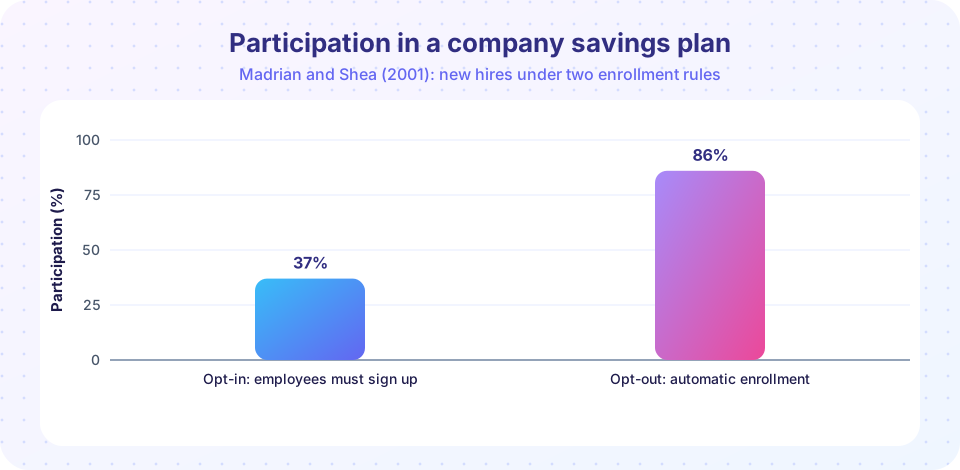
Brigitte Madrian and Dennis Shea studied a large US company that changed its 401(k) retirement plan from opt-in to automatic enrollment in 1998. Among new hires, participation went from about 37 percent to about 86 percent. A second finding is subtler. Many people who were automatically enrolled stayed at the default contribution rate (a low one) and in the default investment fund (a conservative one), even though few people who opted in had chosen that combination. The default did not only raise participation; it shaped how much people saved and where they invested.
James Choi, David Laibson, Brigitte Madrian and Andrew Metrick (2004) followed up with data from several firms and found default effects on contribution rate and on the investment fund. Choi, Laibson and Madrian, and later Gabriel Carroll and coauthors (2009), studied active choice: requiring employees to choose, yes or no, within a limited time. Active choice raised participation compared with opt-in, and in theory it can be better than an opt-out default for people whose preferred saving rates differ widely, because it does not anchor them at one level.
Richard Thaler and Shlomo Benartzi (2004) designed Save More Tomorrow: employees commit now to raise their savings rate each time they get a raise. Because the increase comes out of future pay increases, it does not feel like a loss, and because the escalation is automatic, inertia works in the saver's favor. In the first company where it was tried, a large majority (about three quarters) of those offered the plan joined, and average savings rates rose from about 3.5 percent to about 13.6 percent over roughly 40 months. Programs like it have since spread in many countries; the United Kingdom's auto-enrollment law, phased in from 2012, uses an opt-out default and has been associated with a sharp rise in workplace pension participation, with only a small share of workers opting out.
Organ donation
Eric Johnson and Daniel Goldstein (2003) compared consent rates across European countries. In countries with opt-in systems (you register to be a donor), stated consent was low, from single digits to under 30 percent. In countries with opt-out systems (everyone is a donor unless they register otherwise), stated consent was above 85 percent. This was widely reported as proof that defaults save lives.
The story needs care. Consent rates are not donation rates: the actual number of donors depends on how many people die in circumstances that allow donation, on hospital infrastructure, on families' consent, and on registries. Analyses of actual donation rates (such as Alberto Abadie and Sebastien Gay, 2006) find that opt-out is associated with higher donation rates in some data, but the effect is smaller and less certain than the consent-rate comparisons suggest. Spain, with one of the highest donation rates, owes much to its transplant coordination system. This example shows both the power of the idea and why you should check what outcome was measured.
Why do defaults work?
Researchers have distinguished three channels (for example Dinner, Johnson, Goldstein and Liu, 2011):
- Effort. Changing a default costs time and attention, and some people never get around to it. This is inertia.
- Endorsement. A default looks like a recommendation: if the company chose it, it must be a reasonable choice for people like me.
- Reference point. The default becomes the status quo, and leaving it feels like a loss if loss aversion operates. People then overvalue what they already have.
Each channel predicts something different. If effort is the main channel, making it easier to change the default should weaken the effect. If endorsement matters, a default described as "a suggestion from an expert" should be stronger than a default described as random. Studies of these predictions suggest that all three channels contribute, in proportions that vary by context.
A simple inertia model
Suppose a share w of employees would choose to save if they thought carefully. Each person acts on her preference with probability a (the "attention" probability), and otherwise sticks with the default.
- Opt-in: participants are those who want to save and act:
w × a. - Opt-out: participants are those who want to save (they stay) plus those who do not want to save but fail to opt out:
w + (1 − w)(1 − a). - Active choice: everyone must decide, so participation is
w.
With w = 0.75 and a = 0.5, opt-in gives 37.5 percent and opt-out gives 87.5 percent, close to the Madrian-Shea numbers. The model is a calibrated illustration, not an estimate. It also shows something important: under opt-out, the ones who do not want to save but remain enrolled (12.5 percent in the example) are people the default has moved against their preferences. Whether a default is a good nudge depends on how large that group is and how costly it is to them.
The limits of defaults
- Stickiness at the wrong level. A low default rate or a conservative fund can leave people worse off than active choice would. Setting the default is a design decision with welfare consequences.
- Heterogeneity. People differ. A default that suits the average employee can harm those with high-interest debt who should not be saving into a pension. Researchers have therefore studied side effects such as extra borrowing; the evidence generally suggests such effects are small compared with the increase in savings, but they deserve monitoring.
- Defaults can be abused. Pre-ticked boxes for paid add-ons or subscriptions use the same psychology against the chooser. Regulators in several jurisdictions restrict such defaults.
- Reactance. People who notice a default and dislike being steered may act against it.
Common misconceptions
"Defaults only work because people are lazy." Effort is one channel; endorsement and reference-point effects also matter.
"Opt-out always beats opt-in." It raises participation, but participation is not welfare. If the default is poorly set or unsuitable for some, active choice can be better.
"Organ donation defaults prove that opt-out saves lives." The consent comparison overstates the effect on actual donation, which depends on infrastructure and family decisions.
Try it
First, compute participation under the three designs for different values of w and a, and plot opt-in against opt-out as attention changes. The model uses the formulas from the lesson.
Press Run (or Ctrl + Enter) to see the result here.
Program input · what you'd type while the program runs
Type the answers before you press Run, one per line. Each time the program reads a line (with input()), it gets the next line from this box.
Second, an interactive version. Set the share who want to save and the chance that people act; the widget shows participation under each design and how many people end up in a state they did not choose.
Check your understanding
Quick check · 5 questions
of 5 answered You scored / 5 · perfect!
-
1. What happened to participation among new hires in Madrian and Shea's study when the plan moved from opt-in to automatic enrollment?
Automatic enrollment raised participation sharply, while many people stayed at the default contribution rate and fund. -
2. Which is NOT a proposed channel of the default effect?
Defaults work through effort, implied endorsement and reference-point effects, not through price. -
3. In the inertia model with w = 0.75 and a = 0.5, what is opt-out participation?
0.75 + 0.25 × 0.5 = 0.875. -
4. Why are organ donation consent comparisons misleading about donations?
Actual donor numbers depend on mortality, infrastructure and families' decisions. -
5. What is a key advantage of active choice over opt-out?
When people must choose, they are not steered to a possibly unsuitable default.
Summary
- Defaults can move participation from a minority to a large majority, as in Madrian and Shea's 401(k) study.
- The effect works through effort, endorsement and reference points, and it also anchors the amount saved and the fund chosen.
- Save More Tomorrow turns inertia into an ally; organ-donation comparisons need caution about what is measured.
- A good default is set with the chooser's interests in mind, and active choice can be preferable when preferences differ.
Track your progress
Create a free account to tick off lessons and pick up where you left off on any device.
of Behavioral Economics lessons completed