


















Lesson 27 of 47 · Time and Risk Preferences
Chapter 5 Review: Time and Risk Preferences
Review chapter 5 with a one-picture summary, a recap table of key formulas and a ten-question quiz on discounting, present bias, commitment and risk attitudes.
You have now met the standard models of patience and risk, the evidence that challenges them, and the tools people use to manage their own impulses. This review gathers the pieces in one picture, one table and one set of questions. Read the picture first, try to answer the quiz without looking back, and then use the table to check what you missed.
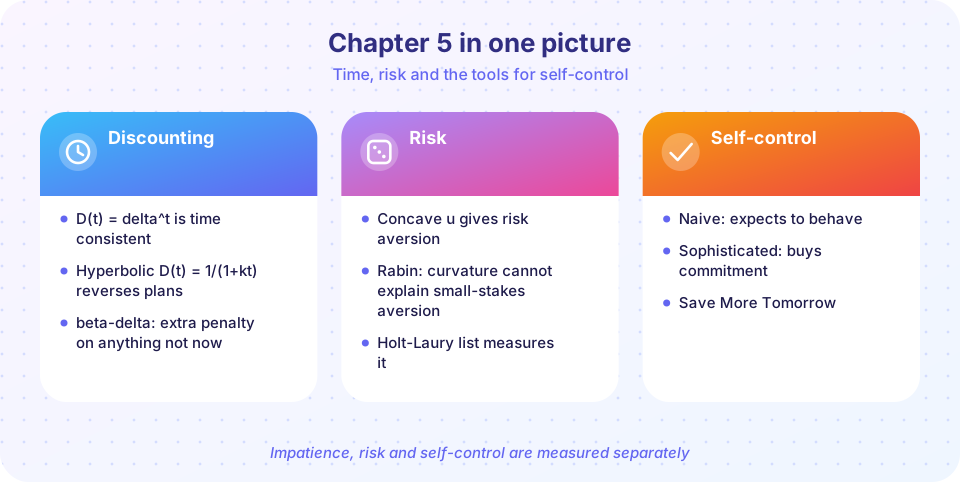
What you will learn
- A single recap of the chapter's formulas and findings.
- How to check yourself on the key ideas with mixed questions.
- Which ideas to revisit if a question surprised you.
Recap table
| Idea | Formula or statement | Why it matters |
|---|---|---|
| Discounted utility | U = Σ δ^t · u(c_t) |
The default model of patience; time consistent |
| Exponential discounting | D(t) = δ^t |
Constant percentage loss of value per period |
| Hyperbolic discounting | D(t) = 1 / (1 + k·t) |
Steep early drop, flat later; allows reversals |
| Common difference effect | Sooner-reward choice flips when both dates move later | The signature of non-exponential discounting |
| Beta-delta model | U_0 = u_0 + β · Σ δ^t · u_t |
Simple model of present bias |
| Naive versus sophisticated | Beliefs about one's own future bias | Sophisticates seek commitment |
| Commitment device | Binding choice today | Evidence from savings and work studies |
| Expected utility | EU = Σ p_i · u(x_i) |
Concave u means risk aversion |
| Certainty equivalent | Sure amount with the same utility | Risk premium = expected value minus CE |
| Rabin's calibration | Small-stakes aversion cannot be curvature alone | Points to loss aversion |
| Holt-Laury list | Four safe choices means risk neutral | Standard measurement method |
Where learners often slip
- Mixing up time consistency and patience. A very impatient exponential discounter is still time consistent. Reversals need a changing discount rate, not a high one.
- Reading
βas a discount rate. In the beta-delta modelβis a one-time extra penalty on everything that is not now. The per-period discount rate isδ. - Thinking commitment is always valuable. It helps people who predict their future bias correctly and who face little uncertainty about future needs.
- Treating the CRRA coefficient as a fixed trait. Estimates depend on the task, the stakes and the domain.
Try it
First, a toolkit that implements the chapter's three main formulas in a few lines. Run it and check the outputs against the lesson examples.
Press Run (or Ctrl + Enter) to see the console output here.
No output.
Second, draw the three discount curves from the toolkit on the same axes to see where each one differs. The beta-delta curve has a visible drop between "now" and "next week"; this plot is a demonstration of the formulas.
Press Run (or Ctrl + Enter) to see the result here.
Program input · what you'd type while the program runs
Type the answers before you press Run, one per line. Each time the program reads a line (with input()), it gets the next line from this box.
Check your understanding
Quick check · 10 questions
of 10 answered You scored / 10 · perfect!
-
1. Under exponential discounting with δ = 0.9 per week, how is 110 received in one week valued today?
0.9 × 110 = 99. -
2. Which pattern is the hallmark of hyperbolic discounting?
The sooner reward wins when it is immediate but the later one wins when both are delayed: the common difference effect. -
3. In the beta-delta model, which value of β means no present bias?
At β = 1 the model collapses to exponential discounting. -
4. With β = 0.7, δ = 1, which does the person choose: 100 now or 130 in four days?
0.7 × 130 = 91 < 100. -
5. A sophisticated person differs from a naive one because she...
Sophistication concerns beliefs about future behavior, not the strength of the bias. -
6. Which is a commitment device?
A commitment device restricts your own future options. -
7. For u(x) = √x and a 50-50 gamble between 0 and 100, the certainty equivalent is 25. What is the risk premium?
Expected value 50 minus certainty equivalent 25 is 25. -
8. What did Rabin's calibration argument conclude?
Rejecting a small favorable bet at all wealth levels through curvature alone implies absurd rejection of huge large-stakes bets. -
9. In the Holt-Laury list, a person who makes 8 safe choices is...
A risk-neutral person makes 4 safe choices; 8 indicates considerably more risk aversion. -
10. Why might estimated discount rates drop after accounting for utility curvature?
Joint estimation of risk and time preferences (Andersen and coauthors, 2008) found lower discount rates.
Summary
- Chapter 5 covers three linked ideas: discounting, risk attitudes and self-control.
- Exponential discounting is time consistent; hyperbolic and beta-delta models allow reversals.
- Commitment devices help sophisticated, present-biased people.
- Concave utility explains risk aversion at large stakes but not small ones, and risk attitudes vary with context.
Track your progress
Create a free account to tick off lessons and pick up where you left off on any device.
of Behavioral Economics lessons completed