


















Lesson 13 of 47 · Heuristics and Biases
Availability and representativeness
Understand the availability and representativeness heuristics, the Linda problem, base-rate neglect and Bayes' rule, with worked examples and simulations.
How likely is a plane crash compared with a car crash? Is a quiet, tidy man who likes order more likely to be a librarian or a farmer? Questions about probability are hard to compute, so the mind answers easier ones: How easily can I picture an example? and How well does this match my picture of the type? The first shortcut is called the availability heuristic; the second is the representativeness heuristic. Both come from Tversky and Kahneman's work in the early 1970s.
This lesson explains each, shows when it produces predictable errors, and teaches the one piece of mathematics, Bayes' rule, that lets you check your own judgments.
What you will learn
- How the availability heuristic works and where it misleads.
- How the representativeness heuristic leads to the conjunction fallacy and base-rate neglect.
- How to apply Bayes' rule with natural frequencies.
- Why "streaks" and the gambler's fallacy are tied to representativeness.
Key terms
Availability heuristic: judging how common or likely something is by how easily examples come to mind.
Representativeness heuristic: judging probability by how closely something resembles a typical case.
Base rate: how common something is in the population, before you look at the particular case.
Conjunction fallacy: judging that A and B together is more likely than A alone.
Bayes' rule: the correct way to update a probability given new evidence.
The availability heuristic
When examples come to mind easily, we judge the event to be frequent. This is often a good cue: common things are easier to recall. It fails when ease of recall is driven by something other than frequency, such as vividness, recency or media coverage.
In a classic 1973 experiment, Tversky and Kahneman asked people whether the letter K is more common as the first letter of English words or as the third letter. In fact it is more common in third position, but most people said first position, because words are easier to recall by their first letter. In a famous 1978 study, Sarah Lichtenstein and colleagues found that people overestimated dramatic, widely reported causes of death (such as tornadoes and accidents) and underestimated quieter ones (such as diabetes and asthma). After a widely reported disaster, people tend to overestimate its likelihood for a while.
Availability is not always a bias. If you recall fewer examples because the thing is rarer, availability gives a good answer. The trouble comes when something other than frequency drives recall.
The representativeness heuristic
We judge "How likely is it that this person is a member of that group?" by "How similar is this person to my image of that group?" Similarity is a useful cue but it ignores things that matter for probability, chiefly the base rate.
The Linda problem
Tversky and Kahneman (1983) described Linda: 31, single, outspoken and very bright, who majored in philosophy, was deeply concerned with discrimination and social justice, and took part in anti-nuclear demonstrations. Participants ranked statements by probability, including:
- Linda is a bank teller.
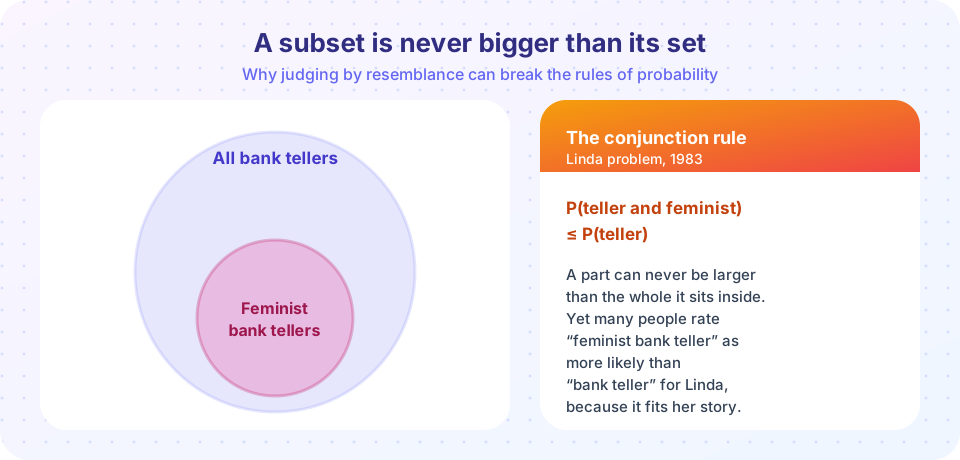
- Linda is a bank teller and is active in the feminist movement.
A large majority (about 85% in the original sample) judged the second more probable than the first. That is impossible: every feminist bank teller is a bank teller, so P(teller and feminist) <= P(teller). This is the conjunction fallacy. The extra detail makes the story more representative and more believable, while making the event less probable. The effect has been replicated many times, and it drops when the problem is posed in terms of frequencies ("out of 100 people like Linda, how many ...?").
Base-rate neglect
Imagine a taxi problem. In a city, 85% of cabs are green and 15% are blue. A witness says a cab in a hit-and-run was blue. Tests show the witness identifies colors correctly 80% of the time. What is the probability that the cab was actually blue?
Many people answer 80%, ignoring that blue cabs are rare. Use natural frequencies: out of 100 cabs, 15 are blue and 85 green. The witness says "blue" for 80% of the 15 blue cabs (12 cabs) and for 20% of the 85 green cabs (17 cabs). Of the 29 "blue" reports, 12 are right:
P(blue | says blue) = 12 / 29 = 0.41
So the answer is about 41%, not 80%. This is Bayes' rule in everyday numbers. The lesson is that evidence is worth less when the event it points to is rare. Gerd Gigerenzer and Ulrich Hoffrage (1995) showed that people do much better when information is presented as natural frequencies like these.
Streaks and the gambler's fallacy
People expect random sequences to look "random": few long runs, frequent alternation. After five heads in a row, many feel tails is "due". This is the gambler's fallacy: a fair coin has no memory. Real random sequences contain longer streaks than intuition expects. The reverse error is believing in hot hands. A 1985 study by Thomas Gilovich, Robert Vallone and Amos Tversky found no evidence of the "hot hand" in basketball shooting, but later work by Joshua Miller and Adam Sanjurjo (2018) found a subtle statistical flaw in the original analysis and argued that a modest hot-hand effect likely exists. The topic shows how even a famous bias claim can be revised.
Common misconceptions
- "Availability always misleads." It is a good cue when recall tracks frequency; it fails when vividness or coverage distorts recall.
- "The conjunction fallacy shows people cannot reason about probability." When asked in frequency format, performance improves a lot, so context and framing matter.
- "Base rates are boring." Ignoring base rates leads to serious errors in medicine, security screening and law.
Try it
First, try the Linda problem yourself, then see the check. This is a classroom demonstration.
Second, the taxi problem as a plot. The curve shows how the probability that the cab is blue changes with the base rate of blue cabs, for a witness who is 80% accurate.
Press Run (or Ctrl + Enter) to see the result here.
Program input · what you'd type while the program runs
Type the answers before you press Run, one per line. Each time the program reads a line (with input()), it gets the next line from this box.
Third, a simulation that tests your intuition about streaks. A fair coin is flipped, and we check what follows a streak and how long the longest streak in 100 flips usually is.
Press Run (or Ctrl + Enter) to see the console output here.
No output.
Check your understanding
Quick check · 5 questions
of 5 answered You scored / 5 · perfect!
-
1. Which is the best example of the availability heuristic?
Ease of recall, driven by vivid coverage rather than actual frequency, inflates the judged probability. -
2. Why is judging 'bank teller and feminist' more probable than 'bank teller' a mistake?
The set of feminist bank tellers is contained in the set of bank tellers. -
3. In the taxi problem (15% blue cabs, witness 80% accurate), the probability the cab was blue given the report is about
Of every 29 'blue' reports, 12 come from blue cabs: 12/29 = 0.41. -
4. Base-rate neglect means
People focus on case-specific similarity and underuse the prior probability. -
5. The gambler's fallacy is the belief that
A fair coin has no memory; each flip is independent.
Summary
- Availability: judging frequency by ease of recall. Good when recall tracks frequency, biased when vividness or coverage drives it.
- Representativeness: judging probability by resemblance. It leads to the conjunction fallacy and base-rate neglect.
- Bayes' rule with natural frequencies helps correct judgments (the taxi problem gives about 41%).
- The gambler's fallacy expects random sequences to look more alternating than they do; claims about hot hands have been revised.
Next: Anchoring and adjustment
Track your progress
Create a free account to tick off lessons and pick up where you left off on any device.
of Behavioral Economics lessons completed