


















Lesson 9 of 47 · Rational Choice and Its Limits
Preference anomalies: Allais, Ellsberg and reversals
Work through the Allais and Ellsberg paradoxes and preference reversals, and see exactly why they contradict expected utility theory, with runnable checks.
A good theory makes risky predictions: it says what should not happen. Expected utility theory says people should not make certain combinations of choices. Beginning in the 1950s, careful experiments showed that many people do, and they do it consistently. These patterns are called anomalies. In this lesson you will meet three of the most important and prove for yourself why the theory forbids them.
No single anomaly destroys a theory, but together they show where it is wrong. That tells researchers what to build next.
What you will learn
- The Allais paradox and the algebra that shows it violates expected utility.
- The Ellsberg paradox and ambiguity aversion.
- Preference reversals and why they challenge the idea of stable preferences.
- How researchers respond to anomalies.
Key terms
Independence axiom: if you prefer lottery X to Y, you should still prefer a mixture of X with a third lottery Z to the same mixture of Y with Z.
Certainty effect: the extra pull of a sure thing compared with a very likely one.
Ambiguity: uncertainty where the probabilities themselves are unknown.
Transitivity: if A is preferred to B and B to C, then A is preferred to C.
Preference reversal: choosing one option over another but pricing them in the opposite order.
The Allais paradox (1953)
Maurice Allais, a French economist who later won the 1988 Nobel prize, designed two choices.
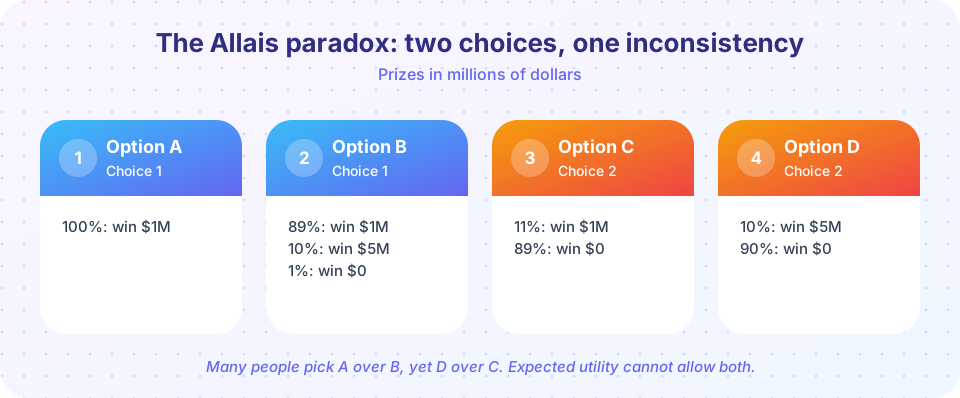
Choice 1. Pick one:
- A: $1 million for sure.
- B: 89% chance of $1 million, 10% chance of $5 million, 1% chance of nothing.
Choice 2. Pick one:
- C: 11% chance of $1 million, 89% chance of nothing.
- D: 10% chance of $5 million, 90% chance of nothing.
Many people choose A in Choice 1 (a sure fortune beats a small risk of ending with nothing) and D in Choice 2 (the chances are almost equal, so take the bigger prize). Each choice looks reasonable. Together they are inconsistent.
Why expected utility forbids it
Scale utility so u(0) = 0 and u($5M) = 1, and let m = u($1M), somewhere between 0 and 1.
- A beats B when
m > 0.89m + 0.10 x 1 + 0.01 x 0. Subtract0.89mfrom both sides:0.11m > 0.10, som > 0.909. - C beats D when
0.11m > 0.10 x 1, which is the same inequality:m > 0.909.
So a person who prefers A also prefers C, and a person who prefers B also prefers D. The popular pair (A and D) is impossible. The reason: both choices share a common 89% chunk ($1M in the first pair, nothing in the second). Independence says that common chunk should not matter, yet it does. Many people respond to the certainty effect: the sure $1M in A feels qualitatively different from a 99% chance.
The Ellsberg paradox (1961)
Daniel Ellsberg (later famous for releasing the Pentagon Papers) proposed an urn with 90 balls. Thirty are red. The other sixty are black or yellow in an unknown proportion. One ball is drawn.
Choice 1. Bet on red, or bet on black? Each bet pays $100 if your color is drawn.
Choice 2. Bet on red-or-yellow, or on black-or-yellow?
Many people choose red in Choice 1 (the odds are known: 30 in 90) and black-or-yellow in Choice 2 (the odds are known: 60 in 90). Suppose you believe the chance of black is b/90, where b is some number between 0 and 60.
- Red beats black when
30 > b. - Black-or-yellow beats red-or-yellow when
60 > 90 - b, i.e., whenb > 30.
No single belief b can satisfy both, so the common pattern is inconsistent with any well-defined probability judgment. People seem to dislike ambiguity: they prefer bets with known odds to bets with unknown odds, even when they have no reason to think the unknown odds are worse. Today the standard way to model this is to allow people to consider a set of possible probabilities and weight the worst case more.
Intransitivity and preference reversals
Intransitive choices. In 1969 Amos Tversky showed participants gambles whose probabilities differed slightly and whose prizes differed more. When probabilities were close, people compared mainly on prize; when far, on probability. Some people then chose A over B, B over C and C over D, yet D over A, a cycle. Transitivity failures tend to be modest in most settings, but they show that choice depends on how comparisons are framed.
Preference reversals. Sarah Lichtenstein and Paul Slovic (1971) used two bets with nearly equal expected value:
- The P-bet: 35/36 chance to win $4, 1/36 chance to lose $1. Safe and small prize.
- The $-bet: 11/36 chance to win $16, 25/36 chance to lose $1.50. Risky and large prize.
When asked to choose, most people pick the P-bet. When asked to name the lowest price at which they would sell each bet, most name a higher price for the $-bet. So the P-bet is preferred in choice and the $-bet in pricing. Choosing and pricing, which should reveal the same preference, differ. The effect has been replicated many times, including with real money, and it suggests that people do not always have a single, stable underlying value: they construct preferences from the task in front of them.
How researchers respond
Faced with anomalies, theorists can (a) keep the theory and explain away the data, (b) weaken the theory (for example, to rank-dependent utility, which drops independence), or (c) build a new descriptive theory. Prospect theory (Chapter 4) takes route (c): it keeps utility-like values but adds reference points, loss aversion and probability weighting, which handles the certainty effect.
Common misconceptions
- "The Allais choices are mistakes." Some decision theorists think so; others argue the choices reflect legitimate regret or attitudes to certainty. The anomaly says the theory fails descriptively, and whether people should change is a separate normative question.
- "Ellsberg shows people hate risk." Ellsberg shows people dislike ambiguity beyond risk. Both bets in the paradox have the same worst case.
- "Preference reversals prove preferences do not exist." They show that elicitation methods matter and that preferences are partly constructed.
Try it
First, a check of the Allais algebra. We scan the utility of $1M (between 0 and 1) and see which options expected utility prefers. The two difference lines are identical, which is the heart of the paradox.
Press Run (or Ctrl + Enter) to see the result here.
Program input · what you'd type while the program runs
Type the answers before you press Run, one per line. Each time the program reads a line (with input()), it gets the next line from this box.
Second, an Ellsberg consistency check. For each possible number of black balls we see what a person with that belief should choose.
Press Run (or Ctrl + Enter) to see the console output here.
No output.
Check your understanding
Quick check · 5 questions
of 5 answered You scored / 5 · perfect!
-
1. In the Allais paradox, which pair of choices violates expected utility?
Expected utility prefers either (A and C) or (B and D). Choosing A in the first problem and D in the second is inconsistent. -
2. Which axiom is violated by the common Allais choices?
Both choices share a common 89% component that should not affect the ranking, but people treat the sure thing differently. -
3. The Ellsberg paradox concerns
People prefer bets with known odds to bets with unknown odds, which no single probability belief can explain. -
4. In a preference reversal, a person typically
Choice and pricing tasks can reveal opposite rankings, so stated values depend on the elicitation method. -
5. What is the certainty effect?
A sure outcome gets extra weight compared with a high-probability outcome, which drives the Allais pattern.
Summary
- The Allais paradox: choosing A over B and D over C contradicts expected utility, because both pairs depend on the same inequality.
- The Ellsberg paradox: people avoid ambiguous bets, which no single probability judgment explains.
- Intransitivity and preference reversals show that preferences depend on how a choice is posed.
- Theorists respond by weakening expected utility or building descriptive alternatives such as prospect theory.
Next: Chapter 2 review
Track your progress
Create a free account to tick off lessons and pick up where you left off on any device.
of Behavioral Economics lessons completed