


















Lesson 22 of 47 · Prospect Theory and Framing
Chapter 4 review: Prospect theory and framing
Review chapter 4: reference points, the value function, loss aversion, probability weighting, framing, the endowment effect and mental accounting, with a ten-question quiz.
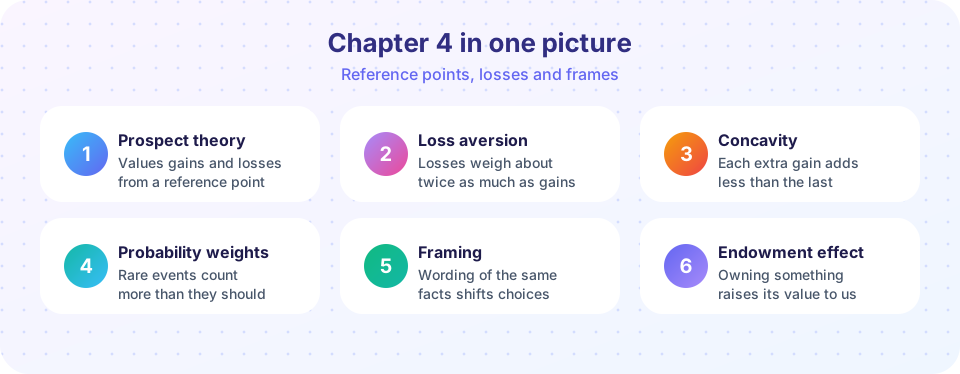
Chapter 4 is the heart of the course. In four lessons you built a descriptive theory of choice under risk and used it to explain framing, the endowment effect and mental accounting. This review ties the pieces together and checks that you can use them.
What you will learn
- A compact recap of prospect theory's ingredients.
- How each ingredient explains a different puzzle.
- Practice with mixed questions across the chapter.
Recap table
| Lesson | Ingredient | What it explains | Key number or example |
|---|---|---|---|
| The value function and loss aversion | Reference point, diminishing sensitivity, loss aversion | Rejecting a +$110/-$100 coin flip; the disposition effect | Exponent 0.88; lambda 2.25 (average near 2 across studies) |
| Probability weighting | Inverse-S decision weights | Allais, lottery tickets and insurance, the fourfold pattern | w(5%) about 13%; w(95%) about 79% |
| Framing effects | Frame sets the reference point | Asian disease reversal; 75% lean versus 25% fat | About 72% sure option in gains; about 78% gamble in losses |
| Endowment effect and mental accounting | Loss aversion for goods; separate accounts | Mug experiment; lost ticket; calculator and jacket | Asking price about twice offering price |
Key terms
Reference point: the benchmark that defines gains and losses.
Loss aversion: losses weigh more than equal gains.
Decision weight: transformed probability used in choice.
Framing: description-dependent choice.
Mental accounting: sorting money into categories with separate rules.
Putting it together
One way to see the chapter: prospect theory is expected utility with three edits. Replace final wealth with changes from a reference point. Replace a smooth utility curve with an S-shaped value function that is steeper for losses. Replace probabilities with decision weights. With these edits, behavior that looked like a pile of unrelated anomalies (Allais, the coin flip, framing, mugs) follows from a small set of principles. That is the mark of a good scientific theory: parsimony plus fit.
Prospect theory also has real limits, and a mature understanding includes them. Parameters differ by person, domain and stakes. Some effects (endowment, loss aversion) shrink with experience or under certain procedures. And descriptive success does not settle whether people should choose this way. Those limits invite better models, a theme that continues in Chapters 5 to 8.
Common misconceptions
- Loss aversion does not mean people never take risks; it means losses need larger gains to compensate.
- The weighting function does not say people misunderstand probabilities; it describes how probabilities enter decisions.
- Framing does not mean people are easily fooled by any wording; effects vary and often shrink when wording is explicit.
- The endowment effect is not the same as ordinary liking; it can appear for mugs assigned at random seconds earlier.
Try it
Press Run (or Ctrl + Enter) to see the console output here.
No output.
Check your understanding
Quick check · 10 questions
of 10 answered You scored / 10 · perfect!
-
1. Prospect theory replaces final wealth with
Outcomes are coded as gains and losses from a reference point. -
2. A value function that is steeper for losses than gains shows
The steeper loss side means a loss counts for more than an equal gain. -
3. Which pattern is part of the fourfold pattern?
Overweighting small probabilities of big losses explains insurance purchases. -
4. In the Asian disease problem, the gain frame produced a preference for
About 72% chose the sure program when outcomes were framed as lives saved. -
5. Which finding supports the endowment effect?
Random assignment rules out differences in taste, so the gap points to ownership. -
6. What does the lost-ticket versus lost-cash example illustrate?
The same $10 loss is treated differently depending on the mental account it is charged to. -
7. Which is a limit of the evidence for the endowment effect?
List (2003) and Plott and Zeiler (2005) found weaker effects with experience or better procedures. -
8. The weighting function with gamma 0.61 gives a 1% chance a decision weight of about
Small probabilities are overweighted: w(0.01) is about 0.055. -
9. Sunk-cost thinking is best corrected by
Sunk costs cannot be recovered, so they should not drive the decision. -
10. Which statement about loss aversion is most accurate?
Studies find averages near 2 with wide variation, and some researchers dispute how general it is.
Summary
- Prospect theory = reference points + an S-shaped value function steeper for losses + decision weights.
- It explains risk attitudes (the fourfold pattern), the Allais certainty effect, framing, the endowment effect and mental accounting.
- Evidence is strong but parameters vary and some effects weaken with experience or procedure.
- Chapter 5 turns to time: why present rewards loom large and why plans fail.
Track your progress
Create a free account to tick off lessons and pick up where you left off on any device.
of Behavioral Economics lessons completed