


















Lesson 3 of 47 · Getting Started
The history of behavioral economics
Trace behavioral economics from Bernoulli and Adam Smith to Simon, Kahneman and Tversky, Thaler and the nudge movement, with the key papers and prizes.
Behavioral economics looks new, but its questions are old. Economists in the eighteenth century already worried about how people value risky gambles and how emotions shape money decisions. What changed in the twentieth century was method: controlled experiments, careful statistics and, eventually, formal models that could compete with the standard theory.
This lesson tells the story in order. You do not need to memorize dates. The aim is to see how the main ideas fit together: each landmark answered a puzzle left by the one before it.
What you will learn
- How early economists treated psychology and risk.
- What Herbert Simon, Daniel Kahneman and Amos Tversky, and Richard Thaler each contributed.
- How the field moved from lab curiosities to government policy.
- How the replication debate reshaped the field.
Key terms
Bounded rationality: Simon's idea that decision makers have limited information, time and computing ability, so they seek "good enough" answers.
Anomaly: an observed behavior that the standard model cannot easily explain.
Prospect theory: Kahneman and Tversky's 1979 descriptive theory of choice under risk.
Choice architecture: the design of the environment in which choices are made.
Replication: repeating a study to see whether its result holds.
Before the twentieth century: psychology inside economics
In 1738 Daniel Bernoulli published a solution to a puzzle now called the St. Petersburg paradox: a coin game whose expected payout is infinite, yet nobody would pay much to play. His fix was that money has diminishing marginal value, which is the seed of the utility concept and of risk aversion. You will use it in Chapter 2.
Adam Smith, often thought of only as the author of The Wealth of Nations (1776), wrote an earlier book, The Theory of Moral Sentiments (1759), full of psychological observations: overconfidence, the pull of sympathy and how people dislike losses. John Maynard Keynes later wrote in 1936 about "animal spirits," moods that move investment. These authors treated psychology as part of the subject.
During the early and mid twentieth century, economics became more mathematical, and the simplified rational agent became standard. Psychology and economics drifted apart.
1950s and 1960s: the first cracks
- Maurice Allais (1953) posed a choice problem where many people violate expected utility, a result now called the Allais paradox. You meet it in Chapter 2.
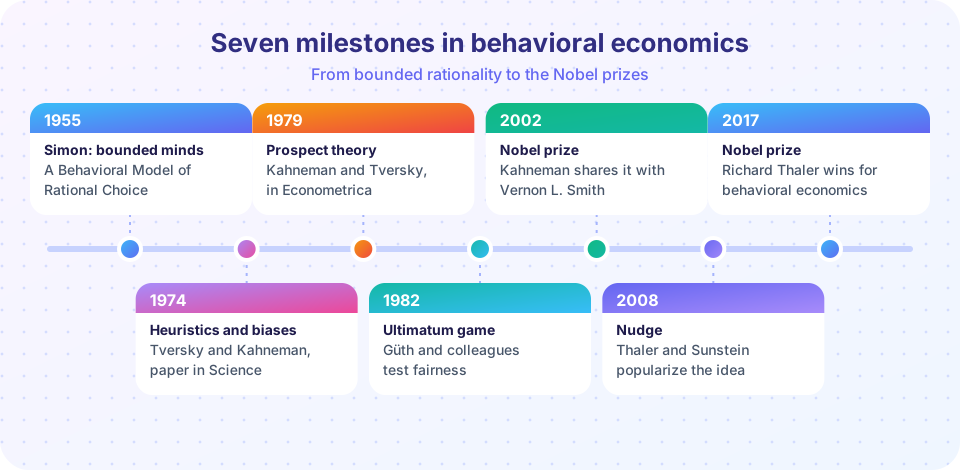
- Herbert Simon (1955) published A Behavioral Model of Rational Choice and argued that human decision makers are "boundedly rational." They satisfice (accept the first option that meets an aspiration) rather than optimize. Simon won the 1978 Nobel prize in economics for his work on decision making in organizations.
- Daniel Ellsberg (1961) showed that people dislike ambiguous bets (unknown odds) beyond what expected utility allows.
These were mostly seen as puzzles at the edge of the theory.
1970s: heuristics and prospect theory
Psychologists Daniel Kahneman and Amos Tversky began a long collaboration in the late 1960s. Their 1974 Science paper, Judgment under Uncertainty: Heuristics and Biases, described how people use shortcuts such as representativeness, availability and anchoring (Chapter 3). In 1979 they published prospect theory in Econometrica, a top economics journal. It offered a formal alternative to expected utility built on reference points, loss aversion and probability weighting (Chapter 4). Their 1981 paper on framing showed that logically equivalent descriptions can reverse choices.
1980s: an economist joins in
Richard Thaler began collecting anomalies and published Toward a Positive Theory of Consumer Choice in 1980. Among his ideas were mental accounting and the endowment effect. From 1987 he wrote a regular "Anomalies" column in the Journal of Economic Perspectives, a kind of public ledger of puzzles. Meanwhile experiments on fairness, such as the ultimatum game of Güth and colleagues (1982), showed that social preferences matter. Experimental economics grew, and Vernon Smith helped establish laboratory methods in economics.
1990s and 2000s: from puzzles to models and policy
Researchers built formal models of present bias and time inconsistency, of fairness and reciprocity, and of investor psychology. Robert Shiller wrote about bubbles and irrational exuberance. In 2002 Daniel Kahneman shared the Nobel prize in economics (with Vernon L. Smith) "for having integrated insights from psychological research into economic science." Amos Tversky had died in 1996, and Nobel prizes are not given posthumously.
In 2008 Thaler and Cass Sunstein published Nudge. Governments began to take notice: the United Kingdom set up a Behavioural Insights Team in 2010, and many other governments followed with similar units. In 2017 Thaler received the Nobel prize "for his contributions to behavioural economics."
The 2010s: scrutiny and maturity
Around 2011 to 2015, large replication projects in psychology found that many published effects were weaker than reported or did not replicate. Behavioral economics was not exempt. Some well-known results held up well (loss aversion in many settings, the power of defaults), while others (for example some "priming" effects) have been seriously questioned. The field responded with larger samples, preregistered analyses and more field experiments. The picture today is a more careful one: robust core results, many small and context-dependent effects, and a healthy debate about how large nudges are in practice.
Common misconceptions
- "Kahneman and Tversky were economists." Both were psychologists. Their influence on economics is why Kahneman received an economics prize.
- "Behavioral economics began with Nudge." It began decades earlier. Nudge popularized policy applications.
- "All the early findings are confirmed." Some are solid, some are fragile. Always check the evidence for a specific effect.
Try it
The first demonstration is a timeline explorer. Drag the slider to a year and see which milestones have happened.
The second demonstration simulates Bernoulli's St. Petersburg game. A fair coin is tossed until it lands heads. If the first head comes on toss k, you win 2^k dollars. The expected payoff is infinite, yet typical average winnings grow only very slowly with the number of plays.
Press Run (or Ctrl + Enter) to see the result here.
Program input · what you'd type while the program runs
Type the answers before you press Run, one per line. Each time the program reads a line (with input()), it gets the next line from this box.
Check your understanding
Quick check · 5 questions
of 5 answered You scored / 5 · perfect!
-
1. What did Bernoulli's 1738 solution to the St. Petersburg paradox introduce?
Bernoulli proposed that each extra dollar adds less value, so a game with infinite expected money has a modest expected utility. -
2. Herbert Simon's 1955 paper argued that decision makers
Simon stressed limits on information, time and computation, so people seek options that are good enough. -
3. Where was prospect theory published in 1979?
Kahneman and Tversky published 'Prospect Theory: An Analysis of Decision under Risk' in the economics journal Econometrica. -
4. Why did Kahneman, but not Tversky, receive the 2002 Nobel prize?
Amos Tversky died in 1996. Kahneman shared the 2002 prize with Vernon L. Smith. -
5. What best describes the effect of the replication debate on behavioral economics?
The field kept its robust core results while tightening its methods and being more cautious about small effects.
Summary
- Early thinkers (Bernoulli, Smith, Keynes) mixed psychology into economics; mid-century mathematics pushed it out.
- Simon (1955) introduced bounded rationality; Allais and Ellsberg exposed paradoxes in expected utility.
- Kahneman and Tversky's heuristics-and-biases program and prospect theory (1974 to 1979) created the modern field; Thaler brought it into economics.
- Nudge (2008) and government behavioral units turned ideas into policy.
- A replication debate in the 2010s made the field more careful.
Next: Methods and evidence
Track your progress
Create a free account to tick off lessons and pick up where you left off on any device.
of Behavioral Economics lessons completed