


















Lesson 40 of 47 · Markets, Finance and Policy Applications
Behavioral Policy: Saving, Health, Taxes and Welfare
See how behavioral insights are used in pensions, health, taxes and consumer protection, what megastudies show, and the welfare questions and critiques that remain.
Governments, health systems and companies now routinely use behavioral ideas: default pension enrollment, reminder letters, redesigned forms and warning labels. This lesson surveys the main application areas, introduces the new generation of very large trials called megastudies, and ends with the hard questions: by what standard do we judge whether people are better off, and are nudges a distraction from bigger reforms?
What you will learn
- Applications in saving, health, tax compliance, energy and consumer finance.
- Why megastudies changed how researchers compare interventions.
- The winner's curse in picking the best-performing program.
- Welfare questions: whose preferences count, and what critics say about nudges.
Key terms
Auto-enrollment: a pension plan that enrolls employees unless they opt out.
Megastudy: a large trial that tests many interventions at once against a common control group and outcome.
Winner's curse: the best-performing option in a noisy comparison usually performs worse when retested.
Internality: a cost that people impose on their future selves by acting against their own long-term interest.
Shrouded attribute: a price component that is not salient when the person chooses (late fees, add-ons).
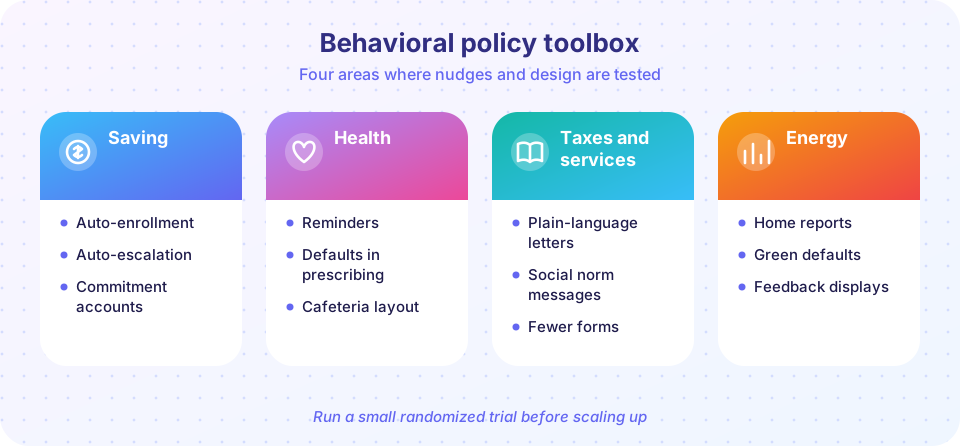
Saving
Pensions are the flagship application. The UK began phasing in automatic enrollment for workplace pensions in 2012, with a minimum contribution that rises over time, and participation among eligible employees rose sharply while only a small share opted out. Similar programs exist in New Zealand, Italy and the United States (many employers use automatic enrollment, and recent US legislation requires it for new plans). The size of the savings depends on the default rate, as the first TryIt shows. A worker with a salary of 30,000 (in today's money, growing 2 percent a year in real terms), a 4 percent real return and 40 years of contributions ends up with a pot of about 117,000 if she saves 3 percent, but about 311,000 if she saves 8 percent. A default that sticks at the wrong level costs a lot, which is why designers use auto-escalation (Save More Tomorrow) and consider active choice.
Health
Reminders and simple prompts help with appointments, vaccination and medication. Behavioral ideas also touch food labeling and the layout of canteens. Evidence is encouraging but varied: texts that remind or tell a patient that a vaccine is "reserved for you" can raise vaccination by a few percentage points, and effects differ across messages and settings. Health systems also use defaults in prescribing, such as generic drugs as the default option in electronic order forms, which has increased generic prescribing in trials.
Taxes and public services
Michael Hallsworth, John List, Robert Metcalfe and Ivo Vlaev (2017) ran large field experiments with the UK tax authority. Reminder letters that told taxpayers that most people in their area had already paid raised on-time payment by a few percentage points compared with the standard letter. Many agencies have also simplified forms, shortened letters and used plain language, which reduces errors and calls to help lines. These are examples of removing sludge (see the previous chapter) as much as nudging.
Energy and the environment
Home energy reports that compare households with their neighbors cut electricity use by about 2 percent on average (Allcott, 2011). Default green electricity tariffs in several European studies led a majority of customers to stay with the green default, though prices and trust matter. Feedback devices show real-time use. As with other interventions, effects tend to be modest and can decay if the reports stop.
Consumer protection and shrouded costs
Xavier Gabaix and David Laibson (2006) modeled markets where firms hide costs such as printer ink or hotel resort fees. If some consumers underestimate those costs, firms compete on the visible price and make money on the hidden extras; transparent firms may be undercut. Policy responses include requiring all-in price displays and clear comparison tools. Sumit Agarwal and coauthors (2015) studied the US CARD Act of 2009, which restricted certain credit-card fees and required clearer disclosure; they estimated savings to consumers of roughly 12 billion dollars a year, with little evidence that firms made up the loss elsewhere. This shows that behavioral ideas can support regulation, not just nudges.
Megastudies
Individual trials test one idea against a control group, and they are published when they work. Katherine Milkman and colleagues pioneered megastudies, which test dozens of interventions at once with a common outcome and population. In a gym-attendance megastudy with tens of thousands of members and about 50 programs, fewer than half of the programs beat the control for increasing gym visits, and experts' predictions about which ones would work were not very accurate. In vaccination megastudies with text messages, a few messages did much better than others, and many had little effect. Megastudies help because they put the programs on equal footing, so researchers see what typically works and how large effects are.
The winner's curse
Suppose you test 50 programs and pick the best performer. Because every estimate contains random noise, the best estimate is often the best true effect plus a lucky draw. Retesting it shows a smaller effect. The second TryIt simulates this. It is a reason to retest a winning program in a fresh sample before scaling it.
Welfare and critiques
If people choose inconsistently, whose preferences should a policy respect? Douglas Bernheim and Antonio Rangel (2009) propose a "choice-based" approach: when behavior is not affected by frames, take it as revealing welfare; when it depends on frames, look to choices made in unframed or well-informed conditions. Critics point out that this cannot resolve every conflict. Another approach measures internalities: Hunt Allcott, Benjamin Lockwood and Dmitry Taubinsky (2019) show that a tax on sugary drinks can be justified when it protects people from the costs they impose on their future selves, and they study how those taxes fall on different incomes.
Critics of the behavioral approach raise several concerns:
- Scarcity and context. Sendhil Mullainathan and Eldar Shafir argued that poverty itself taxes attention. Later replications of some scarcity experiments found mixed support, so the strength of the effect is debated.
- The "i-frame versus s-frame" critique. Nick Chater and George Loewenstein (2023) argue that policy focused on individual behavior (nudges) can crowd out systemic reforms (taxes, regulation, structural change) and so may do harm even if each nudge works.
- Scaling and external validity. As the last lesson showed, effects shrink at scale.
- Heterogeneity. The same design can help some people and hurt others.
A balanced view uses behavioral tools where they are cheap, tested and transparent, and recognizes that they are one instrument among many.
Common misconceptions
"Behavioral policy is just nudges." It also includes simplification, disclosure, regulation of shrouded costs and sometimes mandates informed by behavioral evidence.
"The best performer in a trial is the best program." Selection among noisy estimates exaggerates the winner's effect.
"If a nudge helps the average person, it helps everyone." Effects vary, and heterogeneity is a core welfare issue.
Try it
First, compute what the default contribution rate is worth. The model projects a pension pot from a starting salary of 30,000, real salary growth of 2 percent, a real return of 4 percent and 40 years of contributions. These are illustrative assumptions, not a forecast for any person.
Press Run (or Ctrl + Enter) to see the result here.
Program input · what you'd type while the program runs
Type the answers before you press Run, one per line. Each time the program reads a line (with input()), it gets the next line from this box.
Second, the winner's curse. Fifty programs have true effects drawn from a distribution with mean 0.4 and standard deviation 0.4 percentage points; each is measured with a standard error of 0.6. The code picks the program with the best estimate, many times over, and compares the estimated and true effects of the winner. It is a simulation with assumed numbers.
Press Run (or Ctrl + Enter) to see the result here.
Program input · what you'd type while the program runs
Type the answers before you press Run, one per line. Each time the program reads a line (with input()), it gets the next line from this box.
Check your understanding
Quick check · 5 questions
of 5 answered You scored / 5 · perfect!
-
1. Why does a default savings rate matter for the final pension pot?
In the model, 8 percent saved gives about 2.7 times the pot of 3 percent over 40 years. -
2. What is a megastudy?
Megastudies put many programs on equal footing. -
3. What is the winner's curse?
Selection on noisy estimates picks lucky draws, so the winner's effect shrinks on retest. -
4. What does the i-frame versus s-frame critique say?
Chater and Loewenstein argue that individual-level framing can distract from structural change. -
5. What is a shrouded attribute?
Hidden fees let firms compete on visible prices and profit from the extras.
Summary
- Behavioral designs are used in pensions, health, taxes, energy and consumer finance, with modest but sometimes cost-effective effects.
- The default rate shapes outcomes for decades, so design it carefully.
- Megastudies compare many interventions fairly; retest winners because of the winner's curse.
- Welfare analysis is hard, and critics caution that nudges can distract from structural reform.
Next: Chapter 8 review
Track your progress
Create a free account to tick off lessons and pick up where you left off on any device.
of Behavioral Economics lessons completed