


















Lesson 1 of 47 · Getting Started
Course map
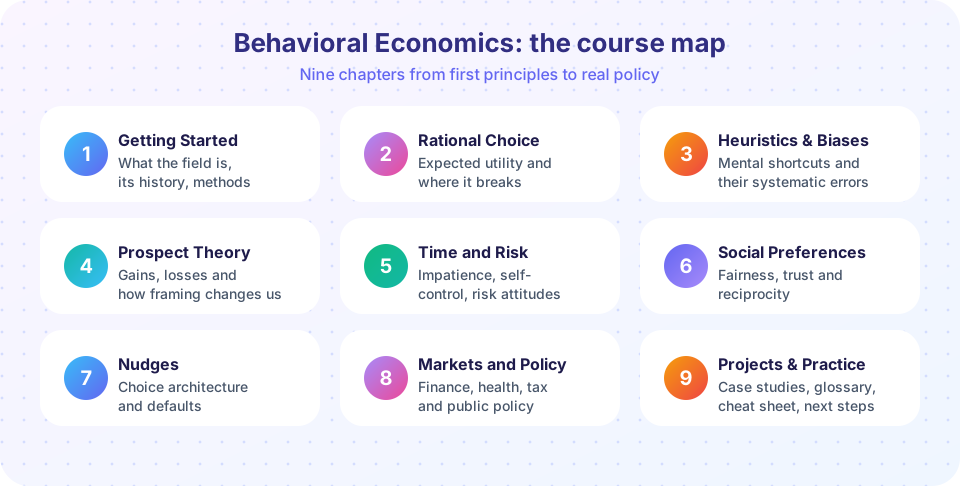
A guided map of this behavioral economics course: who it is for, what you need, how to study it, and a preview of all nine chapters.
Why do people buy gym memberships they never use, hold on to losing stocks, accept a default option without reading it, or turn down a fair offer out of spite? Classical economics has an elegant theory of how a perfectly rational person would choose. Behavioral economics asks what people actually do, measures the gap, and builds better models on top of the evidence.
This course takes you from the first ideas to real policy. It assumes no economics and no advanced mathematics. If you can read a simple graph and compute a percentage, you are ready. Everything is explained from scratch, and the live examples run right in your browser.
Educational information only. This course teaches how people make decisions. It does not give personal financial, investment, legal or medical advice. The demonstrations are teaching toys, not tests or recommendations.
What you will learn
- What behavioral economics is, where it came from and how it differs from the standard model.
- How to describe the standard model of rational choice precisely, so you can see where real behavior departs from it.
- The main heuristics and biases, and the evidence (and the replication problems) behind them.
- Prospect theory, loss aversion and framing, the most influential descriptive theory of risky choice.
- How to read, run and criticize a behavioral experiment.
Key terms
Behavioral economics: the study of how psychology, social context and limited cognition shape economic decisions.
Standard model: the textbook assumption that people have stable preferences and choose the option with the highest utility.
Heuristic: a mental shortcut that gives a fast, usually good, sometimes wrong answer.
Bias: a systematic, predictable departure from a normative benchmark.
Nudge: a change in how choices are presented that steers behavior without banning options or changing prices much.
Who this course is for
The course suits three kinds of learner. School and university students meet the ideas that now appear in introductory economics, psychology, business and public policy courses. Professionals in product design, marketing, finance, health and government use the ideas to design better choices. Curious adults simply want to understand their own decisions. The writing is plain, terms are defined when they first appear, and every idea is tied to a concrete case.
You do not need a calculator, but you will meet some arithmetic: expected values, percentages and a few simple functions. Where a formula appears it is written in plain text and then used in a worked example.
How the course is organized
The course has nine chapters, and each follows the same rhythm: an overview, a few content lessons, and a review.
- Getting Started introduces the field, its history and its methods.
- Rational Choice and Its Limits states the standard model and the first evidence against it.
- Heuristics and Biases covers mental shortcuts and systematic errors.
- Prospect Theory and Framing covers gains, losses and how wording changes choices.
- Time and Risk Preferences covers impatience, self-control and attitudes to risk.
- Social Preferences and Fairness covers fairness, trust, reciprocity and cooperation.
- Nudges and Choice Architecture covers defaults, the design of choices and the debate about paternalism.
- Markets, Finance and Policy Applications applies the ideas to investing, saving, health and tax.
- Projects and Practice brings everything together in case studies and practice sets.
Foundations
How we judge and value
Time and other people
Using the ideas
How to study this course
- Predict before you read the result. Many lessons describe a classic experiment. Decide what you would choose first, and notice your own pull toward the famous answer.
- Run the demonstrations. Change the numbers and watch what moves. These are small models, not real measurements, but they make the ideas concrete.
- Keep a scorecard of evidence. For each effect note what was found, in whom, and how well it has replicated. Behavioral economics has taught itself to be skeptical, and so should you.
- Connect to your own life, carefully. Noticing a bias in yourself is useful, but one story is not evidence. The aim is understanding, not self-diagnosis.
A note on evidence
Behavioral economics and psychology went through a "replication crisis" in the 2010s, when several well-known effects turned out smaller or less reliable than first reported. This course names the landmark studies, says what they actually found, and flags where later work has weakened or sharpened the picture. Learning which results are solid and which are fragile is part of the skill.
Try it
Check your understanding
Quick check · 4 questions
of 4 answered You scored / 4 · perfect!
-
1. What is the main goal of behavioral economics?
The field keeps economics' tools but tests its behavioral assumptions against evidence, then revises the models where they fail. -
2. Which description best fits a heuristic?
Heuristics trade accuracy for speed. Their errors lean in known directions, which is why they can be studied. -
3. Why does this course flag replication problems?
Some famous effects shrank or failed in later studies. Good practice is to weigh the strength of the evidence, not to accept or reject a field wholesale. -
4. What does this course say about personal advice?
The demonstrations are teaching toys. They are not tests, diagnoses or recommendations.
Summary
- Behavioral economics measures how people really choose and improves models of choice.
- The course has nine chapters, each with an overview, content lessons and a review.
- You do not need advanced mathematics; terms are defined as they appear.
- Predict first, run the demonstrations, and weigh the strength of evidence.
- Nothing here is personal financial, legal or medical advice.
Track your progress
Create a free account to tick off lessons and pick up where you left off on any device.
of Behavioral Economics lessons completed