


















Lesson 8 of 47 · Rational Choice and Its Limits
Bounded rationality and satisficing
Understand bounded rationality, satisficing, aspiration levels, search costs, optimal stopping and choice overload, with simulations you can run yourself.
The standard model hands the decision maker a complete list of options and unlimited ability to compare them. Real life does not. When you choose an apartment, a phone plan or a job, you do not know all the options, you cannot evaluate every detail and your time is limited. Herbert Simon, a political scientist, economist and computer scientist, built a theory of choice around this fact.
His central claim was that human rationality is bounded. The right question is not "what is the best option?" but "what can a mind with limited time and information do well?" The answer is often to search sensibly and stop when something is good enough.
What you will learn
- What bounded rationality means and why Simon proposed it.
- How satisficing works and when it beats maximizing.
- How search costs and optimal stopping rules shape good decisions.
- What the research on choice overload shows, and its limits.
Key terms
Bounded rationality: reasoning that is limited by information, time and cognitive capacity.
Satisficing: searching until an option meets an aspiration level, then choosing it.
Aspiration level: the threshold of "good enough", which can adjust with experience.
Search cost: the time, money or effort spent looking at another option.
Optimal stopping: deciding when to stop searching to get the best expected result.
Simon's scissors
Simon described human decision making with the image of a pair of scissors: one blade is the structure of the environment (what information and options are available), the other is the limits of the mind (what can be remembered and computed). To understand behavior you must look at both blades. A decision rule that looks silly when judged against a perfect computer can be sensible for a mind with limits in a particular environment.
This changes what counts as a "mistake." The standard model asks whether you picked the best option. Bounded rationality asks whether your procedure was reasonable given what you knew and what it cost to find out more.
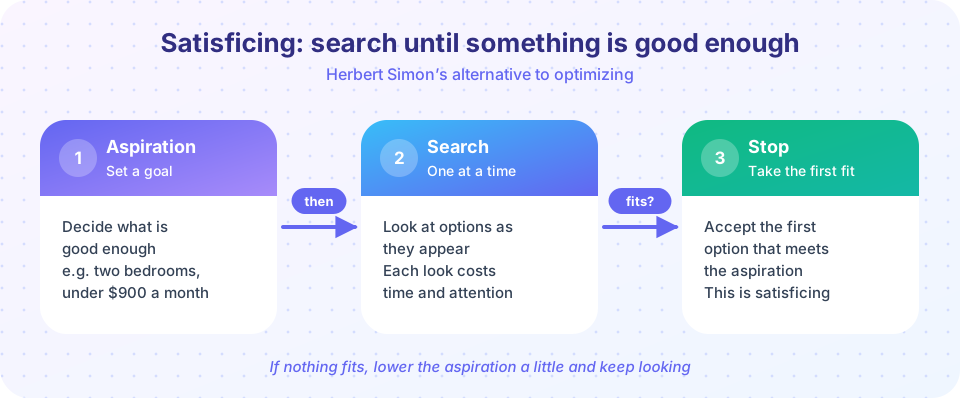
Satisficing in three steps
- Set an aspiration level. Decide what is good enough: two bedrooms, under $900 a month, within walking distance of work.
- Search sequentially. Look at options as they appear, one by one.
- Stop at the first option that meets the aspiration. If none does after a while, lower the aspiration a little and continue.
Simon coined the word satisfice (a blend of satisfy and suffice) in 1956. The method does not guarantee the best option. It does guarantee a decent one with limited effort, and in many real situations it is close to optimal once search costs are counted.
An example with numbers
Suppose each apartment you view has a "quality score" between 0 and 1 (uniform at random), and each additional viewing costs you 0.01 in time and trouble. If you accept the first score of 0.8 or higher, then each viewing succeeds with probability 0.2, so you expect to view 5 apartments. Your expected quality is about 0.9 (the average of scores above 0.8) and your expected search cost is 5 x 0.01 = 0.05, giving net quality about 0.85. A maximizer who views 50 apartments pays 50 x 0.01 = 0.5 in search cost and finds a best score near 0.98, for a net of roughly 0.48. Counting the cost of looking, the satisficer wins easily.
The secretary problem: a rigorous stopping rule
Sometimes you cannot go back to an option you passed over: a candidate may take another job. Mathematicians studied this as the secretary problem. If options arrive in random order and you want to maximize the chance of picking the single best, the optimal rule is to look at about the first 37% of options without choosing, then take the next one that beats everything seen so far. The fraction is 1/e, about 0.368, and the chance of success approaches the same number, about 37%. This is a clean example of "bounded" but optimal-in-context behavior: you do not examine everything, and you still do well.
Ecological rationality
Gerd Gigerenzer and colleagues developed the idea of fast and frugal heuristics: simple rules (such as "take the first cue that discriminates" or "recognize and choose the familiar") that can match or beat complex statistical models in environments where data are scarce and noisy. The claim is ecological rationality: a heuristic is good or bad relative to the environment. This is a counterweight to the view that heuristics are just sources of error, and Chapter 3 returns to the debate.
Choice overload and its limits
More options can sometimes make choosing harder. In a famous 2000 field study, Sheena Iyengar and Mark Lepper set up tasting tables with 24 jams or 6 jams. More shoppers stopped at the large display, but far fewer bought from it. Later reviews found that the effect is not universal: a 2010 meta-analysis by Benjamin Scheibehenne and colleagues found an overall average near zero with large differences across studies, so choice overload seems to appear under certain conditions (for example, when options are hard to compare and the person lacks a clear goal). Barry Schwartz and colleagues distinguished maximizers, who aim for the best, from satisficers; in their studies maximizers often reported less satisfaction. As with other findings in this course, treat these as patterns that depend on context, not as laws.
Common misconceptions
- "Satisficing is laziness." It is a rational response to costly search. Often it beats maximizing once the cost of looking is counted.
- "Bounded rationality means people are irrational." It means people reason well within limits; the question is whether the procedure suits the environment.
- "More choice is always better (or always worse)." The evidence shows that it depends on the setting, the person's goals and how easy options are to compare.
Try it
The first demonstration simulates the apartment search. Each option has a quality in [0, 1], each look costs 0.01, and the satisficer accepts the first option at or above a threshold. The maximizer examines all 50 options and picks the best.
Press Run (or Ctrl + Enter) to see the result here.
Program input · what you'd type while the program runs
Type the answers before you press Run, one per line. Each time the program reads a line (with input()), it gets the next line from this box.
The second demonstration tests the "look first, then leap" rule from the secretary problem with 100 candidates. It varies how many you let pass.
Press Run (or Ctrl + Enter) to see the console output here.
No output.
Check your understanding
Quick check · 5 questions
of 5 answered You scored / 5 · perfect!
-
1. Satisficing means
Satisficing (satisfy plus suffice) stops at the first good-enough option. -
2. In Simon's scissors metaphor, the two blades are
Behavior depends on both what the environment offers and what the mind can process. -
3. In the secretary problem, the best rule is to skip about what fraction of candidates before choosing?
The optimal skip fraction is 1/e, about 37%, after which you take the first candidate better than all those skipped. -
4. What does recent research say about choice overload?
Iyengar and Lepper found it in a famous study, but a 2010 meta-analysis found large variation and a small average effect. -
5. Why can satisficing beat maximizing?
When looking is costly, the net payoff from extra search can be negative.
Summary
- Bounded rationality (Simon) studies sensible reasoning given limited information, time and cognition.
- Satisficing sets an aspiration, searches sequentially and stops at the first fit; with search costs it can beat maximizing.
- The secretary problem gives a precise stopping rule: skip about 37%, then leap.
- Ecological rationality says a heuristic is good or bad relative to its environment.
- Choice overload depends on the context; averages across studies are small.
Next: Preference anomalies
Track your progress
Create a free account to tick off lessons and pick up where you left off on any device.
of Behavioral Economics lessons completed