


















Lesson 10 of 47 · Rational Choice and Its Limits
Chapter 2 review: Rational choice and its limits
Review chapter 2: expected utility, risk aversion, bounded rationality, satisficing and the Allais and Ellsberg paradoxes, with a recap table and a ten-question quiz.
Chapter 2 gave you the standard model in precise form, then showed three kinds of pressure on it: limits on the decision maker (Simon), paradoxes in the axioms (Allais, Ellsberg) and instability in what people prefer (reversals). This review pulls the threads together.
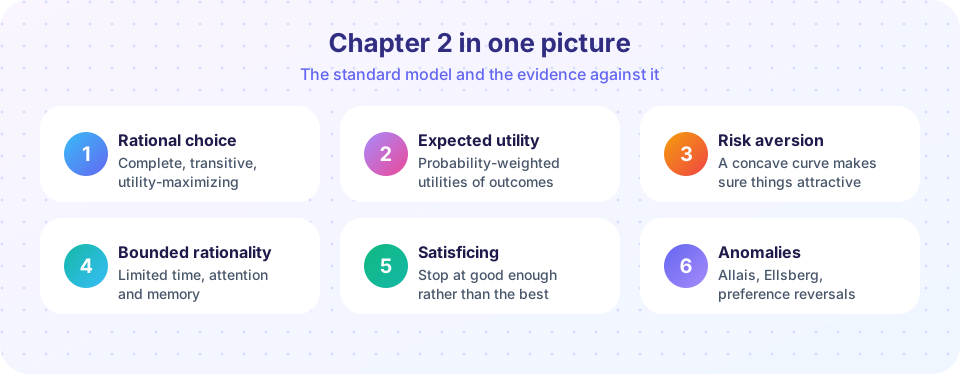
What you will learn
- A compact recap of expected utility, risk aversion and the anomalies.
- How to tell a failure of the axioms from a failure of the assumption of unlimited cognition.
- Practice with mixed questions across the chapter.
Recap table
| Lesson | Key idea | Worked example |
|---|---|---|
| Expected utility and Homo economicus | Utility from consistent preferences; EU maximization; concave utility is risk aversion | u(x) = sqrt(x): CE of a 50/50 $0/$100 gamble is $25 |
| Bounded rationality and satisficing | Limited minds search sequentially and stop at "good enough" | Apartment search with a 0.01 cost per look; the 37% rule |
| Preference anomalies | Allais, Ellsberg, intransitivity and reversals contradict the axioms | Choosing A and D is impossible under EU |
Key terms
Expected utility: sum over outcomes of probability times utility.
Certainty equivalent: the sure amount worth the same as a gamble.
Satisficing: stop at the first option that meets an aspiration level.
Independence axiom: a common component should not change a ranking.
Ambiguity aversion: dislike of unknown odds beyond known risk.
Two kinds of challenge
It helps to sort the evidence into two groups.
- Limits on the decision maker. Even if the axioms were reasonable, no one has unlimited time and computing ability. Simon's bounded rationality and satisficing explain real search behavior and also give prescriptive guidance (the 37% rule).
- Failures of the axioms themselves. Allais violates independence, Ellsberg violates the idea that beliefs are probabilities, and reversals violate procedure invariance (the same preference should appear in choosing and in pricing).
Both challenges matter for different reasons. The first suggests how to model processes; the second suggests how to change the functional form of the utility theory.
Common misconceptions
- Expected utility is not "maximize expected money." The utility curve bends, which is how risk aversion arises.
- A paradox does not mean the participants are foolish. It means the theory's prediction fails descriptively.
- Satisficing is not a flaw. It can be the best strategy once the cost of looking is counted.
Try it
A last quick check of your intuition: a self-scoring game that applies the chapter's formulas.
Press Run (or Ctrl + Enter) to see the console output here.
No output.
Check your understanding
Quick check · 10 questions
of 10 answered You scored / 10 · perfect!
-
1. With u(x) = sqrt(x), what is the certainty equivalent of a 50% chance of $64 and a 50% chance of $0?
EU = 0.5 x 8 = 4, so sqrt(CE) = 4 and CE = 16. -
2. Which of these is a failure of the independence axiom?
Allais shows that a common component changes preferences, which independence forbids. -
3. Satisficing is best described as
A satisficer sets an aspiration and stops when it is met. -
4. The optimal skip fraction in the secretary problem is about
The 1/e rule gives about 37%. -
5. Which is an example of ambiguity?
Ambiguity means the probabilities themselves are unknown. -
6. A preference reversal occurs when
The P-bet is chosen but the $-bet is priced higher, so the elicitation method changes the ranking. -
7. Rabin's calibration argument suggests that small-stakes risk aversion is better explained by
Concave utility of total wealth implies absurd large-stakes risk aversion, so a reference-dependent explanation fits better. -
8. In Simon's scissors, which two blades must be considered?
Behavior reflects both what the environment offers and what minds can process. -
9. The risk premium for a gamble equals
It is the amount of expected value a risk-averse person will give up to avoid the risk. -
10. Which statement about choice overload is best supported?
Meta-analysis found large variation and an average near zero.
Summary
- The standard model: consistent preferences, utility, expected utility, risk aversion via concavity.
- Pressure on the model comes from limits on minds (Simon) and from failures of the axioms (Allais, Ellsberg, reversals).
- Rabin's critique shows concave utility of wealth cannot explain small-stakes risk aversion; Chapter 4 offers prospect theory.
- Next we study the shortcuts people actually use.
Track your progress
Create a free account to tick off lessons and pick up where you left off on any device.
of Behavioral Economics lessons completed