


















Lesson 12 of 47 · Heuristics and Biases
System 1 and System 2
Learn the dual-process view of fast intuitive and slow deliberate thinking, the Cognitive Reflection Test, the Stroop effect, and the criticisms of the two-systems idea.
Read the word below and say its ink color aloud: RED printed in blue ink. You probably felt a tug toward saying "red" before you corrected yourself. A part of your mind read the word automatically. Another part, with effort, overrode it. This tug-of-war is a vivid example of a distinction psychologists draw between fast, automatic thinking and slow, deliberate thinking.
In this lesson you will learn the two-systems framework that organizes much of the heuristics-and-biases literature, test it with a quick demonstration, and weigh the criticisms, because it is a useful metaphor and an imperfect theory.
What you will learn
- The traits that distinguish System 1 and System 2.
- How the Cognitive Reflection Test and the Stroop effect illustrate them.
- Why System 2 often accepts what System 1 suggests.
- The limits of the two-systems idea.
Key terms
Dual-process theory: the family of theories that distinguish fast, automatic processes from slow, controlled ones.
System 1 and System 2: labels introduced by Keith Stanovich and Richard West (2000) and popularized by Daniel Kahneman's Thinking, Fast and Slow (2011).
Cognitive Reflection Test (CRT): three short problems by Shane Frederick (2005) with a tempting wrong answer.
Stroop effect: slower responses when a word's meaning conflicts with its ink color.
Cognitive load: the demand placed on limited working memory.
Two modes of thinking
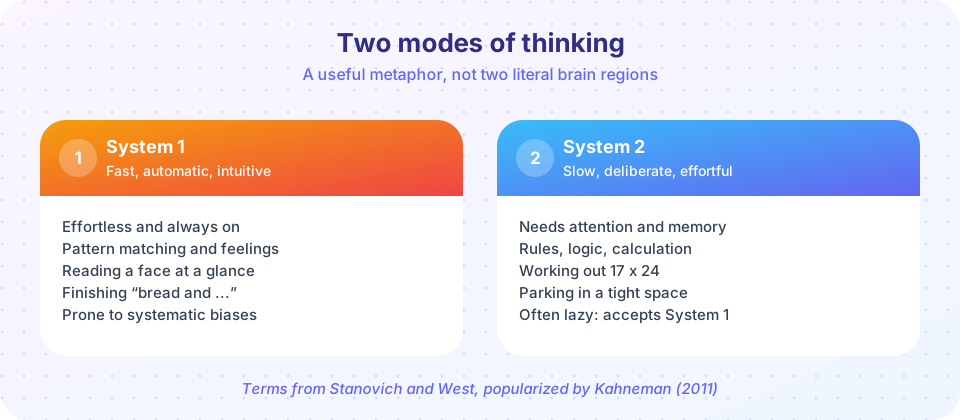
System 1 operates automatically and quickly, with little or no sense of voluntary control. It reads faces, finishes the phrase "bread and ...", detects hostility in a tone of voice and drives a car on an empty road. It works by association and pattern matching, and it generates impressions, feelings and intuitions.
System 2 allocates attention to effortful mental activities: computing 17 x 24, comparing two phones on several features, checking an argument, keeping to a diet. It is slow, serial and limited by working memory. It is also associated with the experience of agency and choice.
In Kahneman's story, System 1 constantly proposes answers and System 2, which is lazy, usually endorses them with only a quick check. Biases appear when System 1's answer is wrong and System 2 fails to intervene. A heuristic is a System 1 shortcut; a correction is System 2 doing its job.
The Cognitive Reflection Test
Shane Frederick's three-item test (2005) measures whether you stop to check an intuitive answer:
- A bat and a ball cost $1.10 together. The bat costs $1.00 more than the ball. How much does the ball cost? (Intuitive: 10 cents. Correct: 5 cents.)
- If it takes 5 machines 5 minutes to make 5 widgets, how long would it take 100 machines to make 100 widgets? (Intuitive: 100 minutes. Correct: 5 minutes, since each machine makes one widget in 5 minutes.)
- A patch of lily pads doubles in size every day. If it takes 48 days to cover the whole lake, how long to cover half? (Intuitive: 24 days. Correct: 47 days.)
Many people, including students at selective universities, give at least one intuitive answer. Scores correlate with patience and with some measures of judgment, but the test measures a mix of numerical skill and the disposition to reflect, and its correlations with real-world behavior are modest. Note also that the CRT items are now widely known, so many test-takers have seen them.
The Stroop effect
John Ridley Stroop reported in 1935 that naming the ink color of a color word is slower and error-prone when the word names a different color (incongruent) than when it matches (congruent). Reading is so automatic that it interferes with the controlled task of naming ink. The effect is among the most replicable in psychology and a clean demonstration of automatic processing colliding with intention.
What strains System 2?
System 2 has limited capacity. When people are tired, rushed or loaded with a secondary task, they are more likely to accept intuitive answers. A related popular idea, ego depletion (that willpower is a resource that runs down), appeared in experiments by Roy Baumeister and colleagues, but a large multi-lab replication (Hagger and colleagues, 2016) found an effect close to zero. Treat dramatic claims about "mental fuel" with skepticism, even though the plain facts that attention is limited and that multitasking hurts performance are well supported.
Criticisms of the two-systems idea
The two-systems picture is a useful organizing metaphor. As a literal theory it has critics.
- The features do not neatly cluster. Fast, unconscious, automatic and associative do not always go together, and some deliberate processes are quick while some intuitions are slow.
- A continuum, not two boxes. Many mental processes lie between the extremes, and expert intuition is built from practice.
- Not two brain regions. The "systems" are descriptions of types of processing, not two specific places in the brain. Kahneman himself calls them fictional characters.
Researchers such as Gigerenzer, Keren and Schul, and Melnikoff and Bargh have pressed these points. The practical lesson survives: some judgments are automatic and some are controlled, and errors often come from accepting the first without checking.
Common misconceptions
- "System 1 is bad, System 2 is good." System 1 is often accurate, especially in familiar domains where you have had feedback (a chess master's intuition); System 2 can also err or rationalize.
- "People with high intelligence do not show biases." Cognitive ability helps on some tasks but does not remove biases such as myside bias.
- "There are two parts of the brain." The systems are conceptual labels.
Try it
First, a Stroop demonstration. For each word, click the button that names its ink color, not the word. The page times your responses for congruent and incongruent trials. This is a classroom-style demonstration, not a test, and your times depend on your device.
Second, the three CRT problems with their answers worked out in code, so you can see where the intuitive answer breaks.
Press Run (or Ctrl + Enter) to see the console output here.
No output.
Check your understanding
Quick check · 5 questions
of 5 answered You scored / 5 · perfect!
-
1. Which task is most likely handled by System 2?
Effortful calculation needs attention and working memory, which is System 2 territory. -
2. In the CRT, what is the correct answer to the lily pad problem (48 days to cover the lake)?
The patch doubles daily, so it covers half the lake one day before it covers all of it. -
3. The Stroop effect shows that
Incongruent trials are slower because automatic reading competes with the controlled task. -
4. Which is a fair criticism of the two-systems idea?
Critics argue the dichotomy is a useful metaphor but not a precise theory. -
5. What did a large 2016 multi-lab replication find about ego depletion?
Hagger and colleagues found little evidence for the effect, a reminder to check replication.
Summary
- System 1 is fast, automatic and associative; System 2 is slow, effortful and limited.
- System 2 is often lazy and accepts System 1's suggestions, which is how biases slip through.
- The CRT and the Stroop effect illustrate intuition and its override.
- The two-systems picture is a helpful metaphor, not two brain regions; ego depletion has not replicated well.
Track your progress
Create a free account to tick off lessons and pick up where you left off on any device.
of Behavioral Economics lessons completed