


















Lesson 45 of 47 · Projects and Practice
Glossary: Behavioral Economics Terms (Chapters 5 to 8)
A searchable glossary of behavioral economics terms from time and risk preferences, social preferences, nudges and applications, with flashcards to test yourself.
Every field has its own vocabulary, and behavioral economics borrows words from economics, psychology and statistics. This glossary gathers the 47 terms you met in chapters 5 to 8. Use the table to look things up, the search box to find a term quickly and the flashcards to test whether you can recall a definition from memory. Recalling a definition without looking is one of the most effective ways to learn it, because it strengthens the memory more than rereading does.
What you will learn
- The precise meaning of the key terms in the second half of the course.
- Which terms belong together, and which pairs are easy to confuse.
- How to use retrieval practice (flashcards) to check yourself.
Key terms
Retrieval practice: testing yourself on what you have learned instead of rereading it.
Spaced repetition: reviewing material at increasing intervals.
Interleaving: mixing different kinds of problems while you practice.
Mnemonic: a memory aid; for example EAST for Easy, Attractive, Social, Timely.
The glossary
| Term | Definition |
|---|---|
| Active choice | A design that requires everyone to make an explicit choice, with no default option. |
| Agent-based model | A simulation in which many simple agents follow rules and group patterns emerge. |
| Auto-enrollment | A plan that enrolls people automatically unless they opt out. |
| Auto-escalation | A pre-agreed schedule that raises a savings rate over time, for example with each pay rise. |
| Beta-delta model | A model of present bias in which everything after now is discounted by an extra factor beta, then by delta per period. |
| Boost | An intervention that builds a person's skills or knowledge so she can decide better, instead of steering her. |
| Certainty equivalent | The sure amount that gives the same utility as a gamble. |
| Choice architecture | The way options are organized and presented to a decision maker. |
| Choice overload | The idea that too many options can reduce choosing or satisfaction; evidence is mixed and context dependent. |
| Commitment device | A choice made now that restricts your own future options. |
| Conditional cooperator | A person who contributes more to a public good when others contribute more. |
| CRRA utility | Utility of the form x^(1 - rho) / (1 - rho), with ln(x) when rho = 1; rho measures relative risk aversion. |
| Dark pattern | An interface design that tricks or pressures users into choices they would not otherwise make. |
| Default | The option that takes effect when the person does nothing. |
| Descriptive norm | Information about what most people do. |
| Dictator game | A game in which one player decides how to split a sum and the other has no say. |
| Discount factor | The weight given to a benefit that arrives after a delay; it equals 1 at delay zero. |
| Disposition effect | The tendency to sell assets that have gained value and hold those that have lost value. |
| Effect size | How large a difference an intervention makes, in percentage points or standard-deviation units. |
| Exponential discounting | Discounting by a constant percentage per period, D(t) = delta^t; it is time consistent. |
| Free rider | Someone who benefits from a group's contributions without contributing. |
| Gain-loss ratio | Expected gains divided by expected losses of a gamble; a loss-averse person accepts it if her loss aversion is below the ratio. |
| Hyperbolic discounting | Discounting of the form 1 / (1 + k t), with steep early drops and flatter later declines. |
| Inequity aversion | A dislike of unequal outcomes, usually stronger when behind than when ahead. |
| Limits to arbitrage | Reasons arbitrageurs cannot always correct mispricing, such as risk and funding constraints. |
| Marginal per capita return | The share of each contributed unit that returns to the contributor in a public goods game, m / n. |
| Megastudy | A large trial that tests many interventions against one control group with a common outcome. |
| Momentum | The tendency of recent winning stocks to keep outperforming for a few months. |
| Myopic loss aversion | Loss aversion combined with frequent evaluation, which makes risky assets look less attractive. |
| Naive (present biased) | A present-biased person who expects her future selves not to be present biased. |
| Nudge | A change in choice architecture that alters behavior predictably without forbidding options or changing incentives much. |
| Opt-in and opt-out | Opt-in requires action to join; opt-out enrolls automatically unless the person acts. |
| Overconfidence | Believing that your judgment or information is better than it is. |
| Power | The probability that a study detects an effect of a given size if it exists. |
| Preference reversal | A change in the ranking of two options as time passes, without any new information. |
| Present bias | Overweighting the immediate period relative to all later periods. |
| Public goods game | A game in which each member chooses how much to put in a common pot that is multiplied and shared equally. |
| Publication bias | The tendency for significant or exciting results to be published more often than null results. |
| Reciprocity | Responding kindly to kind actions and unkindly to unkind ones. |
| Risk premium | The expected value of a gamble minus its certainty equivalent. |
| Sludge | Excess friction that stops people doing things that would benefit them. |
| Sophisticated (present biased) | A present-biased person who correctly predicts that her future selves will also be present biased. |
| Status quo bias | A tendency to stick with the current arrangement even when better ones are available. |
| Trust game | A game in which a sender chooses an amount to send, it is multiplied, and the receiver chooses how much to return. |
| Ultimatum game | A game in which a proposer offers a split and the responder accepts or rejects; rejection gives both nothing. |
| Warm glow | Utility that comes from the act of giving, regardless of the effect on others. |
| Winner's curse | The best of many noisy estimates is usually overstated and shrinks when retested. |
Pairs that are easy to confuse
- Exponential versus hyperbolic discounting. Exponential loses a constant percentage per period and never reverses plans; hyperbolic loses more at short delays, so plans can reverse.
- Naive versus sophisticated. Both are present biased; they differ in whether they foresee their own future bias.
- Present bias versus impatience. Impatience is a high discount rate; present bias is a change of the rate with timing.
- Trust versus trustworthiness. Trust is the sender's choice; trustworthiness is the receiver's return.
- Nudge versus sludge versus dark pattern. A nudge helps the chooser; sludge makes beneficial actions hard; a dark pattern pushes the user against her interests.
- Opt-out versus active choice. Opt-out has a default; active choice makes everyone decide.
- Effect size versus significance. A result can be significant but tiny, or large but uncertain.
Common misconceptions
"Memorizing definitions is enough." Definitions are a start. You need to be able to use a term: compute with it, apply it to a case, and tell it apart from similar terms.
"A term means the same everywhere." Words such as "risk aversion" or "norm" have slightly different meanings in different fields; check the definition used in the source you are reading.
"Rereading is the best revision." Self-testing usually works better.
Try it
First, a searchable glossary. Type part of a term or of a definition to filter the list.
Second, flashcards. You see a definition and pick the matching term from four options. The deck is shuffled each time, and your score is shown at the end of ten cards.
Check your understanding
Quick check · 5 questions
of 5 answered You scored / 5 · perfect!
-
1. Which term describes the sure amount that gives the same utility as a gamble?
The certainty equivalent is the sure amount worth the same as the gamble; the risk premium is the expected value minus it. -
2. What distinguishes sludge from a nudge?
Sludge raises the cost of acting and is the opposite of helpful design. -
3. A present-biased person who correctly predicts her future lapses is called:
Sophisticated individuals foresee their own present bias and may buy commitment. -
4. Which game is one in which the second player cannot reject the split?
In the dictator game the recipient has no say. -
5. What is the winner's curse?
Selecting the top estimate selects lucky draws, so the effect shrinks when retested.
Summary
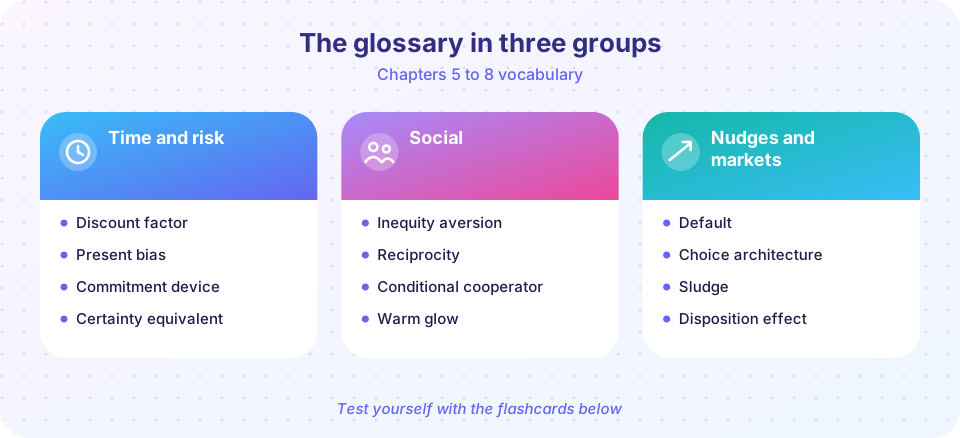
- The glossary lists 47 terms for chapters 5 to 8, grouped by time and risk, social preferences, and nudges and markets.
- Several pairs are easy to confuse; learn the contrast, not just the labels.
- Self-testing with flashcards strengthens recall more than rereading.
- Use the cheat sheet next to this glossary when you revise.
Next: Cheat sheet
Track your progress
Create a free account to tick off lessons and pick up where you left off on any device.
of Behavioral Economics lessons completed