


















Lesson 16 of 47 · Heuristics and Biases
Chapter 3 review: Heuristics and biases
Review chapter 3: System 1 and System 2, availability, representativeness, anchoring, overconfidence and confirmation bias, with a recap table and a ten-question quiz.
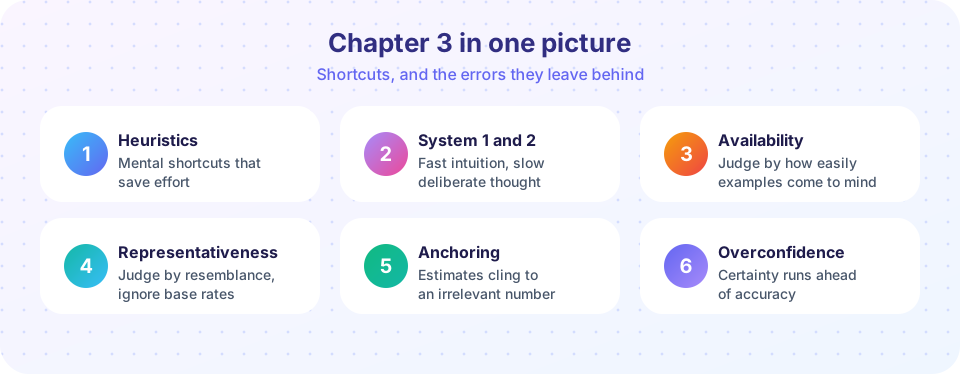
Chapter 3 introduced the heuristics-and-biases program: fast shortcuts that usually serve us well and that sometimes fail in predictable ways. This review gathers the key ideas, links them to the evidence (including its limits), and gives you a mixed quiz.
What you will learn
- A compact recap of the five main topics.
- A habit for diagnosing which heuristic a judgment might be using.
- Practice with mixed questions across the chapter.
Recap table
| Lesson | Shortcut or bias | Classic evidence | Antidote |
|---|---|---|---|
| System 1 and System 2 | Accepting the fast answer | CRT, Stroop effect | Pause and check |
| Availability and representativeness | Judging by ease of recall or by resemblance | Linda problem, taxi problem | Base rates, natural frequencies |
| Anchoring and adjustment | Starting numbers pull estimates | Wheel of fortune, sentencing dice | Consider the opposite |
| Overconfidence and confirmation bias | Sure more often than right; seeking confirming evidence | 2-4-6 task, calibration studies | Pre-mortem, outside view |
Key terms
Heuristic: a quick rule that substitutes an easier question for a harder one.
Base rate: how common an event is before you consider the case at hand.
Anchor: an initial number that pulls later estimates toward it.
Calibration: the match between confidence and accuracy.
Positive testing: testing only cases that fit your hypothesis.
A diagnostic habit
When you catch yourself making a quick judgment, ask three questions.
- What easier question might I have answered instead? (How easily do examples come to mind? How much does this resemble the type?)
- What number or story was I given first? (Is there an anchor?)
- What would convince me I am wrong? (Have I looked for disconfirming evidence?)
These questions will not remove biases, but they interrupt the automatic path and bring in System 2 at low cost.
Common misconceptions
- Heuristics are not always errors; they are efficient shortcuts that fail in specific situations.
- Knowing about a bias does not make you immune; structure (checklists, data, feedback) works better than willpower.
- Not every famous effect replicates equally well: anchoring and the conjunction fallacy are robust, ego depletion is not.
Try it
A quick diagnostic tool: pick a situation and see which heuristic is most likely involved.
Check your understanding
Quick check · 10 questions
of 10 answered You scored / 10 · perfect!
-
1. Which problem is the classic demonstration of the conjunction fallacy?
Rating 'bank teller and feminist' above 'bank teller' violates the conjunction rule. -
2. The probability that the cab was blue in the taxi problem (15% blue, witness 80% accurate) is about
12 of 29 'blue' reports are correct. -
3. System 2 is best described as
It is a label for effortful, controlled processing, not a brain region. -
4. Which finding is the weakest evidence for a claim about mental processes, based on large replications?
A large multi-lab replication found an effect near zero for ego depletion. -
5. A student predicts a thesis will take one month but it takes nearly two. This is an example of
People underestimate their own project durations by focusing on the best case. -
6. Which is the best remedy for the planning fallacy?
Reference class forecasting corrects the tendency to ignore delays. -
7. In the Wason 2-4-6 task, a good strategy is to
Tests that could fail are the ones that reveal when your hypothesis is too narrow. -
8. A negotiator opens with a high price to
A high opening offer tends to pull the final outcome upward. -
9. Overprecision means
It shows up as confidence intervals that are too narrow. -
10. Which is a reasonable view of heuristics?
Both Kahneman and Tversky's and Gigerenzer's traditions are partly right.
Summary
- Heuristics substitute easy questions for hard ones; biases are their predictable failures.
- Availability and representativeness distort probability; Bayes' rule and natural frequencies correct them.
- Anchors pull estimates; considering the opposite and outside data reduce the pull.
- Overconfidence and confirmation bias combine to harden beliefs; feedback and pre-mortems help.
- Next: Chapter 4 explains how people value gains, losses and risk, and how wording changes choices.
Track your progress
Create a free account to tick off lessons and pick up where you left off on any device.
of Behavioral Economics lessons completed