


















Lesson 34 of 45 · Past Tense and Sentences
Verbal Sentences and Connectors
Build Arabic sentences that start with the verb, make the verb agree, and link ideas with wa, thumma, lakin and li-anna to tell a short story.
You can now form past-tense verbs. The next step is putting them into sentences and joining sentences into a story. Arabic has a favorite order for telling what happened: the verb comes first. After that, you meet a handful of tiny connecting words that glue sentences together, so your Arabic stops sounding like a list of facts and starts sounding like a story.
What you will learn
- The verb-first (VSO) sentence pattern and how the verb agrees with the doer
- How to put the doer first when you want to stress who acted
- The key connectors: وَ, ثُمَّ, فَـ, لَكِنْ, أَوْ, لِأَنَّ, بَعْدَ أَنْ, قَبْلَ أَنْ
- Time words for the past, such as أَمْسِ, قَبْلَ يَوْمَيْنِ and الأُسْبُوع المَاضِي
Key terms
Verbal sentence: a sentence that begins with a verb (verb, doer, object).
Nominal sentence: a sentence that begins with a noun or pronoun.
Subject (فَاعِل, fāʿil): the doer of the action.
Conjunction (حَرْف عَطْف): a word that joins words or sentences, such as وَ (and).
Verb first
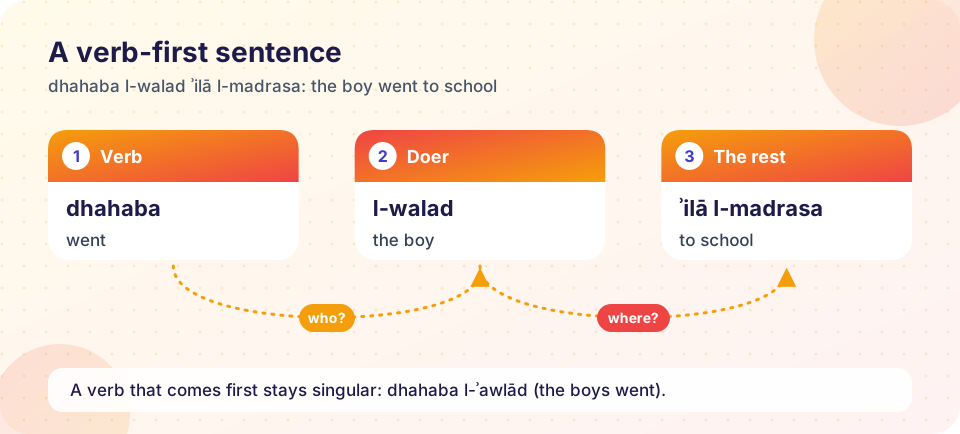
The standard past-tense sentence has three parts in this order: the verb, the doer, and everything else (the object and the place).
| Arabic | Transliteration | Meaning |
|---|---|---|
| كَتَبَ الوَلَد الرِّسَالَة. | kataba l-walad ar-risāla. | The boy wrote the letter. |
| ذَهَبَ الوَلَد إِلَى المَدْرَسَة. | dhahaba l-walad ʾilā l-madrasa. | The boy went to school. |
| شَرِبَتِ البِنْت الشَّاي. | sharibati l-bint ash-shāy. | The girl drank the tea. |
In Arabic you do not repeat the doer inside the verb when the doer is named: you simply say the verb with its gender, and then the noun. That leads to the one rule that surprises English speakers.
Agreement when the verb comes first
When the verb comes before the doer, it agrees with the doer in gender but stays singular, even if the doer is plural:
| Arabic | Meaning | What is happening |
|---|---|---|
| ذَهَبَ الوَلَد | The boy went. | masculine singular |
| ذَهَبَتِ البِنْت | The girl went. | feminine singular |
| ذَهَبَ الأَوْلَاد | The boys went. | masculine, singular verb |
| ذَهَبَتِ البَنَات | The girls went. | feminine, singular verb |
Think of it this way: the verb "does not yet know" how many doers there are, so it stays singular. A small spelling note: ذَهَبَتِ takes a kasra on the last ت because the next word starts with ال (the two sounds join). You will see this everywhere.
Putting the doer first
If you start with the doer, you are emphasizing who did it, like the boys, they went. Now the verb agrees completely in gender and number:
- الأَوْلَاد ذَهَبُوا. (al-ʾawlād dhahabū.) The boys went.
- البَنَات ذَهَبْنَ. (al-banāt dhahabna.) The girls went.
- الطُّلَّاب فَهِمُوا الدَّرْس. (aṭ-ṭullāb fahimū d-dars.) The students understood the lesson.
Both orders are correct. Use verb-first for narration and doer-first when you want contrast or emphasis.
Connectors: gluing sentences together
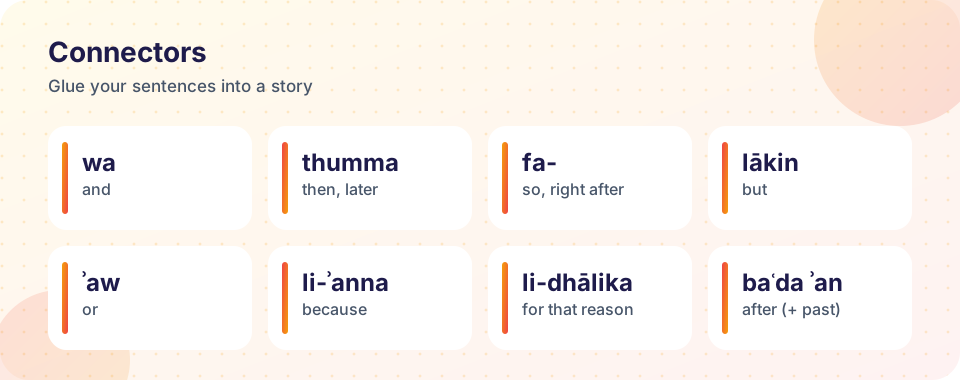
| Connector | Meaning | Example |
|---|---|---|
| وَ (wa) | and | ذَهَبْتُ وَاشْتَرَيْتُ خُبْزًا. (I went and bought bread.) |
| ثُمَّ (thumma) | then (after a pause) | أَكَلْتُ ثُمَّ ذَهَبْتُ. (I ate, then I went.) |
| فَـ (fa-) | so, then (immediately) | سَمِعْتُ البَاب فَفَتَحْتُ. (I heard the door, so I opened.) |
| لَكِنْ (lākin) | but | أَرَدْتُ أَنْ أَذْهَبَ لَكِنْ لَمْ أَسْتَطِعْ. |
| أَوْ (ʾaw) | or | الشَّاي أَوْ القَهْوَة؟ (Tea or coffee?) |
| لِأَنَّ (li-ʾanna) | because | لَمْ أَذْهَبْ لِأَنِّي كُنْتُ مَرِيضًا. |
| لِذَلِكَ (li-dhālika) | for that reason | كُنْتُ مَرِيضًا لِذَلِكَ بَقِيتُ فِي البَيْت. |
| بَعْدَ أَنْ (baʿda ʾan) | after (+ past) | بَعْدَ أَنْ أَكَلْتُ ذَهَبْتُ. (After I ate, I went.) |
| قَبْلَ أَنْ (qabla ʾan) | before (+ subjunctive) | قَبْلَ أَنْ أَذْهَبَ. (Before I go.) |
The little وَ and فَـ attach directly to the next word, with no space: وَاشْتَرَيْتُ, فَفَتَحْتُ. The other connectors stand alone.
Time words for the past
| Arabic | Transliteration | Meaning |
|---|---|---|
| أَمْسِ | ʾamsi | yesterday |
| قَبْلَ يَوْمَيْن | qabla yawmayn | two days ago |
| قَبْلَ أُسْبُوع | qabla ʾusbūʿ | a week ago |
| الأُسْبُوع المَاضِي | al-ʾusbūʿ al-māḍī | last week |
| السَّنَة المَاضِيَة | as-sana al-māḍiya | last year |
| أَوَّلًا / أَخِيرًا | ʾawwalan / ʾakhīran | first / finally |
| عِنْدَمَا | ʿindamā | when (+ past) |
Put the time word at the start or the end of the sentence: أَمْسِ ذَهَبْتُ إِلَى المَدْرَسَة or ذَهَبْتُ إِلَى المَدْرَسَة أَمْسِ.
A story from start to finish
Read this short story about yesterday, then cover the English.
- أَمْسِ اسْتَيْقَظْتُ فِي السَّاعَة السَّابِعَة. (ʾamsi istayqaẓtu fī s-sāʿa as-sābiʿa.) Yesterday I woke up at seven.
- شَرِبْتُ القَهْوَة وَأَكَلْتُ الخُبْز. (sharibtu l-qahwa wa-ʾakaltu l-khubz.) I drank coffee and ate bread.
- ثُمَّ ذَهَبْتُ إِلَى الجَامِعَة. (thumma dhahabtu ʾilā l-jāmiʿa.) Then I went to the university.
- دَرَسْتُ هُنَاكَ سَاعَتَيْن. (darastu hunāka sāʿatayn.) I studied there for two hours.
- رَجَعْتُ إِلَى البَيْت فِي المَسَاء. (rajaʿtu ʾilā l-bayt fī l-masāʾ.) I returned home in the evening.
- لَمْ أَطْبُخْ لِأَنِّي كُنْتُ مُتْعَبًا. (lam ʾaṭbukh li-ʾannī kuntu mutʿaban.) I did not cook because I was tired.
Notice how six short sentences, three connectors and a time word form a complete little story.
Building a sentence in layers
A good way to see how a verbal sentence works is to build one in layers, starting with only the verb and adding one piece at a time.
- ذَهَبَ (dhahaba): "he went". Already a complete sentence, because the verb contains its own doer.
- ذَهَبَ الوَلَد (dhahaba l-walad): "the boy went". We now name the doer.
- ذَهَبَ الوَلَد إِلَى المَدْرَسَة (dhahaba l-walad ʾilā l-madrasa): "the boy went to school". We add the destination.
- ذَهَبَ الوَلَد إِلَى المَدْرَسَة أَمْسِ (dhahaba l-walad ʾilā l-madrasa ʾamsi): "the boy went to school yesterday". We add the time.
- ذَهَبَ الوَلَد إِلَى المَدْرَسَة أَمْسِ ثُمَّ رَجَعَ إِلَى البَيْت (…thumma rajaʿa ʾilā l-bayt): "…then he returned home". We add a second action with a connector.
Notice that every new piece goes after the previous ones. You can keep stretching the sentence in this way without ever having to rearrange it, which makes Arabic sentences easy to build while you speak.
Why verb first?
Verb-first order is the neutral order for narration. The verb tells the listener at once what happened, and the doer follows. Newspaper headlines use it all the time. Putting the doer first is a deliberate choice that adds emphasis or contrast: الأَوْلَاد ذَهَبُوا وَالبَنَات رَجَعْنَ (the boys went, while the girls came back). For a beginner, the useful lesson is this: when you tell what happened, start with the verb; when you want to highlight who did something, start with the person.
Writing a short paragraph
Try writing five sentences about a day in the past. Use one time word, two different connectors and at least one negative with لَمْ. A model: أَمْسِ ذَهَبْتُ إِلَى السُّوق. اشْتَرَيْتُ خُبْزًا وَشَايًا. ثُمَّ رَجَعْتُ إِلَى البَيْت. لَمْ أَطْبُخْ لِأَنِّي كُنْتُ مُتْعَبًا. شَرِبْتُ الشَّاي وَنِمْتُ. Be careful not to begin every sentence with وَ. A paragraph of وَ sentences feels breathless; mixing ثُمَّ, فَـ and plain full stops gives your writing a natural rhythm, as it does in English when you vary and, then and so.
Reading a short passage
Read this short passage and notice how the connectors, the verb-first order and the time words work together.
أَمْسِ ذَهَبَتْ سَارَة إِلَى المَكْتَبَة. فَتَحَتْ كِتَابًا وَقَرَأَتْ سَاعَة. ثُمَّ رَجَعَتْ إِلَى البَيْت لِأَنَّهَا كَانَتْ جَائِعَة.
In English: "Yesterday Sara went to the library. She opened a book and read for an hour. Then she went home because she was hungry." Look at the pieces. Every sentence begins with a verb or a time word (ذَهَبَتْ, فَتَحَتْ, رَجَعَتْ). The verbs are all in the feminine singular because Sara is a woman. The connectors وَ (and), ثُمَّ (then) and لِأَنَّهَا (because she) link the actions. The word جَائِعَة (hungry, feminine) follows كَانَتْ, just like the descriptions you met earlier. A passage like this is a perfect model: copy its structure and swap the details to describe your own day.
Common misconceptions
"A verb before a plural doer must be plural." It stays singular: ذَهَبَ الأَوْلَاد, not "dhahabū l-ʾawlād". Plural only appears when the doer comes first.
"Use a comma and a space after wa." وَ attaches to the next word: وَأَكَلْتُ.
"Thumma and fa- are the same." ثُمَّ adds a pause or delay; فَـ shows the next step follows right away or as a result.
Try it
Rebuild the sentences from scrambled words. Remember that the verb comes first in a story.
Choose the connector or word that completes each sentence.
Check your understanding
Quick check · 5 questions
of 5 answered You scored / 5 · perfect!
-
1. What is the normal word order in a past-tense story?
A verbal sentence begins with the verb: kataba l-walad ar-risāla. -
2. How do you say "The boys went" with the verb first?
When the verb comes first it stays singular and agrees only in gender. -
3. What does ثُمَّ mean?
thumma links one step to the next: first this, then that. -
4. Which phrase means "last week"?
al-ʾusbūʿ al-māḍī, literally the past week. -
5. What does the connector لِأَنَّ introduce?
li-ʾanna means because and introduces the reason.
Summary
- Past-tense stories start with the verb, followed by the doer and the rest.
- A verb that comes first agrees in gender but stays singular; a doer-first sentence has full agreement.
- وَ, ثُمَّ, فَـ, لَكِنْ, أَوْ, لِأَنَّ link sentences and ideas.
- Use time words such as أَمْسِ and قَبْلَ يَوْمَيْن to place events in time.
Next: Past tense review
Track your progress
Create a free account to tick off lessons and pick up where you left off on any device.
of Arabic for Beginners lessons completed