Skip to content
Tutorials Center
My learning

Topics

Lesson 32 of 45 ยท Past Tense and Sentences

Past Tense and Sentences: The Big Picture

See how the Arabic past tense works with endings instead of prefixes, how verb-first sentences are built, and what this chapter will teach you.

You can now say what you do and what you will do. This chapter adds what you did: I went, she wrote, we studied. Stories, news, jokes and explanations all live in the past tense, so it is the key that turns "talking about now" into real conversation.

Here is the good news. The past tense is built differently from the present tense, but it is no harder. The present tense used a prefix at the front and an ending at the back. The past tense uses only endings, and they are short and regular. If you can conjugate a verb in the present, you will pick up the past within an hour of practice.

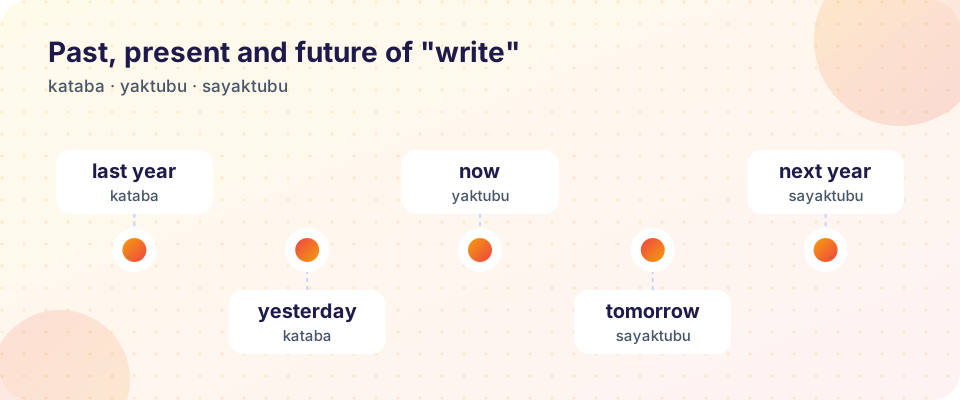
A timeline from last year to next year showing kataba for the past, yaktubu for now and saสพaktubu for the future.
The past tense looks back: kataba means he wrote.

What you will learn

  • How the past tense is built and how it differs from the present
  • What a verb-first sentence looks like
  • How to tell a story in the past using simple connecting words
  • What each lesson in this chapter covers

Key terms

Past tense (al-mฤแธฤซ): the form that describes a finished action, such as wrote or went.

Suffix: an ending attached to the end of a word. The Arabic past tense is built with suffixes.

Dictionary form: the form listed in a dictionary. In Arabic it is the past tense "he" form, for example ูƒูŽุชูŽุจูŽ (kataba, he wrote).

Verbal sentence: a sentence that begins with a verb, the normal order for stories in Arabic.

The big idea: endings, not prefixes

In the present tense you attached a prefix (ูŠูŽู€, ุชูŽู€) and an ending. In the past tense the stem stays whole, and a short ending marks the person:

Person Past of ูƒูŽุชูŽุจูŽ Transliteration
he ูƒูŽุชูŽุจูŽ kataba
she ูƒูŽุชูŽุจูŽุชู’ katabat
I ูƒูŽุชูŽุจู’ุชู katabtu
you (m.) ูƒูŽุชูŽุจู’ุชูŽ katabta
we ูƒูŽุชูŽุจู’ู†ูŽุง katabnฤ
they (m.) ูƒูŽุชูŽุจููˆุง katabลซ

The root letters never move; you just hang a suffix on the end. Compare that with English, where you add -ed to regular verbs and memorize hundreds of irregular forms: Arabic has far fewer exceptions in the past tense.

The "he" form, ูƒูŽุชูŽุจูŽ, is also the dictionary form of an Arabic verb. When you look a verb up, you will find it listed this way. That is why you have been learning verbs as pairs: ูƒูŽุชูŽุจูŽ / ูŠูŽูƒู’ุชูุจู.

Telling a story

A typical Arabic story starts with the verb: ุฐูŽู‡ูŽุจูŽ ุงู„ูˆูŽู„ูŽุฏ ุฅูู„ูŽู‰ ุงู„ู…ูŽุฏู’ุฑูŽุณูŽุฉ (dhahaba l-walad สพilฤ l-madrasa, "went the boy to the school"). Verb first, then who did it, then the rest. We will explore that order in lesson three and learn the little words that join sentences: ูˆูŽ (and), ุซูู…ูŽู‘ (then), ู„ูŽูƒูู†ู’ (but), ู„ูุฃูŽู†ูŽู‘ (because). Together with time words like ุฃูŽู…ู’ุณู (yesterday), they let you tell a whole day.

Here is a short past-tense dialogue to read now:

Arabic Transliteration English
ู…ูŽุงุฐูŽุง ููŽุนูŽู„ู’ุชูŽ ุฃูŽู…ู’ุณูุŸ mฤdhฤ faสฟalta สพamsi? What did you do yesterday?
ุฐูŽู‡ูŽุจู’ุชู ุฅูู„ูŽู‰ ุงู„ุณูู‘ูˆู‚. dhahabtu สพilฤ s-sลซq. I went to the market.
ูˆูŽู…ูŽุงุฐูŽุง ุงุดู’ุชูŽุฑูŽูŠู’ุชูŽุŸ wa-mฤdhฤ ishtarayta? And what did you buy?
ุงุดู’ุชูŽุฑูŽูŠู’ุชู ุฎูุจู’ุฒู‹ุง ูˆูŽุชูููŽู‘ุงุญู‹ุง. ishtaraytu khubzan wa-tuffฤแธฅan. I bought bread and apples.
ู‡ูŽู„ู’ ุฐูŽู‡ูŽุจู’ุชูŽ ูˆูŽุญู’ุฏูŽูƒูŽุŸ hal dhahabta waแธฅdaka? Did you go alone?
ู„ูŽุงุŒ ุฐูŽู‡ูŽุจู’ุชู ู…ูŽุนูŽ ุฃูŽุฎููŠ. lฤ, dhahabtu maสฟa สพakhฤซ. No, I went with my brother.

The past tense in one look

Endings only No prefixes
He form The dictionary form
Same stem kataba, katabtu, katabnฤ
1 / 3

What the rest of the chapter covers

Lesson Topic
Past tense conjugation The ten endings, ูƒูŽุงู†ูŽ (was), and saying "did not" with ู„ูŽู…ู’
Verbal sentences and connectors Verb-first order, agreement, ูˆูŽ, ุซูู…ูŽู‘, ู„ูŽูƒูู†ู’, ู„ูุฃูŽู†ูŽู‘ and time words
Past tense review Recap, mixed practice and a quiz

Why the past tense is easier than it looks

Many learners fear the past tense because English has so many irregular forms (go, went, gone; write, wrote, written). Arabic is kinder. A regular verb has one past stem and ten endings. There are no separate "past participles" to memorize, and the endings are short and consistent. If you can attach -tu, -ta, -ti, -nฤ and -ลซ to a stem, you can already talk about the past for hundreds of verbs.

The part that deserves extra care is hearing the endings. The difference between ูƒูŽุชูŽุจู’ุชู (I wrote), ูƒูŽุชูŽุจู’ุชูŽ (you wrote, to a man) and ูƒูŽุชูŽุจู’ุชู (you wrote, to a woman) is a single short vowel at the very end of the word. In real speech it can be fast and quiet, so you will train your ear as well as your tongue. As you work through this chapter, say each form aloud, and when you listen to Arabic, listen for that last vowel.

A study plan for the chapter

Give the three lessons about a week. Spend the first two days on the conjugation table, saying the ten forms of ูƒูŽุชูŽุจูŽ and ุดูŽุฑูุจูŽ aloud. Spend the next two days on ูƒูŽุงู†ูŽ and ู„ูŽู…ู’, which let you describe states and negate actions. Spend the last days on the story lesson: write six short sentences about yesterday, using at least two connectors and one time word, and read them aloud. When you finish the chapter you will be able to describe a whole day in the past, something that transforms a beginner's Arabic from lists of words into real storytelling.


Try it

Flip through ten past-tense verbs (the dictionary "he" form). Notice how many you already know from the present tense.

Ten past-tense verbs

Then match past forms with their meanings.

Past forms and meanings

Check your understanding

Quick check ยท 3 questions

of 3 answered You scored / 3 ยท perfect!

  1. 1. How is the Arabic past tense built?

    The past stem stays whole and a suffix marks the person: katabtu, katabnฤ, katabลซ.
  2. 2. What is the dictionary form of an Arabic verb?

    Dictionaries list verbs by the past he form, such as kataba.
  3. 3. Which sentence starts the normal way for a story?

    A verbal sentence begins with the verb: dhahaba l-walad สพilฤ l-madrasa.

Summary

  • The past tense uses endings only; the stem ูƒูŽุชูŽุจ- stays the same.
  • The past "he" form is the dictionary form.
  • Stories tend to begin with the verb, followed by connecting words and time words.
  • You will also learn ูƒูŽุงู†ูŽ (was) and ู„ูŽู…ู’ (did not) in this chapter.

Next: Past tense conjugation