


















Lesson 1 of 45 · Getting Started
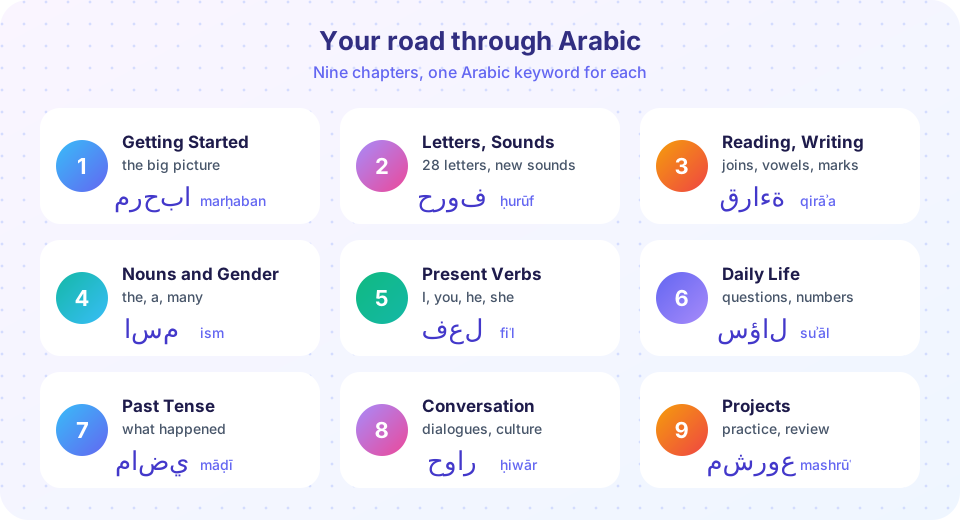
Course Map: Your Road Through Arabic
Start here: see all nine chapters of this Arabic course, who it is for, how to study each lesson and what to expect from Modern Standard Arabic.
Arabic has a reputation for being hard. Part of that reputation is fair: the script runs from right to left, a few sounds are new to English speakers, and the written language is not the language most people chat in at the market. But much of it is exaggerated. The alphabet has 28 letters, the grammar is more regular than English in many places, and one clever idea, the three-letter root, lets you guess the meaning of whole families of words. This course is built to take you from zero to reading simple Arabic, writing it by hand and building your own sentences, one small step at a time.
What you will learn
- What the course covers, in which order, and why that order works.
- Who the course is for and what you need before you begin.
- How to study a lesson so the words actually stay in your memory.
- Which form of Arabic you are learning, and what it can and cannot do for you.
- How Arabic text is stored on a computer, using a first Python experiment.
Key terms
Arabic script: the writing system used for Arabic. It is an abjad, which means it writes mainly consonants and long vowels.
Modern Standard Arabic (MSA): the shared written and formal spoken form, in Arabic al-fuṣḥā (الفصحى), "the most eloquent".
Transliteration: writing Arabic words with Latin letters so you can pronounce them before you can read the script.
Root: a set of usually three consonants that carries a core meaning, such as k-t-b for writing.
Harakat: the small marks above and below letters that show short vowels.
Who this course is for
You are the right reader if you are curious about Arabic and have never studied it. You might want to travel, read the news, talk with family or friends, study religious or classical texts, or add a language to your CV. You do not need to know any other language, and you do not need any grammar vocabulary beforehand: every term is explained the first time it appears.
You need three things. The first is a little time each day, as short as 15 minutes. The second is a pen and paper, because writing the letters by hand is the fastest way to learn them. The third is a willingness to feel clumsy for the first few weeks. Everybody who learns Arabic goes through a stage where the letters look like a row of identical waves. That stage ends faster than you expect.
What "Arabic" means in this course
Arabic is not one uniform language in daily life. People in Cairo, Beirut, Casablanca and Riyadh speak noticeably different dialects, and they often cannot follow each other's casual speech without effort. What they all share is Modern Standard Arabic. It is the language of newspapers, books, news broadcasts, speeches, official documents and school. It is also the form that learners of Arabic as a foreign language usually start with, and it is what this course teaches.
This choice has a clear benefit: once you can read and write MSA, you can read a sign in any Arabic-speaking country, and people everywhere will understand you. It also has a limit that we will be honest about: no one speaks MSA as a baby language at home, and everyday shop talk uses dialect. Lesson 2 explains this in depth, and Chapter 8 shows how MSA phrases and dialect phrases sit side by side in real conversations. When a dialect word is much more common than the MSA one, we will say so.
The nine chapters at a glance
Chapters 1 to 3
First you learn to see the script.
Chapters 4 and 5
Then you build the words.
Chapters 6 and 7
Next you talk about life.
Chapters 8 and 9
Finally you put it together.
This lesson belongs to Chapter 1, Getting Started. In this chapter you meet the language itself, its varieties, the idea of the root and your first greetings. Chapter 2 teaches the 28 letters, three or four at a time, with their sounds. Chapter 3 shows how letters join into words and how the vowel marks work. Chapter 4 covers nouns, gender, the word for "the", plurals and the first full sentences. The slice of the course you are reading now ends there; later chapters continue with verbs, daily life, the past tense, conversation and projects.
Every chapter begins with an overview, has two to four content lessons and ends with a review that gathers the key facts in one picture and a longer quiz.
How to study a lesson
A good routine for each lesson takes about 30 to 40 minutes and has four steps.
- Read it once for the idea. Do not stop to memorize anything yet.
- Do the Try it blocks. They are small games and tools: flashcards, matching drills and short programs. Playing with the material is where learning actually happens.
- Write it by hand. Copy each new letter or word five times, slowly, and say it aloud as you write.
- Return tomorrow. Spend five minutes on yesterday's flashcards before you read anything new. A few short sessions on separate days beat one long session, a result that psychologists call the spacing effect.
Say everything aloud, even when you are alone. Pronunciation lives in your mouth and ears, not only in your eyes. Arabic has sounds that need muscle practice, and speaking from the very first day makes later chapters much easier.
Transliteration, IPA and what you will see on the page
Almost every Arabic word in this course appears three ways: in Arabic script, in transliteration and with an English meaning. For example: كِتَاب, kitāb, "book". The transliteration uses a few special symbols: ā, ī, ū for long vowels, ʿ for the throat sound ع, ʾ for the glottal stop (the catch in the middle of "uh-oh"), and dots under letters like ḥ, ṣ, ḍ, ṭ, ẓ for sounds you will learn in Chapter 2. From time to time you will also see the IPA (International Phonetic Alphabet) in square brackets, such as [kiˈtaːb], where a colon-like mark means a long vowel. You do not need to memorize the IPA; it is there for readers who know it.
Transliteration is a bridge, not a destination. By the end of Chapter 3 you will read the script itself, and from then on transliteration will only be used for new words and tricky sounds.
A first experiment: Arabic inside a computer
Computers do not store letters as pictures but as numbers called code points, and they store Arabic text in the order you would say it, the order called logical order. The screen then draws it right to left. You can see this yourself. The first block below is a planner that estimates how long the course will take you; the second asks Python to take a word apart.
Try it
Press Run (or Ctrl + Enter) to see the result here.
Program input · what you'd type while the program runs
Type the answers before you press Run, one per line. Each time the program reads a line (with input()), it gets the next line from this box.
When you run the second block, look at the order of the list: the number 1 is the letter م (m), which is the rightmost letter on a printed line. That is the whole story of Arabic direction. Position 1 is the first letter you read, so it sits at the right.
Common misconceptions
"Arabic is impossible for English speakers." The U.S. Foreign Service Institute ranks Arabic among the languages that take English speakers the longest, so it is a long project. But a long project is not an impossible one, and the first milestones, reading the alphabet and holding a greeting, are reachable in weeks.
"Arabic is written without vowels, so nobody can read it." Native readers rely on context and on their knowledge of word patterns, which is a skill you will build. Learning materials, children's books and religious texts add vowel marks, and so does this course.
"I should learn only transliteration, because the script is too hard." Transliteration hides sounds and varies from book to book. Learners who commit to the script early advance faster, and the alphabet takes only a few weeks.
Check your understanding
Quick check · 5 questions
of 5 answered You scored / 5 · perfect!
-
1. Which form of Arabic does this course teach?
The course teaches Modern Standard Arabic (MSA), the shared written and formal form, and mentions dialects where they matter. -
2. What does the word root k-t-b carry in Arabic?
Words like kitāb (book), kātib (writer) and maktab (office) all share the consonants k-t-b and the idea of writing. -
3. In which direction is Arabic written?
Arabic runs from right to left, although numerals and Latin words inside the text keep their own direction. -
4. Why does the course repeat the advice to write each new letter by hand?
Writing the shapes slowly while saying the sounds links movement, sight and sound, and that helps memory. -
5. What is the best use of transliteration in this course?
Transliteration helps at the start, but the goal is reading Arabic script directly, which you will do by Chapter 3.
Summary
- The course has nine chapters; the first four teach letters, reading and nouns.
- It teaches Modern Standard Arabic (MSA) and notes dialect differences honestly.
- Every word appears in Arabic script, transliteration and English.
- Study in short daily sessions, speak aloud and write by hand.
- Arabic text is stored in logical order and displayed right to left.
- A course cannot replace speaking with people: find a tutor, a class or a language partner as soon as you can.
Track your progress
Create a free account to tick off lessons and pick up where you left off on any device.
of Arabic for Beginners lessons completed