


















Lesson 33 of 45 · Past Tense and Sentences
Past Tense Conjugation
Conjugate regular Arabic verbs in the past tense for all persons, learn kāna (was) and common irregular verbs, and say did not with lam.
The past tense is the friendliest verb form in Arabic. Every regular verb works the same way: keep the stem, add a short ending. There is no prefix to remember and the endings are only about ten tiny pieces. By the end of this lesson you will be able to say what you did, what other people did, and what you did not do.
We use كَتَبَ (kataba, he wrote) as our model verb again, so you can compare the past with the present tense side by side.
What you will learn
- The ten past-tense endings and how to attach them
- How the stem changes slightly for I, you and we
- The verb كَانَ (kāna, to be, was) in the past
- How to say did not with لَمْ and a few common irregular verbs
Key terms
Past stem (كَتَب-, katab-): the root letters with their past vowels: fatha on the first, fatha or kasra on the second.
Silent alif: the alif written after -ū in كَتَبُوا. It is not pronounced.
Jussive (majzūm): the form of the present tense used after لَمْ. Its singular form ends in a sukun.
Irregular (weak) verb: a verb with a و, ي or hamza among its root letters, whose stem changes in some forms.
Past tense versus present tense
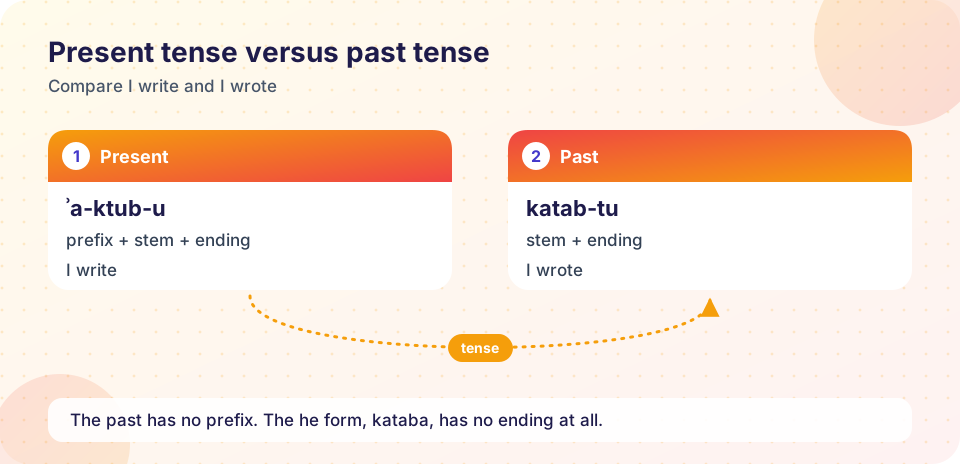
The present tense wraps the stem in a prefix and an ending (أَكْتُبُ). The past tense keeps the stem intact at the front and adds a suffix at the back (كَتَبْتُ). Notice that the pattern is fatha, fatha, fatha in the third-person form, the three short vowels of كَتَبَ.
The ten forms of the past tense
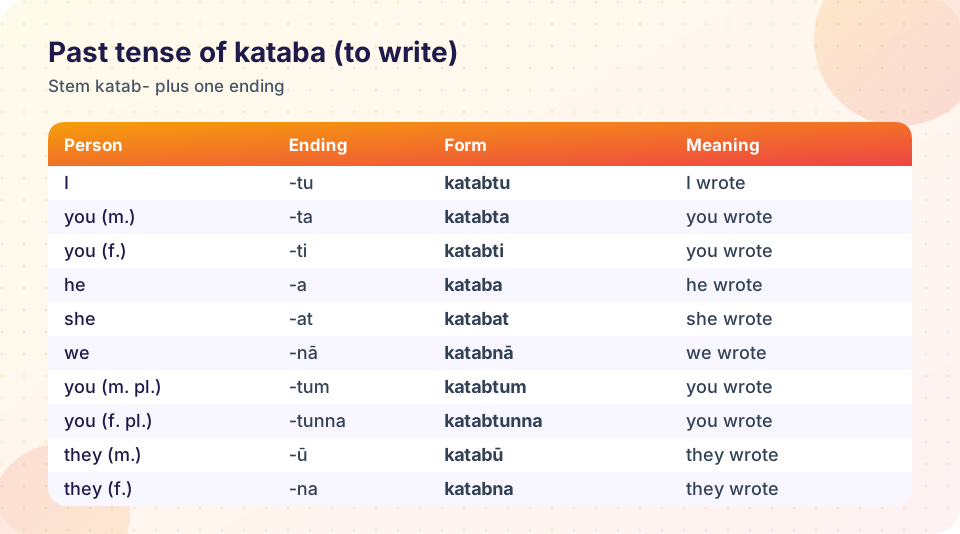
| Pronoun | Form | Transliteration | Ending |
|---|---|---|---|
| أَنَا (I) | كَتَبْتُ | katabtu | -tu |
| أَنْتَ (you m.) | كَتَبْتَ | katabta | -ta |
| أَنْتِ (you f.) | كَتَبْتِ | katabti | -ti |
| هُوَ (he) | كَتَبَ | kataba | -a |
| هِيَ (she) | كَتَبَتْ | katabat | -at |
| نَحْنُ (we) | كَتَبْنَا | katabnā | -nā |
| أَنْتُمْ (you m. pl.) | كَتَبْتُمْ | katabtum | -tum |
| أَنْتُنَّ (you f. pl.) | كَتَبْتُنَّ | katabtunna | -tunna |
| هُمْ (they m.) | كَتَبُوا | katabū | -ū (+ silent alif) |
| هُنَّ (they f.) | كَتَبْنَ | katabna | -na |
A few details make this table easy:
- The endings for I, you and we begin with a sukun on the last root letter: كَتَبْـتُ, كَتَبْـنَا. That sukun is why the verb sounds closed before the ending.
- The pattern -tu, -ta, -ti is a lovely mini-rule: the vowel of the ending changes with the person (u for I, a for you m., i for you f.). The same letter ت appears in all three.
- The third-person forms begin the same as the dictionary form and add nothing (he), a -at (she) or -ū (they m.).
- The feminine plural -na looks the same as the "we" ending -nā, but "we" has a long final ā and the feminine plural has a short a. Context helps.
There is also a dual set (for two people), كَتَبَا (katabā, the two of them wrote, m.) and كَتَبَتَا (katabatā, f.), but everyday speech usually uses the plural.
Verbs with a kasra in the stem
The second root vowel in the past can be fatha or kasra. The endings do not change: شَرِبَ (shariba, drank) becomes شَرِبْتُ (sharibtu), شَرِبْنَا (sharibnā), شَرِبُوا (sharibū). Verbs such as فَهِمَ (fahima, understood) and سَمِعَ (samiʿa, heard) behave the same.
Hamzated verbs
أَكَلَ (akala, ate) and قَرَأَ (qaraʾa, read) follow the same pattern: أَكَلْتُ (ʾakaltu, I ate), قَرَأْتُ (qaraʾtu, I read), قَرَأَتْ (qaraʾat, she read). The hamza keeps its spelling in these forms.
The verb "to be" in the past: كَانَ
In the present, Arabic has no to be. In the past it does: كَانَ (kāna). It conjugates differently because its middle letter is a long vowel:
| Person | Form | Transliteration |
|---|---|---|
| I | كُنْتُ | kuntu |
| you (m.) | كُنْتَ | kunta |
| you (f.) | كُنْتِ | kunti |
| he | كَانَ | kāna |
| she | كَانَتْ | kānat |
| we | كُنَّا | kunnā |
| you (m. pl.) | كُنْتُمْ | kuntum |
| they (m.) | كَانُوا | kānū |
Use it to describe the past: كُنْتُ طَالِبًا. (kuntu ṭāliban.) I was a student. كَانَ البَيْت كَبِيرًا. (kāna l-bayt kabīran.) The house was big. The thing described, here طَالِبًا and كَبِيرًا, takes a tanwin fatha (ـًا) after كَانَ. This small spelling detail is worth noticing even before you learn the full grammar behind it.
Common irregular verbs
Weak verbs bend the stem, mostly in the I, you and we forms:
| Verb (he) | Meaning | "I" form | Notes |
|---|---|---|---|
| قَالَ qāla | say | قُلْتُ qultu | the long ā shortens |
| نَامَ nāma | sleep | نِمْتُ nimtu | the long ā shortens |
| جَاءَ jāʾa | come | جِئْتُ jiʾtu | the hamza sits on ya |
| مَشَى mashā | walk | مَشَيْتُ mashaytu | the ending ya returns |
| اشْتَرَى ishtarā | buy | اشْتَرَيْتُ ishtaraytu | the ending ya returns |
| أَرَادَ ʾarāda | want | أَرَدْتُ ʾaradtu | shortened |
| سَافَرَ sāfara | travel | سَافَرْتُ sāfartu | regular |
Learn the "he" form and the "I" form together, and the rest follows the endings you know. For example قَالَتْ (qālat, she said), قَالُوا (qālū, they said), قُلْنَا (qulnā, we said).
Saying "did not" with لَمْ
To negate a past action, put لَمْ (lam) before the present verb in the jussive. The meaning is past, even though the verb looks present. The jussive of singular forms ends in a sukun instead of damma:
- كَتَبْتُ → لَمْ أَكْتُبْ (lam ʾaktub): I did not write.
- ذَهَبَ → لَمْ يَذْهَبْ (lam yadhhab): he did not go.
- شَرِبَتْ → لَمْ تَشْرَبْ (lam tashrab): she did not drink.
The plural forms behave like the subjunctive in the last lesson: the nūn of -ūna and -īna drops. لَمْ يَكْتُبُوا (lam yaktubū, they did not write) and لَمْ تَكْتُبِي (lam taktubī, you f. did not write); the feminine plural stays لَمْ يَكْتُبْنَ. In writing you can also negate the past with مَا plus the past verb (مَا ذَهَبْتُ), but لَمْ is the standard choice.
Worked example: what did you do yesterday?
Let us build a few answers to the question مَاذَا فَعَلْتَ أَمْسِ؟ (What did you do yesterday?), one step at a time. The question uses فَعَلْتَ (faʿalta, you did), the you (m.) form of فَعَلَ (faʿala, to do).
To say I studied Arabic, start from the dictionary form دَرَسَ (darasa, he studied). Drop the final fatha, close the last root letter with a sukun, and add -tu: دَرَسْتُ (darastu). Then add the object: دَرَسْتُ العَرَبِيَّة (darastu l-ʿarabiyya). To say we studied, swap the ending for -nā: دَرَسْنَا العَرَبِيَّة. To say she studied, add -at: دَرَسَتِ العَرَبِيَّة. In each case the verb keeps the stem daras- and changes only its tail.
Now try a verb you have not used in the past: فَتَحَ (to open). I opened the window becomes فَتَحْتُ النَّافِذَة. They opened the shop becomes فَتَحُوا المَتْجَر. This is the whole method: find the stem, close it with a sukun if you need a consonant ending, and add the ending for the person.
Why the sukun appears
You may wonder why كَتَبْتُ has a sukun on the ب. Arabic dislikes a run of more than a couple of short vowels in a row, and it builds words from syllables like kat- and tab-. When the ending begins with a consonant (-tu, -nā), the stem closes with a sukun so that the syllable ends with a consonant, giving ka-tab-tu. When the ending is only a vowel, as in كَتَبَ (ka-ta-ba), no sukun is needed. If you can say the three syllables of katabtu smoothly, you have the rhythm of the whole past tense.
Hearing the endings
Practice the three endings that differ by a single vowel until you can hear them: -tu (I), -ta (you, masculine), -ti (you, feminine). Record yourself saying كَتَبْتُ، كَتَبْتَ، كَتَبْتِ and play it back. The sounds u, a and i are the only difference, and getting them right is a sign of respect to the person you are speaking to, because the ending tells them whether you are addressing a man or a woman.
Common misconceptions
"The past needs a separate pronoun." It does not. كَتَبْتُ already means I wrote; add أَنَا only for emphasis.
"لَمْ goes with a past verb." It goes with the present (jussive) form: لَمْ أَكْتُبْ, not "lam katabtu".
"-nā and -na are the same." We wrote is كَتَبْنَا (long ā); they (f.) wrote is كَتَبْنَ (short a).
Try it
Choose a verb, switch to past, and use test mode to cover the answers. Say each form aloud.
The Python stand-in below applies the past-tense rules to a root. Change the root, or the two vowels, and run it.
Press Run (or Ctrl + Enter) to see the result here.
Program input · what you'd type while the program runs
Type the answers before you press Run, one per line. Each time the program reads a line (with input()), it gets the next line from this box.
Now choose the right form to complete each sentence.
Check your understanding
Quick check · 5 questions
of 5 answered You scored / 5 · perfect!
-
1. What is the past tense of كَتَبَ for "we"?
katabnā: stem + sukun + -nā. -
2. Which ending marks "you (f.)" in the past?
The vowel changes with the person: -tu (I), -ta (you m.), -ti (you f.). -
3. How do you say "I did not write"?
lam is followed by the present-tense jussive form: lam ʾaktub. -
4. Which form is "she was"?
kānat is the she form of kāna. -
5. What is "I said" from قَالَ?
The long ā of qāla shortens in the I form: qultu.
Summary
- The past tense has no prefix: stem + ending (-tu, -ta, -ti, -a, -at, -nā, -tum, -tunna, -ū, -na).
- The "he" form is the dictionary form; the third-person plural -ū has a silent alif.
- كَانَ (was) conjugates as كُنْتُ, كُنْتَ, كَانَ, كَانَتْ, كُنَّا, كَانُوا.
- Negate the past with لَمْ + jussive (لَمْ أَكْتُبْ).
- Weak verbs shorten their stem in the I, you and we forms (قُلْتُ, نِمْتُ).
Track your progress
Create a free account to tick off lessons and pick up where you left off on any device.
of Arabic for Beginners lessons completed