


















Lesson 9 of 45 · Letters and Sounds
Letters 18 to 28: ʿAyn to Yā’
Finish the alphabet: ʿayn, ghayn, fā', qāf, kāf, lām, mīm, nūn, hā', wāw and yā', with throat-sound tips, a map of the mouth and 15 example words.
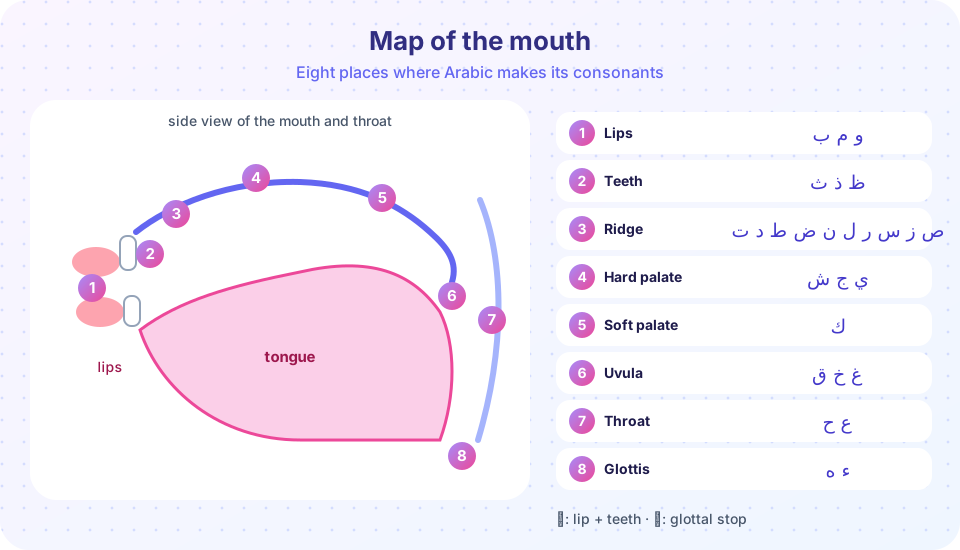
Eleven letters remain, and with them you will have met the whole alphabet. This group contains the most famous Arabic sounds: ʿayn (ع), a squeeze in the throat, ghayn (غ), a gargled r, and qāf (ق), a k from deep in the mouth. It also contains seven letters that are easy, because they sound close to English. Two of them, و and ي, have a double life as consonants and as long vowels, which makes them the most useful letters in the alphabet. To make sense of the new sounds, we begin with a map of the mouth.
What you will learn
- The names, shapes and sounds of ع غ ف ق ك ل م ن ه و ي.
- Where in the mouth and throat each Arabic consonant is made.
- How to make ʿayn, ghayn, ḥā' and qāf.
- How و and ي work both as consonants (w, y) and as long vowels (ū, ī).
- Fifteen new words you can already say.
Key terms
Place of articulation: the spot where the airflow is narrowed or stopped to make a consonant, from the lips back to the throat.
Pharyngeal: made in the pharynx, the throat behind the tongue: ح and ع.
Uvular: made near the uvula, the small flap hanging at the back of the mouth: ق (and in many accents غ and خ).
Long vowel: ā, ī, ū, held about twice as long as the short vowels.
Glottal: made at the voice box, as in ه or the catch in "uh-oh".
A map of the mouth
Look at the numbered picture. English uses mostly places 1 to 5, the front and middle of the mouth. Arabic uses all eight. The throat sounds (7 and 8, and the uvular ones at 6) are the ones that feel foreign, but they are made by the same muscles you use to swallow, cough and breathe out. Notice that the plain letters ت د ط ض ن ل ر س ز ص all sit at place 3 (the ridge behind the teeth): that is why their emphatic partners differ only in the tongue's back.
The deep throat pair: ح and ع
You met ح (ḥā’) in the first lesson: a whispered, breathy sound in the pharynx. ع (ʿayn) is its voiced partner: the same position, with your voice switched on.
To make ʿayn: say a long "aaah" as at the doctor, then tighten the muscles at the back of your throat so the sound turns thin and slightly strained. Another trick is to imagine you are swallowing while saying "ah". Do not close the throat completely, as in the glottal stop; keep air flowing. The name of the letter is the word ʿayn, which means "eye" and also "spring of water".
Shape: ع looks like a small head with a tail; in the middle of a word it narrows to a triangular head. غ is the same with one dot above.
Examples: عَيْن (ʿayn, "eye"), عَرَبِيّ (ʿarabī, "Arab; Arabic").
ghayn (غ) and khā' (خ)
غ (ghayn) is the voiced partner of خ. It sounds like the French r in rouge or a soft gargle: the back of the tongue rises toward the uvula, and the vocal cords vibrate. It is not a g, even though English transliteration uses "gh".
Examples: غَيْم (ghaym, "clouds"), غُرْفَة (ghurfa, "room").
Fā’ (ف) and qāf (ق)
Both letters have a small round head. ف has one dot above; ق has two dots above. In the middle of a word, the head is a small loop sitting on the line.
- ف (fā’) is f as in fish.
- ق (qāf) is a q made at the very back of the mouth, with the back of the tongue against the uvula. Think of a k pronounced deeper, as if from your throat, with a dull click.
The pair كَلْب (kalb, "dog") and قَلْب (qalb, "heart") is the classic test: the first has an ordinary k, and the second has the deep one. Say them alternately several times.
Dialect warning: ق varies a lot. In Cairo and Beirut it is usually a glottal stop ("uh-oh"), in much of the Gulf and in Upper Egypt a hard g, and in Palestinian village speech a k. In MSA it is always q.
Examples: فِيل (fīl, "elephant"), فَم (fam, "mouth"), قَمَر (qamar, "moon"), قَلْب (qalb, "heart").
The easy seven: ك ل م ن ه و ي
| Letter | Name | Shape | Sound | Example |
|---|---|---|---|---|
| ك | kāf | tall stroke with a small zigzag | k | كَلْب kalb (dog), كُرَة kura (ball) |
| ل | lām | tall stroke with a hook at the base | l | لَيْل layl (night) |
| م | mīm | round loop with a tail | m | مَطَر maṭar (rain), مَدِينَة madīna (city) |
| ن | nūn | bowl with a dot above | n | نَهْر nahr (river) |
| ه | hā’ | small loop | h (as in hat) | هِلَال hilāl (crescent) |
| و | wāw | loop with a tail | w, or long ū | وَلَد walad (boy), نُور nūr (light) |
| ي | yā’ | swoop with two dots below | y, or long ī | يَد yad (hand), كَبِير kabīr (big) |
Details to notice:
- ل is a "clear" l, as in leaf, in almost every word. The one famous exception is the name الله (Allāh), where it is "dark" like the l in full.
- ن has the same bowl as ب ت ث, but its dot is above; in the middle of a word you tell it apart by position and dot.
- ه is a plain breath, unlike the squeezed ح. Make a clear distinction: hilāl (crescent) has the light h; ḥalīb (milk) has the whisper.
- و never joins to the letter that follows it, like ا د ذ ر ز.
Long vowels: ا و ي
Now you can finish the vowel system from Chapter 1. Three letters stand for long vowels: ا = ā, و = ū, ي = ī. The letters و and ي are also consonants, w and y. How do you tell which job they do? In a word like نُور (nūr), a vowel mark of the right kind sits on the preceding letter and the و carries no mark of its own; the same letter in وَلَد (walad) has its own vowel mark (fatḥa) above it. For the moment, learn the pattern word by word:
- nūr (light): و is ū
- walad (boy): و is w
- kabīr (big): ي is ī
- yad (hand): ي is y
- yawm (day) has both as consonants: ي is y (it carries a fatḥa) and و is w (it carries a sukūn, the "no vowel" mark).
In Chapter 3 you learn the marks and then the rule becomes mechanical.
The words of the lesson
| Arabic | Transliteration | Meaning |
|---|---|---|
| عَيْن | ʿayn | eye |
| غَيْم | ghaym | clouds |
| غُرْفَة | ghurfa | room |
| فِيل | fīl | elephant |
| قَمَر | qamar | moon |
| كَلْب | kalb | dog |
| لَيْل | layl | night |
| مَطَر | maṭar | rain |
| نَهْر | nahr | river |
| نُور | nūr | light |
| هِلَال | hilāl | crescent |
| وَلَد | walad | boy |
| وَرْدَة | warda | rose |
| يَد | yad | hand |
| يَوْم | yawm | day |
Common substitutions and how to fix them
Almost every English-speaking learner starts with the same handful of substitutions, and it helps to know them in advance:
- ع replaced by ا or by silence. Fix: say "aaa" and then squeeze the back of your throat in the middle of the vowel, as if the sound were passing through a narrow pipe. The vowel after ع often sounds a little darker.
- ح replaced by ه. Fix: for ح, imagine blowing warm air onto cold glass and tightening the throat; for ه, a relaxed, gentle breath. Practice the pair ḥubb (love) and hubb.
- غ replaced by g. Fix: say a French r, or start gargling water and then do it without water.
- ق replaced by k. Fix: say "k" and slide the contact point back until the sound comes from the very back of the mouth. In dialect speech, the glottal stop or a hard g is perfectly natural, so learners who follow a Cairene or Levantine tutor will use those. In MSA, the deep q is the standard.
Do ten repetitions of each pair in the morning and in the evening. Pharyngeal consonants use muscles you do not normally train, so tiredness in the throat is normal. Stop if you feel pain, drink water and come back later.
Letter names are useful
Arabic letter names are used in everyday speech, for instance when someone spells a name aloud on the phone. "Sara" would be sīn, alif, rā', tā' marbūṭa. It is worth learning the names thoroughly, because they give you the sounds and the order, and they help in dictionaries, which are arranged alphabetically.
Try it
Press Run (or Ctrl + Enter) to see the result here.
Program input · what you'd type while the program runs
Type the answers before you press Run, one per line. Each time the program reads a line (with input()), it gets the next line from this box.
The Python output shows the point of the long-vowel section: و and ي are sometimes consonants and sometimes vowels, and the writing alone does not always decide. Vowel marks (Chapter 3) and knowing the word do.
Common misconceptions
"ع is a silent letter." It is a real consonant with a real sound, and ʿarabī sounds quite different without it. Learners who skip ع are still understood, but it takes practice to do it right.
"غ is a g." The "gh" spelling is just a convention; غ is a voiced gargled sound, not a hard g.
"ق and ك are the same." They are different letters, and qalb (heart) and kalb (dog) are different words.
"و and ي are vowels only." They are consonants as well (w and y).
Check your understanding
Quick check · 6 questions
of 6 answered You scored / 6 · perfect!
-
1. Which letter is the voiced partner of ح?
ʿayn (ع) is made in the same place as ḥā' but with the voice switched on. -
2. Which word means 'heart'?
Qalb (heart) starts with qāf; kalb (dog) starts with kāf. -
3. How many dots does ق have?
Qāf has two dots above; fā' has one above. -
4. Which letters can stand for long vowels?
Alif (ā), wāw (ū) and yā' (ī) double as long vowels. -
5. Where is ق made?
Qāf is uvular: the back of the tongue meets the uvula. -
6. What is 'ghayn' (غ) closest to?
Ghayn is a voiced gargle, like the French r.
Summary
- ع is a voiced squeeze in the throat, the partner of ح; غ is a gargled r, the partner of خ.
- ف is f; ق is a deep q; ك is k.
- ل م ن ه are l, m, n, h; ه is a plain breath, unlike ح.
- و and ي are w and y as consonants and ū and ī as long vowels.
- The mouth map shows the whole range, from the lips (1) to the voice box (8).
Track your progress
Create a free account to tick off lessons and pick up where you left off on any device.
of Arabic for Beginners lessons completed