


















Lesson 15 of 45 · Reading and Writing
Hamza, Tā’ Marbūṭa and Alif Maqṣūra
Master Arabic's special letters: hamza and its seats, alif madda, tā' marbūṭa as the feminine ending and alif maqṣūra, with word lists and reading drills.
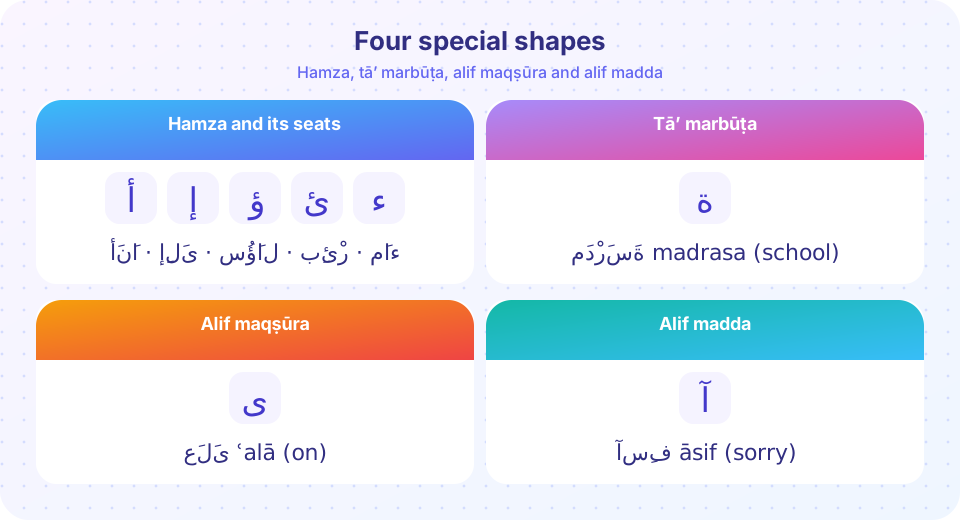
The 28 letters of the alphabet cover almost everything, but written Arabic uses a few extra signs that you will see on nearly every page. The hamza writes the glottal stop; the tā' marbūṭa marks most feminine words; the alif maqṣūra is a dotless final yā' that sounds like ā; and alif madda is a hamza fused with a long ā. None of them is hard once you can name it, and each of them solves a specific problem in the writing system. This lesson explains the problems and the solutions.
What you will learn
- What the hamza sounds like and where it is written.
- A beginner's rule for choosing the hamza's seat.
- What alif madda looks and sounds like.
- How tā' marbūṭa works, and how it differs from hā'.
- How alif maqṣūra looks and sounds, and how it differs from yā'.
Key terms
Hamza (ء): the sign for the glottal stop, the catch in the throat in "uh-oh".
Seat (kursī): the letter (alif, wāw or yā') the hamza sits on, or the line itself.
Alif madda (آ): a hamza followed by a long ā, written with a wavy sign over alif.
Tā' marbūṭa (ة): "tied tā'": a letter shaped like hā' with two dots, used for most feminine endings.
Alif maqṣūra (ى): a final dotless yā' pronounced as ā.
The hamza (ء)
Say "uh-oh" slowly and notice the tiny closure in the middle: that is a glottal stop. In Arabic it is a full consonant, the hamza, and it appears at the start, in the middle and at the end of words. English speakers hear it as the break in "uh-oh" or in some pronunciations of "bottle" (Cockney or Glaswegian). Arabic transliteration marks it with ʾ.
It is not counted among the 28 letters, but it is written all the time, mainly on top of or below alif, wāw or yā'. Those three are the hamza's seats, and choosing the seat follows rules that the language has settled on. For a beginner, here is a working summary.
At the beginning of a word
The seat is always alif. The hamza goes above the alif for the vowels a and u (أ), and below it for i (إ):
| Word | Reads | Meaning |
|---|---|---|
| أَنَا | anā | I |
| أُمّ | umm | mother |
| إِلَى | ilā | to |
In unvowelled text, the hamza above or below still tells you the first vowel, which is useful.
In the middle of a word
The hamza picks the seat that matches the strongest of the vowels around it. The ranking, from strongest to weakest, is kasra (i) > ḍamma (u) > fatḥa (a) > sukūn. Then:
- kasra decides ئ (the seat is a dotless yā');
- ḍamma decides ؤ (the seat is wāw);
- fatḥa decides أ (the seat is alif);
- if both vowels are sukūn or a long vowel, the hamza usually stands alone on the line, ء.
| Word | Reads | Meaning | Why this seat |
|---|---|---|---|
| بِئْر | biʾr | well | kasra before it: yā' |
| سُؤَال | suʾāl | question | ḍamma beats fatḥa: wāw |
| رَأْس | raʾs | head | fatḥa and sukūn: alif |
| سَأَلَ | saʾala | he asked | fatḥa and fatḥa: alif |
| قِرَاءَة | qirāʾa | reading | after a long ā: on the line |
| جُزْء | juzʾ | part | after a sukūn at the end: on the line |
Hamza spelling has more exceptions than this table shows, and even native writers check the rules. For now, aim to recognize each form and say the glottal stop, not to spell every hamza from memory.
At the end of a word
After a long vowel or a letter with sukūn, the hamza stands on the line: مَاء (māʾ, "water"), شَيْء (shayʾ, "thing"). After a short vowel, it follows the same seat logic as in the middle.
Alif madda (آ)
When a hamza is followed by a long ā, Arabic writes the pair as one letter: alif with a wavy sign above it, آ. It is read ʾā: a glottal stop, then a long a.
| Word | Reads | Meaning |
|---|---|---|
| آسِف | āsif | sorry (said by a man) |
| آخِر | ākhir | last |
| قُرْآن | qurʾān | Qur'an (the book; reading) |
You can think of آ as "hamza + alif" squeezed into one shape. Never write أا for this, because that is not how Arabic spells it.
Tā' marbūṭa (ة)
The tā' marbūṭa appears only at the end of a word. It looks like a hā' (ه) with two dots on top, and it connects to the letter before it but never to a letter after it. It marks most feminine nouns and adjectives, and it also appears in many words that have nothing to do with gender, like qahwa (coffee).
Its sound changes with the situation:
- At the end of a word, in speech or when you pause, it sounds like a short -a: مَدْرَسَة (madrasa, "school").
- When something follows that attaches to the word (for example, the possessor in "the boy's school"), it turns into a t: مَدْرَسَةُ الْوَلَدِ (madrasatu l-walad, "the boy's school").
Examples of words that end in ة:
| Arabic | Reads | Meaning |
|---|---|---|
| مَدْرَسَة | madrasa | school |
| مَدِينَة | madīna | city |
| مَكْتَبَة | maktaba | library |
| سَيَّارَة | sayyāra | car |
| قَهْوَة | qahwa | coffee |
| حَدِيقَة | ḥadīqa | garden |
Tā' marbūṭa versus hā' and tā'
To avoid mixing them up:
- ة has two dots, appears only at the end of a word, and shows a feminine ending (usually the sound -a).
- ه has no dots; it is the plain h, and as a final letter it means "his" or "him": كِتَابُهُ (kitābuhu, "his book") versus كِتَابَة (kitāba, "writing").
- ت is the ordinary t and can appear anywhere.
You will learn gender fully in the next chapter. For now remember that ة is a good clue that a word is feminine.
Alif maqṣūra (ى)
The alif maqṣūra ("shortened alif") is written as a yā' without its two dots, at the end of a word, and it is pronounced as a long ā, not as ī. It appears in only a few dozen common words, but they are very common ones.
| Arabic | Reads | Meaning |
|---|---|---|
| عَلَى | ʿalā | on |
| إِلَى | ilā | to |
| حَتَّى | ḥattā | until |
| مَتَى | matā | when |
| مَعْنَى | maʿnā | meaning |
| مُسْتَشْفَى | mustashfā | hospital |
The difference with ي: ى has no dots and is read ā; ي at the end of a word has two dots below and is read ī or a consonant y. A regional note: in Egyptian printing, a final yā' is also often written without dots, so you will meet dotless forms that are really ī. Context and vocabulary tell you which one you have.
Make a mini deck of these ten small words: ʿalā, ilā, ḥattā, matā, ana, umm, āsif, ākhir, māʾ, shayʾ. They give you the major special letters in real use, and they are among the most frequent words in the language.
A three-step way to learn hamza
Hamza spelling worries even native writers, so do not try to master all of it today. Use this plan instead. Step one, recognize: in everything you read, circle the hamzas and say the glottal stop. Step two, use the ranking rule (kasra over ḍamma over fatḥa over sukūn) to explain the seat for each word you meet; do not worry if you occasionally get one wrong. Step three, after a few weeks, test yourself by writing ten common hamza words from memory and checking them against a dictionary.
One related point: the alif at the start of the article ال and at the beginning of a few common words like اِسْم (ism, "name") and اِبْن (ibn, "son") is a different kind of alif, the "connecting alif" (hamzat al-waṣl). It is written as a plain alif, and it is pronounced only at the beginning of a sentence, vanishing when another word comes before it. Compare ismī ("my name") with wa smuka ("and your name", dropping the first vowel). You do not need to write it yet, but you now know why some words begin with a plain alif and others with a hamza on it.
Try it
Press Run (or Ctrl + Enter) to see the result here.
Program input · what you'd type while the program runs
Type the answers before you press Run, one per line. Each time the program reads a line (with input()), it gets the next line from this box.
Common misconceptions
"Hamza is a vowel." It is a consonant, the glottal stop. The letters under or over it carry vowels, but the hamza itself is a closure of the throat.
"The hamza seat is arbitrary." It follows the strongest-vowel rule. You will absorb the pattern with practice.
"ة is the letter ه." They look alike, but ة has two dots, appears only at the end and marks the feminine; ه does not.
"ى and ي are the same." ى is read ā; ي is read ī or y. Some regional printing blurs the dots, so rely on vocabulary.
Check your understanding
Quick check · 6 questions
of 6 answered You scored / 6 · perfect!
-
1. What does the hamza represent?
The hamza is the glottal stop, like the catch in 'uh-oh'. -
2. Which hamza seat do you use after a kasra?
Kasra is the strongest vowel and picks the yā' seat. -
3. How is آ read?
Alif madda is a hamza followed by a long ā. -
4. What is ة mainly used for?
Tā' marbūṭa ends most feminine nouns and adjectives. -
5. How is the final letter of عَلَى read?
It is an alif maqṣūra, written like a dotless yā' but read ā. -
6. Where can tā' marbūṭa appear?
It is a word-final letter.
Summary
- The hamza (ء) is the glottal stop; its seat depends on the strongest nearby vowel (i, u, a) or it stands on the line.
- At the start of a word the seat is alif: أ for a/u, إ for i.
- آ is hamza plus long ā.
- ة (tā' marbūṭa) is the feminine ending, pronounced -a, or -t when something follows.
- ى (alif maqṣūra) is a dotless final yā' read as ā.
Track your progress
Create a free account to tick off lessons and pick up where you left off on any device.
of Arabic for Beginners lessons completed