


















Lesson 19 of 45 · Nouns, Gender and Definiteness
The Definite Article ال: Sun and Moon Letters
Learn the Arabic word for 'the': how ال attaches to nouns, the 14 sun and 14 moon letters, how it replaces tanwīn and how possession makes nouns definite.
English has two small words, "a" and "the", that you probably never think about. Arabic only has one of them. The word for "the" is a prefix, ال (al-), which attaches to the front of a noun. "A book" has no article at all: it is just the bare noun, usually with tanwīn in vowelled text. That makes definiteness easy to see in writing but gives the learner two new puzzles: why the l of al- sometimes seems to disappear, and how a noun can be definite without ال. This lesson untangles both.
What you will learn
- How ال turns "a book" into "the book".
- Why tanwīn and ال never appear together.
- The 14 sun letters and 14 moon letters, with a pronunciation rule.
- What happens to the alif of ال after another word.
- How possession and pronoun endings make a noun definite.
Key terms
Definite article (ال): the prefix meaning "the".
Moon letters (ḥurūf qamariyya): letters after which ال is pronounced al-, as in al-qamar, "the moon".
Sun letters (ḥurūf shamsiyya): letters after which the l assimilates, as in ash-shams, "the sun".
Assimilation: one sound becoming like its neighbor.
Idāfa: the "construct" of two nouns, such as "the boy's book".
Adding ال
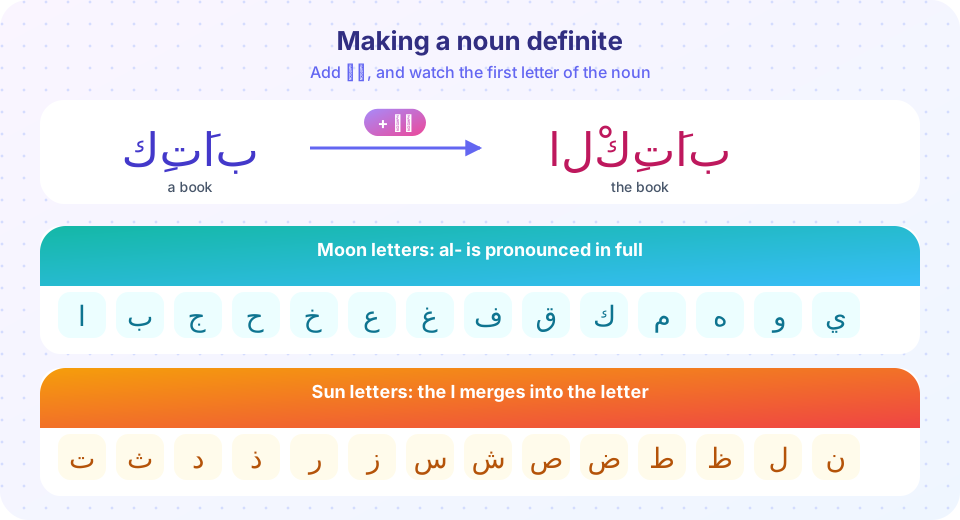
To say "the book", write ال in front of كِتَاب: الْكِتَاب (al-kitāb). Two details of spelling:
- In fully vowelled text, the lām carries a sukūn and the alif is unmarked: الْ. For sun letters, the shadda goes on the noun's first letter instead, as below.
- The noun loses its tanwīn: كِتَابٌ (a book) becomes الْكِتَابُ (the book, with a case vowel). A noun never has both ال and tanwīn.
| Indefinite | Definite |
|---|---|
| كِتَابٌ kitābun, a book | الْكِتَابُ al-kitābu, the book |
| بَيْتٌ baytun, a house | الْبَيْتُ al-baytu, the house |
| مَدْرَسَةٌ madrasatun, a school | الْمَدْرَسَةُ al-madrasatu, the school |
In fast speech, and in pausal forms, the final case vowel is dropped: al-kitāb, al-bayt. We write them that way when we are teaching pronunciation, and keep the case endings only when the lesson needs them.
Moon letters and sun letters
Arabic has a quirk: sometimes you do not pronounce the l of ال. Say الْقَمَر (al-qamar, "the moon") and you hear the l clearly. Say الشَّمْس and you hear ash-shams, with the l swallowed and the sh doubled. Letters of the first kind are called moon letters (after qamar); letters of the second kind are called sun letters (after shams).
| Group | Letters | Count |
|---|---|---|
| Moon letters | ا ب ج ح خ ع غ ف ق ك م ه و ي | 14 |
| Sun letters | ت ث د ذ ر ز س ش ص ض ط ظ ل ن | 14 |
Rough rule: sun letters are the ones made with the tip or front of the tongue at the teeth and the ridge behind them (and ل and ن, the same place). The l of ال, made at exactly the same place, melts into them. Moon letters are mostly made at the lips, in the throat or further back, so the l stays distinct. The rule is imperfect at the hard palate: ش is a sun letter, but ج and ي are moon letters. Use the rule as a memory aid, but learn the two lists.
How the spelling behaves:
- The spelling of ال does not change. You always write ال plus the noun. Only the pronunciation changes.
- In vowelled text, a sun letter gets a shadda, which tells you to double it: الشَّمْس.
| Moon-letter nouns | Reads | Sun-letter nouns | Reads |
|---|---|---|---|
| الْقَمَر | al-qamar (the moon) | الشَّمْس | ash-shams (the sun) |
| الْكِتَاب | al-kitāb (the book) | النُّور | an-nūr (the light) |
| الْبَيْت | al-bayt (the house) | الدَّرْس | ad-dars (the lesson) |
| الْوَلَد | al-walad (the boy) | الرَّجُل | ar-rajul (the man) |
| الْجَمَل | al-jamal (the camel) | السَّيَّارَة | as-sayyāra (the car) |
| الْمَدْرَسَة | al-madrasa (the school) | الطَّالِب | aṭ-ṭālib (the student) |
Do you see why Chapter 1's greetings sounded the way they did? as-salāmu ʿalaykum is السَّلَامُ, with the sun letter س: it is not "al-salāmu" but as-salām. ṣabāḥ an-nūr is the sun letter ن. You have been using this rule since your first lesson.
Do not memorize the two lists in the abstract. When you learn a new noun, say it with ال once: al-bayt, ash-shams. Your ear learns the pattern and your mouth follows.
The alif of ال is shy
The alif of ال is a special alif, called hamzat al-waṣl, "the connecting alif". At the beginning of a sentence you pronounce it: al-bayt. After another word that ends in a vowel, it vanishes and the l attaches to the vowel before it:
| Phrase | Reads | Meaning |
|---|---|---|
| فِي الْبَيْتِ | fī l-bayt | in the house |
| مِنَ الْمَدْرَسَةِ | mina l-madrasa | from the school |
| عَلَى الْبَابِ | ʿalā l-bāb | on the door |
You do not need to do anything extra when reading: just say the words smoothly together. The transliteration shows the join with a hyphen: fī l-bayt.
Definite without ال
A noun can be definite in other ways, and when it is, it does not take ال.
- Names of people and most cities and countries: مُحَمَّد (Muḥammad), مِصْر (Egypt), دِمَشْق (Damascus). A few countries use ال, such as الْعِرَاق (Iraq), الْمَغْرِب (Morocco) and السُّودَان (Sudan); learn them as part of the name.
- Pronouns and demonstratives: anā, huwa, hādhā are definite already.
- Nouns with a pronoun ending: the ending means "my", "your", "his" and so on.
| Ending | Reads | Meaning | Example |
|---|---|---|---|
| ـِي | -ī | my | كِتَابِي kitābī (my book) |
| ـكَ | -ka | your (m) | كِتَابُكَ kitābuka |
| ـكِ | -ki | your (f) | كِتَابُكِ kitābuki |
| ـهُ | -hu | his | كِتَابُهُ kitābuhu |
| ـهَا | -hā | her | كِتَابُهَا kitābuhā |
With a feminine ة noun, the ة becomes ت before the ending: مَدْرَسَتِي (madrasatī, "my school").
- The first noun in an idāfa, which is next.
The idāfa: "of"
Arabic has no small word for "of". Instead, two nouns are placed side by side, and the second one owns or describes the first. This idāfa (annexation) is one of the most frequent structures in the language.
| Idāfa | Reads | Meaning |
|---|---|---|
| كِتَابُ الْوَلَدِ | kitābu l-walad | the boy's book |
| بَابُ الْبَيْتِ | bābu l-bayt | the door of the house |
| مَدْرَسَةُ الْبِنْتِ | madrasatu l-bint | the girl's school |
| مِفْتَاحُ السَّيَّارَةِ | miftāḥu s-sayyāra | the car key |
Three rules:
- The first noun never takes ال and never takes tanwīn: not al-kitābu l-walad.
- The second noun can take ال (or be a name or have a pronoun ending); it ends in the "of" vowel, -i, in vowelled text.
- The whole phrase is definite if the second noun is definite. If the second noun is indefinite, the whole phrase is indefinite: كِتَابُ وَلَدٍ (kitābu waladin, "a boy's book").
Notice how this saves a word: "the book of the boy" is simply "book-the boy" with the right vowels. Later chapters will extend it to places, times and relatives.
Reading a vowelled phrase from start to finish
Take the phrase فِي الْمَدْرَسَةِ الْجَدِيدَةِ (fī l-madrasati l-jadīda), "in the new school". Work through it as follows. First, فِي is a preposition meaning "in", and it makes the next noun end with the "of" vowel -i (that is the genitive). Second, الْمَدْرَسَةِ is the definite noun madrasa with ال; because it follows a vowel-final word, the alif of ال is silent and the l joins the previous vowel: fī l-madrasa. Third, the adjective الْجَدِيدَةِ takes ال as well, to match, and the same -i ending. In ordinary speech, the case endings are dropped, so you hear fī l-madrasa l-jadīda.
Longer idāfa chains
An idāfa can have more than two nouns. "The key of the door of the house" is مِفْتَاحُ بَابِ الْبَيْتِ (miftāḥu bābi l-bayt). The rule is simple: only the last noun carries ال, and every noun before it is bare. Each noun is followed by the next one, like links in a chain, and the last link decides whether the whole phrase is definite or indefinite. To read such a chain, start at the end of the sentence, find the last noun and then read backwards through the owners.
Because the first noun of an idāfa never takes ال, a phrase such as kitābu l-walad is definite even though its first word looks bare. This is one of the places where English speakers have to unlearn their reflexes: "the" does not need to appear in front of every definite noun.
Try it
Press Run (or Ctrl + Enter) to see the result here.
Program input · what you'd type while the program runs
Type the answers before you press Run, one per line. Each time the program reads a line (with input()), it gets the next line from this box.
The Python block separates writing from speaking: the written form always has ال, but the spoken form changes for the 14 sun letters.
Common misconceptions
"Sun letters change the spelling of ال." They do not. You always write ال; only the pronunciation changes.
"A noun can have both ال and tanwīn." Never. They are opposites: definite and indefinite.
"The first noun of an idāfa takes ال." It does not. Definiteness comes from the second noun.
"Names need ال like other nouns." Most names do not. A few countries have it as part of the name.
Check your understanding
Quick check · 5 questions
of 5 answered You scored / 5 · perfect!
-
1. How do you say 'the book' in Arabic?
Add ال to the noun and drop the tanwīn: al-kitāb. -
2. Which noun starts with a sun letter?
ش is a sun letter: ash-shams. -
3. What is the correct reading of النُّور?
ن is a sun letter, so the l assimilates: an-nūr. -
4. Which of these is an idāfa meaning 'the boy's book'?
The first noun has no ال and no tanwīn; the second has ال. -
5. Which word is definite without ال?
The ending -ī (my) makes the noun definite.
Summary
- ال means "the"; an indefinite noun has no article (and often shows tanwīn).
- ال and tanwīn never appear together.
- Before 14 sun letters the l assimilates; before 14 moon letters it is pronounced. The spelling is the same.
- Names, pronoun endings and the first noun of an idāfa are definite without ال.
- The idāfa gives "the X of the Y" by putting two nouns side by side.
Track your progress
Create a free account to tick off lessons and pick up where you left off on any device.
of Arabic for Beginners lessons completed