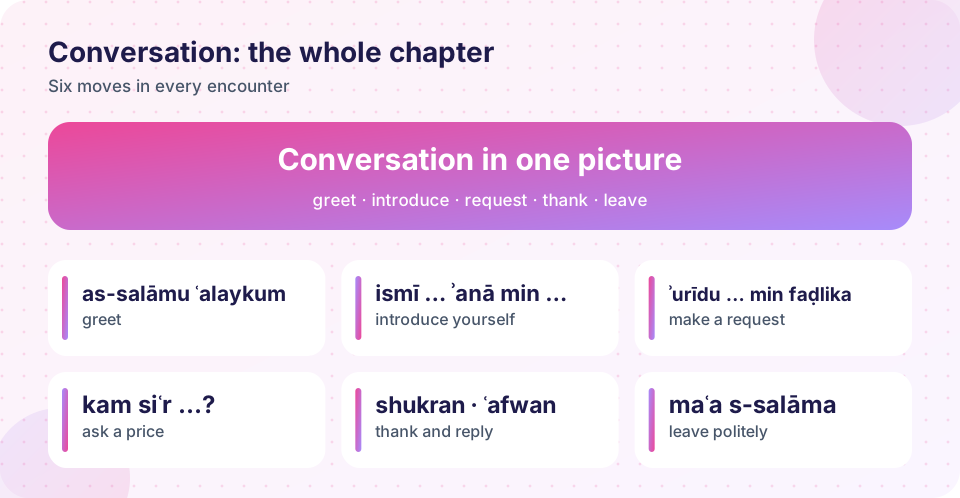
You can now do more than recite rules: you can greet someone, introduce yourself, order a coffee, ask for directions, and talk about why Arabic sounds different from town to town. This review gathers the chapter into one table, suggests a short routine for practice, and then tests you with mixed questions.
The chapter in one picture: greet, introduce, request, ask a price, thank and leave. What you will learn#
A one-page recap of the chapter
A simple way to rehearse conversation every day
How well you can recall and use the phrases
Chapter recap#
Topic
Key phrases
Remember
Greetings
السَّلَامُ عَلَيْكُمْ , صَبَاحُ الخَيْرِ , مَرْحَبًا , أَهْلًا وَسَهْلًا Learn greetings with their replies
How are you?
كَيْفَ حَالُكَ؟ / كَيْفَ حَالُكِ؟ , بِخَيْرٍ، الحَمْدُ لِلَّهِ -ka for a man, -ki for a woman
Polite words
شُكْرًا , عَفْوًا , مِنْ فَضْلِكَ , لَوْ سَمَحْتَ , آسِف / آسِفَة Politeness opens doors
Introductions
اسْمِي , أَنَا مِنْ , أَنَا طَالِب / طَالِبَة , عُمْرِي , أَسْكُنُ فِي Add ة for a woman's job
Market and café
كَمْ سِعْر ...؟ , أُرِيدُ ... مِنْ فَضْلِكَ , بِدُونِ , الحِسَاب Swap the nouns
Travel
أَيْنَ المَحَطَّة؟ , عَلَى اليَمِين , مُسْتَقِيم , تَذْكِرَة Use question words first
Language and culture
فُصْحَى and dialects; hospitality; كُلّ عَام وَأَنْتُمْ بِخَيْر Observe and adapt
A three-minute conversation routine#
Practice this script aloud once a day, changing the details each time:
Greet and reply. Say a greeting, then answer yourself with the proper reply.Introduce yourself. Four sentences: name, country, job or study, where you live.Make a request. Order something, ask a price, or ask for directions with لَوْ سَمَحْتَ .Close politely. شُكْرًا , عَفْوًا , مَعَ السَّلَامَةِ .
Record yourself on your phone once a week. Listening to your own voice reveals which sounds and endings you still skip.
Diagnose yourself#
Compare your quiz result with these areas.
Greetings and replies (quiz 1 and 8). Return to the greeting table and practice each pair aloud, saying both sides yourself.Gender in polite words (quiz 2 and 9). Make a small table: please (مِنْ فَضْلِكَ to a man, مِنْ فَضْلِكِ to a woman) and sorry (آسِف a man speaking, آسِفَة a woman speaking).Introductions (quiz 3). Write five sentences about yourself and say them aloud twice.Shopping, café and travel phrases (quiz 4, 5, 6 and 10). Reread the scenes and rewrite one of them with different nouns.Language and culture (quiz 7 and 8). Reread the dialects lesson and explain in your own words what fuṣḥā is and why dialects exist.
An example of a complete exchange#
Here is a self-contained mini conversation that uses everything in the chapter. A learner enters a small shop, greets the owner, asks the price and leaves politely.
السَّلَامُ عَلَيْكُمْ. (Peace be upon you.) / وَعَلَيْكُمُ السَّلَامُ. تَفَضَّلْ. (And upon you peace. Please, go ahead.) / لَوْ سَمَحْتَ، بِكَمْ هَذَا الكِتَاب؟ (Excuse me, how much is this book?) / عَشَرَة دَنَانِير. (Ten dinars.) / حَسَنًا، أُرِيدُ هَذَا الكِتَاب مِنْ فَضْلِكَ. (Okay, I want this book, please.) / تَفَضَّلْ. (Here you are.) / شُكْرًا. مَعَ السَّلَامَةِ. (Thank you. Goodbye.) / عَفْوًا. مَعَ السَّلَامَةِ. (You are welcome. Goodbye.)
In eight short turns, the learner has used a greeting, a polite opener, a question about price, a request and a goodbye. That is a genuine, complete transaction in Arabic.
Next steps for conversation#
Find someone to practice with. Ask a language partner or tutor to role-play the scenes and to correct you gently. Try a short voice message to a friend each day. Watch a few minutes of a program with subtitles and write down any greeting or phrase you hear. Small, regular contact with real Arabic is what turns the phrases you studied into a language you can use.
Practice that goes beyond the quiz#
A quiz checks recognition. Real progress comes from speaking. This week, have at least three real or simulated conversations in Arabic, even if they are only two minutes each. They could be with a tutor, a language partner, a recording of your own voice or even a role-play with a friend who does not speak Arabic, who can read the English lines while you answer in Arabic. After each conversation, write down two phrases that went well and one that you want to improve. That small habit gives you a list of next steps and a record of your progress.
Try it#
Choose the correct phrase for each situation.
Situations
Reset
< divstyle = " max-width : 620px; margin : 0 auto" > < divclass = " row" style = " justify-content : space-between; margin : 0 0 10px" > < spanclass = " mut" id = " prog" > </ span> < spanclass = " mut" id = " score" > </ span> </ div> < divclass = " card" style = " text-align : center" > < divclass = " ar" lang = " ar" dir = " rtl" id = " q" style = " font-size : 34px; line-height : 1.6" > </ div> < divid = " tr" class = " mut" style = " margin-top : 4px" > </ div> < divid = " en" style = " margin-top : 4px; color : #475569" > </ div> < divclass = " row" id = " opts" > </ div> < divid = " fb" style = " margin-top : 10px; font-weight : 600; min-height : 24px" > </ div> < divclass = " row" > < buttonclass = " go" id = " next" style = " display : none" > </ button> </ div> </ div> </ div> < style>
* { box-sizing : border-box}
body { margin : 0; padding : 14px; font-family : system-ui, 'Segoe UI' , sans-serif; background : linear-gradient ( 135deg, #faf5ff, #eff6ff) ; color : #1e1b4b}
.ar { font-family : 'Noto Naskh Arabic' , 'Segoe UI' , 'Traditional Arabic' , Amiri, serif}
button { font : inherit; font-size : 15px; border : 0; border-radius : 999px; padding : 8px 16px; cursor : pointer; background : #fff; color : #1e1b4b; box-shadow : 0 2px 8px rgba ( 67, 56, 202, .18) }
button:hover { transform : translateY ( -1px) }
button.yes { background : linear-gradient ( 135deg, #10b981, #14b8a6) ; color : #fff}
button.no { background : linear-gradient ( 135deg, #f59e0b, #ef4444) ; color : #fff}
button.go { background : linear-gradient ( 135deg, #6366f1, #a78bfa) ; color : #fff}
.card { background : #fff; border-radius : 20px; box-shadow : 0 10px 24px rgba ( 67, 56, 202, .16) ; padding : 18px}
.row { display : flex; gap : 10px; flex-wrap : wrap; align-items : center; justify-content : center; margin-top : 12px}
.mut { color : #475569; font-size : 14px}
</ style> < script>
const items = [ { "q" : "صَبَاحُ الخَيْرِ" , "en" : "Reply to \"good morning\"." , "options" : [ "صَبَاحُ النُّورِ" , "مَسَاءُ النُّورِ" , "عَفْوًا" ] , "answer" : 0 , "tr" : "ṣabāḥ an-nūr" , "note" : "Good becomes light." } , { "q" : "___ سُكَّر" , "en" : "Without sugar, please." , "options" : [ "مَعَ" , "بِدُونِ" , "إِلَى" ] , "answer" : 1 , "tr" : "bi-dūni sukkar" , "note" : "bi-dūni = without." } , { "q" : "لَوْ سَمَحْتَ، ___ المَحَطَّة؟" , "en" : "Excuse me, where is the station?" , "options" : [ "مَتَى" , "كَيْفَ" , "أَيْنَ" ] , "answer" : 2 , "tr" : "law samaḥta, ʾayna l-maḥaṭṭa?" , "note" : "ʾayna = where." } , { "q" : "أَنَا ___ (a woman: I am a teacher)" , "en" : "I am a teacher." , "options" : [ "مُعَلِّم" , "مُعَلِّمَة" , "مُعَلِّمُونَ" ] , "answer" : 1 , "tr" : "ʾanā muʿallima" , "note" : "Add ة for a woman." } , { "q" : "كُلّ عَام ___ بِخَيْر" , "en" : "May you be well every year." , "options" : [ "وَأَنْتُمْ" , "وَهُمْ" , "وَأَنَا" ] , "answer" : 0 , "tr" : "kull ʿām wa-ʾantum bi-khayr" , "note" : "A festival greeting used by many." } , { "q" : "عَلَى ___ ثُمَّ مُسْتَقِيم" , "en" : "To the left, then straight." , "options" : [ "اليَمِين" , "اليَسَار" , "القَرِيب" ] , "answer" : 1 , "tr" : "ʿalā l-yasār thumma mustaqīm" , "note" : "al-yasār = the left." } ] ;
const $ = id => document. getElementById ( id) ;
let i = 0 , score = 0 , answered = false ;
function show ( ) {
const it = items[ i] ; answered = false ;
if ( ! it) { $ ( 'q' ) . textContent = '' ; $ ( 'tr' ) . textContent = '' ; $ ( 'en' ) . textContent = 'Finished: ' + score + ' of ' + items. length + ' correct.' ; $ ( 'opts' ) . innerHTML = '' ; $ ( 'fb' ) . textContent = '' ; $ ( 'next' ) . style. display = 'none' ; $ ( 'prog' ) . textContent = '' ; return ; }
$ ( 'prog' ) . textContent = 'Question ' + ( i + 1 ) + ' of ' + items. length; $ ( 'score' ) . textContent = 'Score ' + score;
$ ( 'q' ) . textContent = it. q; $ ( 'tr' ) . textContent = '' ; $ ( 'en' ) . textContent = it. en; $ ( 'fb' ) . textContent = '' ; $ ( 'next' ) . style. display = 'none' ;
$ ( 'opts' ) . innerHTML = '' ;
it. options. forEach ( ( o, k ) => { const b = document. createElement ( 'button' ) ; b. className = 'ar' ; b. lang = 'ar' ; b. dir = 'rtl' ; b. style. fontSize = '24px' ; b. textContent = o; b. onclick = ( ) => pick ( k, b) ; $ ( 'opts' ) . appendChild ( b) ; } ) ;
}
function pick ( k, b ) {
if ( answered) return ; answered = true ; const it = items[ i] ;
if ( k === it. answer) { score++ ; b. className += ' yes' ; $ ( 'fb' ) . style. color = '#059669' ; $ ( 'fb' ) . textContent = 'Correct. ' + ( it. note || '' ) ; }
else { b. className += ' no' ; $ ( 'fb' ) . style. color = '#dc2626' ; $ ( 'fb' ) . textContent = 'Not quite. The answer is ' + it. options[ it. answer] + '. ' + ( it. note || '' ) ; }
$ ( 'tr' ) . textContent = it. tr || '' ; $ ( 'score' ) . textContent = 'Score ' + score; $ ( 'next' ) . style. display = '' ;
}
$ ( 'next' ) . onclick = ( ) => { i++ ; show ( ) ; } ;
show ( ) ;
</ script>
Now match the phrases with their meanings.
Phrases and meanings
Reset
< divstyle = " max-width : 640px; margin : 0 auto" > < divclass = " row" style = " justify-content : space-between; margin : 0 0 10px" > < spanclass = " mut" > </ span> < spanclass = " mut" id = " score" > </ span> </ div> < divstyle = " display : grid; grid-template-columns : 1fr 1fr; gap : 10px" > < divid = " L" style = " display : grid; gap : 8px" > </ div> < divid = " R" style = " display : grid; gap : 8px" > </ div> </ div> < divclass = " row" > < buttonclass = " go" id = " re" > </ button> </ div> </ div> < style>
* { box-sizing : border-box}
body { margin : 0; padding : 14px; font-family : system-ui, 'Segoe UI' , sans-serif; background : linear-gradient ( 135deg, #faf5ff, #eff6ff) ; color : #1e1b4b}
.ar { font-family : 'Noto Naskh Arabic' , 'Segoe UI' , 'Traditional Arabic' , Amiri, serif}
button { font : inherit; font-size : 15px; border : 0; border-radius : 999px; padding : 8px 16px; cursor : pointer; background : #fff; color : #1e1b4b; box-shadow : 0 2px 8px rgba ( 67, 56, 202, .18) }
button:hover { transform : translateY ( -1px) }
button.yes { background : linear-gradient ( 135deg, #10b981, #14b8a6) ; color : #fff}
button.no { background : linear-gradient ( 135deg, #f59e0b, #ef4444) ; color : #fff}
button.go { background : linear-gradient ( 135deg, #6366f1, #a78bfa) ; color : #fff}
.card { background : #fff; border-radius : 20px; box-shadow : 0 10px 24px rgba ( 67, 56, 202, .16) ; padding : 18px}
.row { display : flex; gap : 10px; flex-wrap : wrap; align-items : center; justify-content : center; margin-top : 12px}
.mut { color : #475569; font-size : 14px}
</ style> < style> .it { padding : 10px 12px; border-radius : 14px; background : #fff; box-shadow : 0 2px 8px rgba ( 67, 56, 202, .18) ; cursor : pointer; text-align : center; min-height : 44px; display : flex; align-items : center; justify-content : center; border : 2px solid transparent} .it.sel { border-color : #6366f1; background : #eef2ff} .it.ok { background : #d1fae5; border-color : #10b981; cursor : default} .it.bad { background : #fee2e2; border-color : #ef4444} </ style> < script>
const pairs = [ [ "لَوْ سَمَحْتَ" , "excuse me, please" ] , [ "تَشَرَّفْنَا" , "pleased to meet you" ] , [ "حَاضِر" , "right away" ] , [ "مَعَ السَّلَامَةِ" , "goodbye" ] , [ "الحِسَاب مِنْ فَضْلِكَ" , "the bill, please" ] , [ "عَلَى اليَمِين" , "to the right" ] ] ;
const $ = id => document. getElementById ( id) ;
let sel = null , done = 0 , miss = 0 ;
function shuffle ( a ) { a = a. slice ( ) ; for ( let i = a. length - 1 ; i > 0 ; i-- ) { const j = Math. floor ( Math. random ( ) * ( i + 1 ) ) ; [ a[ i] , a[ j] ] = [ a[ j] , a[ i] ] ; } return a; }
function setup ( ) {
sel = null ; done = 0 ; miss = 0 ; $ ( 'L' ) . innerHTML = '' ; $ ( 'R' ) . innerHTML = '' ;
pairs. forEach ( ( p, i ) => { const d = document. createElement ( 'div' ) ; d. className = 'it ar' ; d. lang = 'ar' ; d. dir = 'rtl' ; d. style. fontSize = '24px' ; d. textContent = p[ 0 ] ; d. dataset. i = i; d. onclick = pick; $ ( 'L' ) . appendChild ( d) ; } ) ;
shuffle ( pairs. map ( ( p, i ) => i) ) . forEach ( i => { const d = document. createElement ( 'div' ) ; d. className = 'it' ; d. textContent = pairs[ i] [ 1 ] ; d. dataset. i = i; d. onclick = pick; $ ( 'R' ) . appendChild ( d) ; } ) ;
upd ( ) ;
}
function upd ( ) { $ ( 'score' ) . textContent = done + ' of ' + pairs. length + ' matched, ' + miss + ' misses' + ( done === pairs. length ? ' - well done!' : '' ) ; }
function pick ( e ) {
const el = e. currentTarget; if ( el. classList. contains ( 'ok' ) ) return ;
const side = el. parentElement. id;
if ( ! sel || sel. parentElement. id === side) { if ( sel) sel. classList. remove ( 'sel' ) ; sel = el; el. classList. add ( 'sel' ) ; return ; }
if ( sel. dataset. i === el. dataset. i) { sel. classList. remove ( 'sel' ) ; sel. classList. add ( 'ok' ) ; el. classList. add ( 'ok' ) ; done++ ; }
else { miss++ ; const a = sel, b = el; a. classList. add ( 'bad' ) ; b. classList. add ( 'bad' ) ; setTimeout ( ( ) => { a. classList. remove ( 'bad' , 'sel' ) ; b. classList. remove ( 'bad' ) ; } , 500 ) ; }
sel = null ; upd ( ) ;
}
$ ( 're' ) . onclick = setup; setup ( ) ;
</ script>
Check your understanding#
1. What is the reply to صَبَاحُ الخَيْرِ?
A
صَبَاحُ النُّورِ
B
مَسَاءُ النُّورِ
C
عَفْوًا
2. Which phrase means "please" when speaking to a woman?
A
مِنْ فَضْلِكَ
B
لَوْ سَمَحْتَ
C
مِنْ فَضْلِكِ
3. How do you say "My name is Sami"?
A
اسْمُكَ سَامِي
B
اسْمِي سَامِي
C
سَامِي أَنَا مِنْ
4. What does بِدُونِ mean?
A
with
B
from
C
without
5. How do you ask "Where is the station?"
A
مَتَى المَحَطَّة؟
B
أَيْنَ المَحَطَّة؟
C
مَنْ المَحَطَّة؟
6. How do you ask politely for the bill?
A
الحِسَاب أَهْلًا
B
الحِسَاب مِنْ فَضْلِكَ
C
الحِسَاب شُكْرًا
7. What is fuṣḥā?
A
A dialect spoken only at home
B
Modern Standard Arabic, the shared written and formal language
C
The Egyptian dialect
8. Which greeting is kind and safe for many kinds of festivals?
A
مَعَ السَّلَامَةِ
B
تَشَرَّفْنَا
C
كُلّ عَام وَأَنْتُمْ بِخَيْر
9. How does a man say "I am sorry"?
A
آسِفَة
B
آسِف
C
آسِفُونَ
10. What does عَلَى اليَسَار mean?
A
to the right
B
straight ahead
C
to the left
Summary#
Greetings come in pairs; polite words and the right "you" ending matter.
Market, café and travel scenes reuse the same patterns with different nouns.
Standard Arabic is shared; dialects are spoken varieties; customs vary across a diverse region.
Rehearse a three-minute routine aloud every day.
Next: Project: your Arabic self-introduction