


















Lesson 39 of 45 · Conversation and Culture
Dialects, Culture and Etiquette
Understand the difference between Modern Standard Arabic and spoken dialects, compare everyday words across regions and learn basic etiquette and customs.
Sooner or later, every Arabic learner has the same experience. You learn a phrase from a textbook, say it to a native speaker, and they smile and answer with a different word. You did nothing wrong: you met the biggest feature of the Arabic language world, diglossia. There is a shared standard language for writing and formal speech, and there are many spoken varieties for everyday life. Understanding this will save you confusion and help you choose what to learn next.
This lesson explains how the standard and the dialects relate, shows how a few everyday words change from place to place, and gives you a respectful introduction to customs you may meet in Arabic-speaking communities. Remember that the Arab world is large and diverse, from Morocco in the west to Oman in the east, and no single description fits everywhere.
What you will learn
- What Modern Standard Arabic and the dialects are, and when each is used
- How everyday words differ across five regions
- Why learning the standard first is a good choice
- Basic hospitality, greeting and seasonal customs, with the phrases to go with them
Key terms
Diglossia: a situation in which two forms of one language are used in different settings: a formal one and an everyday one.
Fuṣḥā (الفُصْحَى): Modern Standard Arabic, used in writing, news, formal speeches and education.
ʿĀmmiyya (العَامِّيَّة) or lahja (لَهْجَة): the spoken dialects.
Code-switching: moving between standard and dialect, or between languages, within a conversation.
Standard Arabic and the dialects
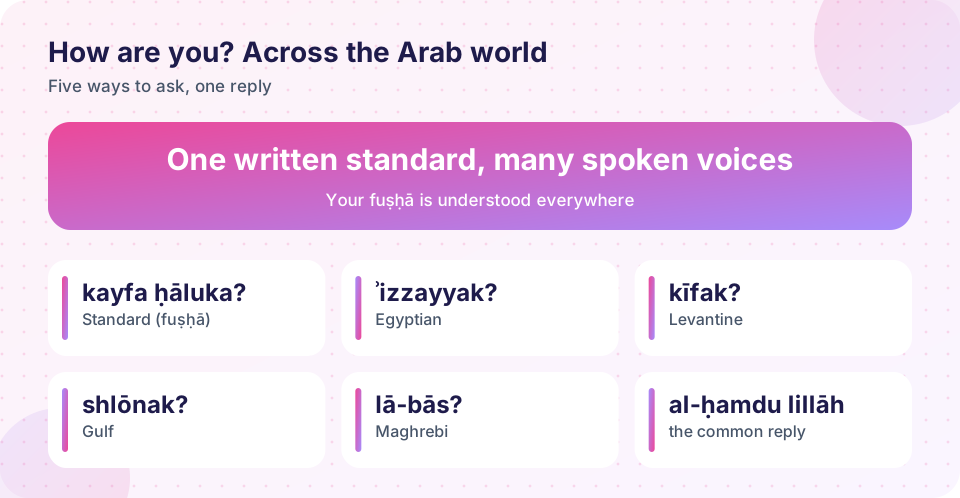
Modern Standard Arabic (fuṣḥā) is what this course teaches. It is the language of books, newspapers, official documents, news broadcasts, university lectures, speeches and much of the media. It is shared across more than twenty countries, so an educated person in Morocco and one in Iraq can read the same newspaper.
The dialects are the languages of home, the street and the market. They are what people learn first as children. They differ in pronunciation, vocabulary and some grammar, and they are traditionally spoken rather than written, so their spelling is not standardized. Common groupings include Maghrebi (Morocco, Algeria, Tunisia), Egyptian, Levantine (Syria, Lebanon, Palestine, Jordan), Gulf (Saudi Arabia's east and the Gulf states), Iraqi, Sudanese and Yemeni, and each of these has local variations.
In real life, the two blend. A television host reads the news in fuṣḥā and chats in a dialect on a talk show. A professor lectures in a mixture. Many people speak a relaxed "educated" style that borrows from both. Egyptian Arabic is understood by many people across the region, partly because of decades of Egyptian films and television, but everyone first learns the dialect of their own home.
Everyday words across regions
The table below compares a few words. Dialect forms are given in transliteration because their spelling varies; the standard form is shown in Arabic. Listen for these when you travel or watch media.
| Meaning | Standard | Egyptian | Levantine | Gulf | Moroccan |
|---|---|---|---|---|---|
| now | الآنَ (al-ʾān) | dilwaʾti | halla | al-ḥīn | dāba |
| what | مَاذَا (mādhā) | ʾēh | shū | wish / shinū | ashnū |
| I want | أُرِيدُ (ʾurīdu) | ʿāyiz (m.) | biddī | ʾabghā | bghīt |
| good | جَيِّد (jayyid) | kwayyis | mnīḥ | zayn | mzyān |
| How are you? | كَيْفَ حَالُكَ؟ | ʾizzayyak? | kīfak? | shlōnak? | lā-bās? |
Not all of these are used in every country of the region, and each has variants, so treat the table as a sample. The grammar you learned, from لَا to the possessive endings, remains the backbone of all of them. Dialects simplify a few things, for example by dropping many endings and the dual, but they use the same roots, so your vocabulary transfers well.
Which should I learn?
Learn fuṣḥā first, then add a dialect for your goals:
- If you want to read, write, follow news, study or work in Arabic, fuṣḥā is essential.
- If you want to chat with friends or travel, add the dialect of the place you care about. Egyptian and Levantine have the most learning material.
- Using fuṣḥā in speech is always understood, though it can sound formal in casual settings, a bit like speaking in the style of a written essay at a café. Locals usually react with kindness and often answer in a simplified dialect.
Culture and etiquette
These are general tendencies, not rules for everyone. Customs vary with country, family, city or village, religion and personal style. Observe, and when in doubt, ask politely.
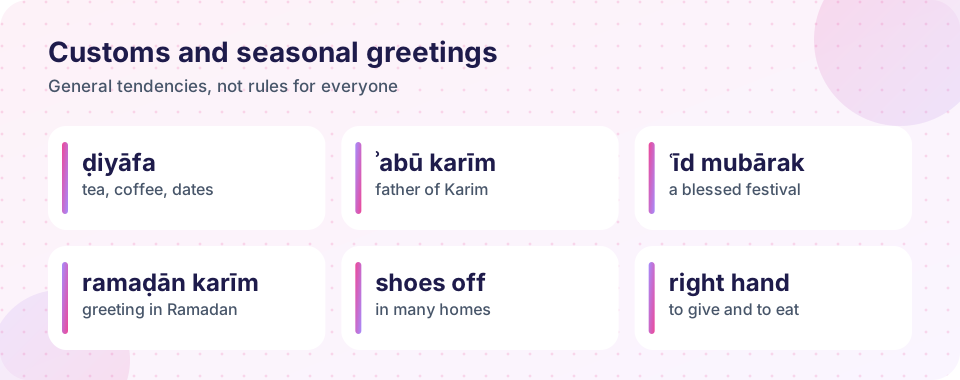
Hospitality (ضِيَافَة, ḍiyāfa)
Hosting guests is a point of pride in many communities. You may be offered tea, coffee, dates or sweets as soon as you sit down. It is polite to accept at least a little. Hosts often insist several times, and a refusal may be repeated for politeness, so a warm شُكْرًا with a hand on your heart is a gentle way to decline. In some places, small cups of Arabic coffee are refilled until you gently shake the cup to signal you have had enough.
Greetings and gestures
Handshakes are common among men, and people often add a few warm words. Some people do not shake hands with the opposite gender for personal or religious reasons: wait for the other person to offer, or place your right hand over your heart and nod. Using the right hand to give, receive and eat is the traditional courtesy.
In the home
In many homes you remove your shoes at the door, and you may be asked to sit in a particular place. It is considerate to bring a small gift, such as sweets or fruit.
Names
You may hear أَبُو كَرِيم (ʾabū karīm, "father of Karim") or أُمّ سَارَة (ʾumm sāra, "mother of Sara"): a respectful way to address a parent by the name of their eldest child. Formal names often include ابْن or بِنْت (son of, daughter of) and a family name.
Seasonal greetings
- كُلّ عَام وَأَنْتُمْ بِخَيْر (kull ʿām wa-ʾantum bi-khayr): "may you be well every year", a warm greeting for birthdays and festivals, used by speakers of all faiths.
- رَمَضَان كَرِيم (ramaḍān karīm) or رَمَضَان مُبَارَك (ramaḍān mubārak): greetings during Ramadan, the month of fasting for Muslims.
- عِيد مُبَارَك (ʿīd mubārak): a blessed festival, said at the Muslim festivals ʿĪd al-Fiṭr and ʿĪd al-Aḍḥā.
The Arab world is home to Muslims, Christians, Druze, Jews and others, and each community has its own festivals. When someone celebrates, a friendly كُلّ عَام وَأَنْتُمْ بِخَيْر is a safe and kind choice.
Common misconceptions
"Dialects are broken Arabic." They are complete, rule-governed varieties with their own rich culture, just as English spoken in Scotland and Texas are both English.
"Arabic speakers cannot understand each other." Understanding varies. Neighboring dialects are usually mutually understandable, and distant ones (such as Moroccan and Gulf) can be difficult at first, but media, school and fuṣḥā provide common ground.
"Standard Arabic is useless for conversation." It is understood everywhere and is the key to reading and writing. Many learners start with fuṣḥā and add a dialect afterwards.
"All Arabs share one religion or one culture." The Arab world is diverse in religion, history, food and customs.
Try it
Flip through everyday dialect words. The spelling is a common one; dialect spelling varies. The English side tells you the meaning and the region.
Now match each dialect word with its meaning and region.
Check your understanding
Quick check · 5 questions
of 5 answered You scored / 5 · perfect!
-
1. What is diglossia?
In Arabic, a standard form (fuṣḥā) is used in formal settings and dialects in daily life. -
2. Which variety does this course teach?
Modern Standard Arabic (fuṣḥā) is shared across the Arab world and is the key to reading and writing. -
3. What is a polite way to decline a second cup of tea you do not want?
A warm thanks with a friendly gesture is a gentle, polite refusal. -
4. What does أَبُو كَرِيم mean?
ʾabū is "father of"; parents are often addressed by the eldest child's name. -
5. What is a kind, safe greeting for a festival if you are unsure of someone's religion?
kull ʿām wa-ʾantum bi-khayr is used for many kinds of celebrations.
Summary
- Arabic has a shared standard form (فُصْحَى) and many spoken dialects.
- Everyday words differ by region, but roots and grammar transfer.
- Learn the standard first, then add a dialect for your goals.
- Hospitality, respectful gestures and seasonal greetings matter; watch, ask and adapt.
- The Arab world is diverse, so avoid assuming one custom fits all.
Next: Conversation review
Track your progress
Create a free account to tick off lessons and pick up where you left off on any device.
of Arabic for Beginners lessons completed