


















Lesson 25 of 45 · Present Tense Verbs
Negation, Wishes and the Future
Say what you do not do, what you want to do and what you will do in Arabic, using lā, ʾan, sa- and lan with the present tense.
Knowing how to conjugate a verb lets you describe facts. Real conversation needs more: I do not know, I want to go, I must leave, we will meet tomorrow. Arabic handles all of these with a few tiny words placed in front of the present-tense verb. The verb itself stays recognizable, but its last vowel sometimes changes. This lesson explains exactly when and how.
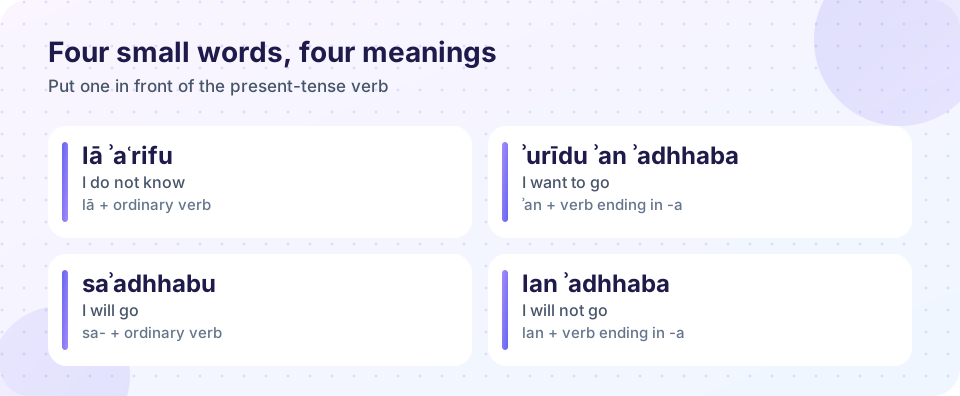
Think of the present tense as a base form and of لَا (lā), أَنْ (ʾan), سَـ (sa-) and لَنْ (lan) as four switches that change the meaning.
What you will learn
- How to negate a present-tense verb with لَا
- How to say I want to, I like to, I must and I can with أَنْ
- How the verb ending changes after أَنْ (the subjunctive)
- How to talk about the future with سَـ, سَوْفَ and لَنْ
Key terms
Negation: making a statement mean the opposite, like not in English.
Particle: a small word, such as لَا or أَنْ, that changes the meaning of the verb after it.
Subjunctive (manṣūb): the form of the present tense used after أَنْ and لَنْ. The final damma becomes a fatha.
Indicative (marfūʿ): the ordinary present-tense form you learned in the last lesson.
The four small words
1. Negation with لَا
To say do not, put لَا before the verb. Nothing else changes, not even the ending. That makes it the easiest rule in this lesson.
- أَعْرِفُ (ʾaʿrifu, I know) → لَا أَعْرِفُ (lā ʾaʿrifu, I do not know)
- هِيَ تَفْهَمُ (hiya tafhamu) → هِيَ لَا تَفْهَمُ (hiya lā tafhamu, she does not understand)
- نَحْنُ نَشْرَبُ القَهْوَة → نَحْنُ لَا نَشْرَبُ القَهْوَة (naḥnu lā nashrabu l-qahwa, we do not drink coffee)
You can strengthen it with أَبَدًا (ʾabadan, never, at all): لَا أَشْرَبُ القَهْوَة أَبَدًا (I never drink coffee). The same لَا also gives a polite warning when paired with a command form: لَا تَذْهَبْ (lā tadhhab, do not go), لَا تَذْهَبِي (lā tadhhabī, do not go, to a woman). You will see more of these in the conversation chapter.
Adverbs that end in -an, such as أَبَدًا, دَائِمًا (dāʾiman, always), أَحْيَانًا (ʾaḥyānan, sometimes), غَدًا (ghadan, tomorrow) and جَيِّدًا (jayyidan, well), keep that ending because it is part of how the adverb is written. Place them near the end of the sentence.
2. Wanting, liking, needing: أَنْ plus the verb
When two verbs follow each other in English we use to: I want to go. Arabic uses the little word أَنْ (ʾan, that, to) between them, and the second verb is conjugated for its own subject:
- أُرِيدُ أَنْ أَذْهَبَ (ʾurīdu ʾan ʾadhhaba): I want to go. Literally, "I want that I go."
- هِيَ تُرِيدُ أَنْ تَشْرَبَ المَاء (hiya turīdu ʾan tashraba l-māʾ): she wants to drink water.
- نُحِبُّ أَنْ نَلْعَبَ (nuḥibbu ʾan nalʿaba): we like to play.
- يَجِبُ أَنْ أَدْرُسَ (yajibu ʾan ʾadrusa): I must study. يَجِبُ is a fixed form meaning it is necessary.
- أَسْتَطِيعُ أَنْ أَسْبَحَ (ʾastaṭīʿu ʾan ʾasbaḥa): I can swim.
The first verb carries the wish, the need or the ability and takes its normal prefix and ending (أُرِيدُ means I want, تُرِيدُ means she wants). The verb after أَنْ matches the person who will do the action.
The ending change after أَنْ
After أَنْ, the present-tense verb switches to its subjunctive form. There are three simple changes:
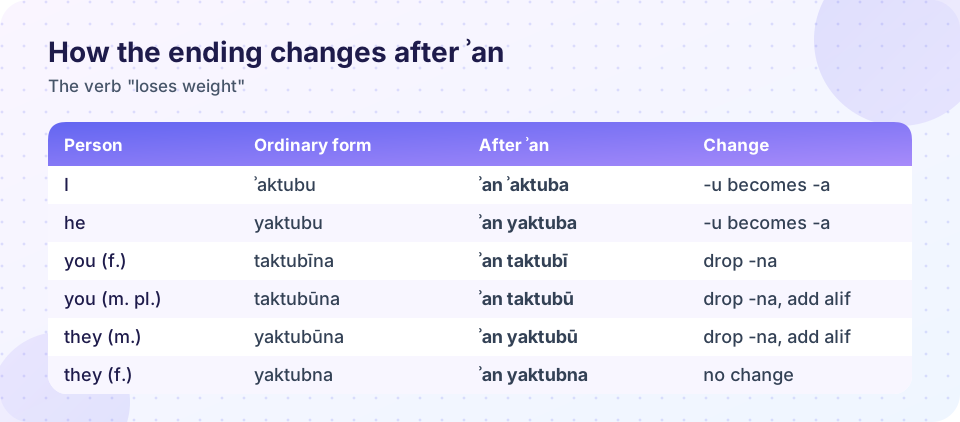
- A final damma becomes a fatha: يَكْتُبُ → أَنْ يَكْتُبَ.
- The endings -īna and -ūna lose their final nūn: تَكْتُبِينَ → أَنْ تَكْتُبِي; يَكْتُبُونَ → أَنْ يَكْتُبُوا. The masculine plural also gains a silent alif, written but not pronounced.
- The feminine plural ending -na does not change: يَكْتُبْنَ → أَنْ يَكْتُبْنَ.
A memory trick: the verb "loses weight" after أَنْ. Its heavy final nūn drops away, and a final damma lightens into fatha.
Full list for كَتَبَ after أَنْ: أَكْتُبَ (I), تَكْتُبَ (you m.), تَكْتُبِي (you f.), يَكْتُبَ (he), تَكْتُبَ (she), نَكْتُبَ (we), تَكْتُبُوا (you m. pl.), تَكْتُبْنَ (you f. pl.), يَكْتُبُوا (they m.), يَكْتُبْنَ (they f.).
Example with a plural subject: هُمْ يُرِيدُونَ أَنْ يَسْكُنُوا فِي القَاهِرَة (hum yurīdūna ʾan yaskunū fī l-qāhira): they want to live in Cairo. Notice that the first verb keeps its -ūna (it is an ordinary present tense), while the second drops the nūn.
3. The future with سَـ, سَوْفَ and لَنْ
Attach سَـ to the front of an ordinary present-tense verb to make a near future: سَأَذْهَبُ (saʾadhhabu, I will go). Use سَوْفَ as a separate word, which is often felt as a more distant or more formal future: سَوْفَ أَذْهَبُ (sawfa ʾadhhabu). To keep things simple, stay with سَـ for now.
For a negative future, use لَنْ (lan) before the subjunctive: لَنْ أَذْهَبَ (lan ʾadhhaba, I will not go), لَنْ يُسَافِرَ (lan yusāfira, he will not travel). So the pair is: سَأَذْهَبُ (I will go, ending -u) and لَنْ أَذْهَبَ (I will not go, ending -a). Compare the endings and you can instantly tell the two apart.
Worked example: building a longer sentence step by step
Suppose you want to say I do not want to go tomorrow. Break it into small decisions, left to right, the way an Arabic speaker would assemble it.
- The main verb is want, first person: أُرِيدُ (ʾurīdu).
- To negate it, put لَا in front, and leave أُرِيدُ unchanged: لَا أُرِيدُ (lā ʾurīdu), "I do not want".
- The thing you do not want is to go. Add أَنْ and the verb go, first person, in its lighter form: أَنْ أَذْهَبَ (ʾan ʾadhhaba).
- Add the time word at the end: غَدًا (ghadan, tomorrow).
Result: لَا أُرِيدُ أَنْ أَذْهَبَ غَدًا. Notice how the negation attached to the wish and not to the going. If you want the opposite meaning, I want not to go, the negative moves inside: أُرِيدُ أَلَّا أَذْهَبَ (ʾurīdu ʾallā ʾadhhaba), where أَلَّا is أَنْ and لَا fused together. You will meet that form in reading before you need it in speech, so do not worry about it yet. The point is that Arabic lets you place the negative exactly where it belongs.
Polite requests and offers
The small words in this lesson are also the building blocks of polite speech. هَلْ تَسْتَطِيعُ أَنْ تُسَاعِدَنِي؟ (hal tastaṭīʿu ʾan tusāʿidanī?) means "Can you help me?". It is هَلْ (a yes/no question), plus تَسْتَطِيعُ (you can), plus أَنْ and the subjunctive تُسَاعِدَ, with the pronoun ending -nī (me) attached. The extra n before the ī is a small helper sound that Arabic adds to a verb that ends in a pronoun ending. You do not need to analyze it now: learn the whole request as one chunk, then swap parts. هَلْ تُرِيدُ أَنْ تَشْرَبَ شَايًا؟ (hal turīdu ʾan tashraba shāyan?) offers someone a cup of tea. سَأَذْهَبُ مَعَكَ (saʾadhhabu maʿaka) promises "I will go with you".
How to practice this lesson
Make a three-column sentence maker on paper. In the first column write six wish or need phrases (أُرِيدُ أَنْ, أُحِبُّ أَنْ, يَجِبُ أَنْ, أَسْتَطِيعُ أَنْ, لَا أُرِيدُ أَنْ, لَنْ). In the second write six verbs you know. In the third write six everyday objects or places. Draw one item from each column and say the sentence aloud with the correct ending. Because you are adding only one new variable at a time, the endings become automatic, and after a week you will find yourself speaking in full sentences instead of single words.
Common misconceptions
"The verb after أَنْ stays unchanged." It does change: the final damma becomes fatha, and the nūn drops from -ūna and -īna. The first verb of the pair stays normal.
"I can use لَا for the future." The usual negative future is لَنْ plus the subjunctive, not لَا plus سَـ. Do not combine سَـ with لَا.
"Arabic has an infinitive like English to go." Arabic uses أَنْ plus a conjugated verb, or a verbal noun (مَصْدَر), which you will learn later.
Try it
Build the sentences by tapping the words in the correct order. Remember that Arabic reads from right to left, so the first word goes on the right.
Now decide which small word and verb ending fit. Think of the rule: سَـ and لَا take the ordinary form, while أَنْ and لَنْ take the lighter -a form.
Check your understanding
Quick check · 5 questions
of 5 answered You scored / 5 · perfect!
-
1. How do you say "I do not know"?
Present-tense negation uses lā plus the ordinary verb: lā ʾaʿrifu. -
2. What happens to the verb يَكْتُبُونَ after أَنْ?
The final nūn of -ūna drops and a silent alif is written: ʾan yaktubū. -
3. Which sentence means "She wants to drink water"?
The pattern is conjugated wish verb + ʾan + subjunctive verb. -
4. What is the difference between سَأَذْهَبُ and لَنْ أَذْهَبَ?
sa- gives a positive future; lan plus the subjunctive gives a negative future. -
5. Which ending does the verb take after لَنْ?
lan and ʾan both take the subjunctive, whose singular ending is a fatha.
Summary
- لَا + present verb = negation, with no change to the verb.
- أَنْ links two verbs (want to, like to, must, can); the second verb is subjunctive.
- The subjunctive turns a final damma into fatha and drops the nūn of -īna and -ūna.
- سَـ or سَوْفَ + present = future; لَنْ + subjunctive = negative future.
Next: Present tense review
Track your progress
Create a free account to tick off lessons and pick up where you left off on any device.
of Arabic for Beginners lessons completed