


















Lesson 6 of 45 · Letters and Sounds
Chapter 2 Overview: The Arabic Alphabet
See all 28 Arabic letters at once: their order, names, shape families, dot patterns and the six letters that never join forward, with an interactive explorer.
The Arabic alphabet looks like one long wave when you first meet it, but it is far more organized than it appears. There are 28 letters. Many of them share a basic shape and differ only by the number and position of dots, so you are really learning about 18 shapes rather than 28 unrelated symbols. This chapter takes the letters in small groups, links each to a sound you can produce and gives you words to practice. This overview shows you the whole map before we walk it.
What you will learn
- The names and order of all 28 letters.
- How shape families and dots reduce the work of learning them.
- Which six letters never join to the letter that follows.
- How the chapter's lessons are organized, and how to practice.
- How the traditional alphabetical order differs from the old abjad order.
Key terms
Letter name: each letter has a name (alif, bā', tā'...) and a sound; the name often starts with the sound, as in "bā'" for b.
Dots (nuqaṭ): one, two or three dots above or below a base shape that tell similar letters apart.
Shape family: letters that share the same body, like ب ت ث.
Non-joiner: a letter that connects to the letter before it but not to the one after it.
Isolated form: the letter written on its own, as in alphabet charts.
The alphabet in order
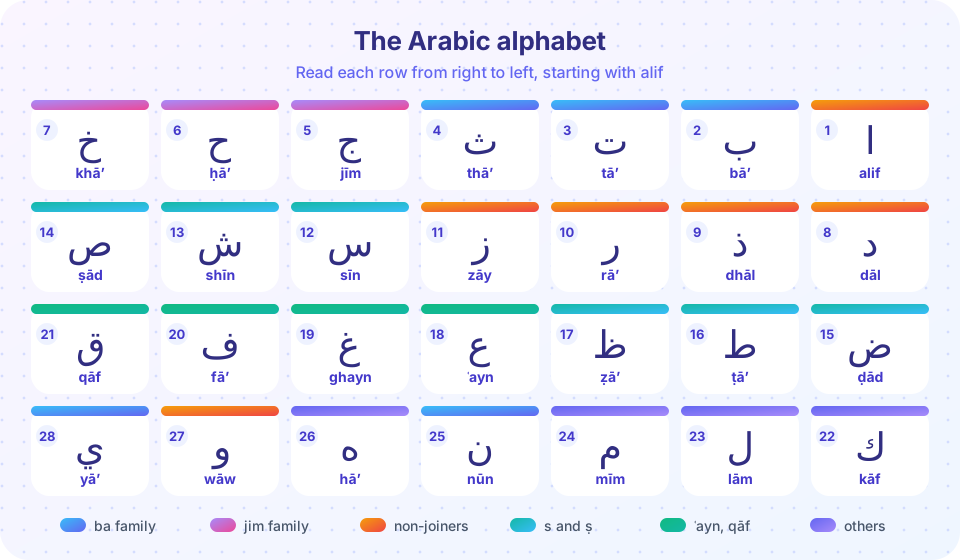
The alphabet below goes in the standard order, called al-ʾalifbāʾ al-hijāʾī ("the alphabetical order by shape"). Read right to left, row by row.
| 1 | 2 | 3 | 4 | 5 | 6 | 7 |
|---|---|---|---|---|---|---|
| ا alif | ب bā’ | ت tā’ | ث thā’ | ج jīm | ح ḥā’ | خ khā’ |
| د dāl | ذ dhāl | ر rā’ | ز zāy | س sīn | ش shīn | ص ṣād |
| ض ḍād | ط ṭā’ | ظ ẓā’ | ع ʿayn | غ ghayn | ف fā’ | ق qāf |
| ك kāf | ل lām | م mīm | ن nūn | ه hā’ | و wāw | ي yā’ |
(The table reads left to right in its columns, to keep the numbers in order. In real Arabic text each row would begin at the right edge.)
The order places similar shapes next to each other: ب ت ث, ج ح خ, د ذ, ر ز, س ش, ص ض, ط ظ, ع غ, ف ق. This is the order of the dictionary, the telephone book and the school register. A second, older order, the abjad order (أبجد هوز حطي ...), is the sequence the Phoenicians and early Semitic alphabets used. It survives in numbering systems and in some lists, but you will not need it for reading.
One more note: the hamza (ء), the glottal stop, is a sound that is written but is not counted as a 29th letter in most school lists. You will meet it in Chapter 3.
Shape families and dots
Look closely and you see only a handful of basic bodies:
- A bowl with dots: ب ت ث (and ن ي when they are in the middle of a word)
- A hook: ج ح خ
- A short stroke: د ذ
- A swoop below the line: ر ز و
- Teeth then a tail: س ش
- A loop-and-tail: ص ض
- A loop with an upright: ط ظ
- A head-and-tail: ع غ
- A small loop with a tail: ف ق
- Singles: ا ك ل م ه
The dots are part of the letter. Moving a dot changes the letter completely, so the number of dots and whether they sit above, below or inside the shape must be exact. When you write by hand, you complete the body of the whole word first and then add all the dots at the end.
| Dots | Letters |
|---|---|
| none | ا ح د ر س ص ط ع ك ل م ه و |
| one | ب ج خ ذ ز ض ظ غ ف ن |
| two | ت ق ي |
| three | ث ش |
The six that never join forward
Arabic letters normally join to their neighbors, but six letters refuse to connect to the letter that follows them: ا د ذ ر ز و. They connect to the letter before them, but after them there is always a small gap. This is a useful trick. When you see a gap in a word, it is either the end of a word or the end of one of these six letters. Chapter 3 shows exactly how joining works.
Sounds: familiar, twisty and new
For an English speaker, the 28 letters fall into three groups:
- Familiar (about 16): ب ت د ز س ش ف ك ل م ن ه و ي ج plus alif, a long vowel. They sound close to English letters.
- A small twist (5): ث ذ ر خ غ. The first two are the two "th" sounds of English; ر is rolled; خ and غ are throat sounds like a gargle.
- New (7): ح ع ق and the four "emphatic" letters ص ض ط ظ. You do not have these sounds in English, so they get extra attention.
What the chapter covers
| Lesson | Letters | Focus |
|---|---|---|
| Letters 1 to 9 | ا ب ت ث ج ح خ د ذ | Shapes, dots, the first throat sounds |
| Letters 10 to 17 | ر ز س ش ص ض ط ظ | The rolled r, plain and emphatic pairs |
| Letters 18 to 28 | ع غ ف ق ك ل م ن ه و ي | Deep throat sounds, long vowels, the map of the mouth |
| Chapter 2 Review | all 28 | Recap, big quiz |
In each lesson, learn the shape, the name and the sound together. Say the name aloud when you write it. Then practice with the words listed, which are chosen so that each letter appears in a real word you can use.
How to practice the letters
- Draw large first. Write each letter in a big size, thinking about the direction of your stroke. Right to left, always.
- Sound it out. Say the sound, then the name, three times.
- Mix and review. The flashcards below reshuffle all 28 letters; ten minutes a day is better than an hour once a week.
- Look for letters in the wild. Packaging, signs, song titles and your phone's keyboard are all free practice.
Why learning the alphabet is worth the effort
It is tempting to postpone the script and live in transliteration. Do not. Transliteration varies from book to book (qamar, kamar, 'amar), it cannot show the difference between ح and ه without special marks, and it slows you down permanently. The script, on the other hand, is a small system: 28 letters, a handful of rules, and a few weeks of practice. Learners who start the script at the beginning generally read their first simple texts within a month, and their pronunciation improves because each letter points to exactly one sound.
Try it
Press Run (or Ctrl + Enter) to see the result here.
Program input · what you'd type while the program runs
Type the answers before you press Run, one per line. Each time the program reads a line (with input()), it gets the next line from this box.
The explorer is a reference tool: tap letters to hear the pattern in your head, then try to say each one aloud. The sounds listed are approximations; the exact positions of the sounds are covered in the next three lessons.
Common misconceptions
"There are 28 completely different shapes." There are far fewer basic shapes; dots do most of the work of telling letters apart.
"The alphabet order is random." It is organized by shape, so related letters sit together. That order makes dictionary lookup possible.
"Dots are optional decoration." They are essential. ب ت ث ن ي look the same without them, and a missing dot changes the word.
Check your understanding
Quick check · 4 questions
of 4 answered You scored / 4 · perfect!
-
1. How many letters are in the standard Arabic alphabet?
There are 28 letters in the standard list; the hamza is treated separately. -
2. Which letters never join to the letter after them?
Alif, dāl, dhāl, rā', zāy and wāw join only backward. -
3. How many dots does the letter ث have?
Thā' has three dots above; shīn also has three. -
4. The standard alphabet order is based mainly on what?
The hijāʾī order places similar shapes together, such as ب ت ث and ج ح خ.
Summary
- The alphabet has 28 letters, ordered by shape families.
- Dots (none, one, two or three) separate letters that share a body.
- Six letters (ا د ذ ر ز و) never join to the next letter.
- About 16 letters feel familiar, 5 are twisted and 7 are new sounds.
- The next three lessons teach the letters in groups, with sounds and example words.
Track your progress
Create a free account to tick off lessons and pick up where you left off on any device.
of Arabic for Beginners lessons completed