


















Lesson 45 of 45 · Projects and Practice
Where to Go Next: Further Study in Arabic
Plan your next steps after Arabic for beginners: grammar to learn, reading, listening and speaking habits, dialect choices and related tracks on this site.
You have finished the beginner course. You can read and write the script, form present and past verbs, ask questions, count, tell the time, talk about family, food and places, hold a short conversation and say a little about yourself in a way that people appreciate. That is a real achievement in a language that many learners find demanding. This final lesson is a roadmap: what to learn next, how to practice, and how to keep going when progress feels slow.
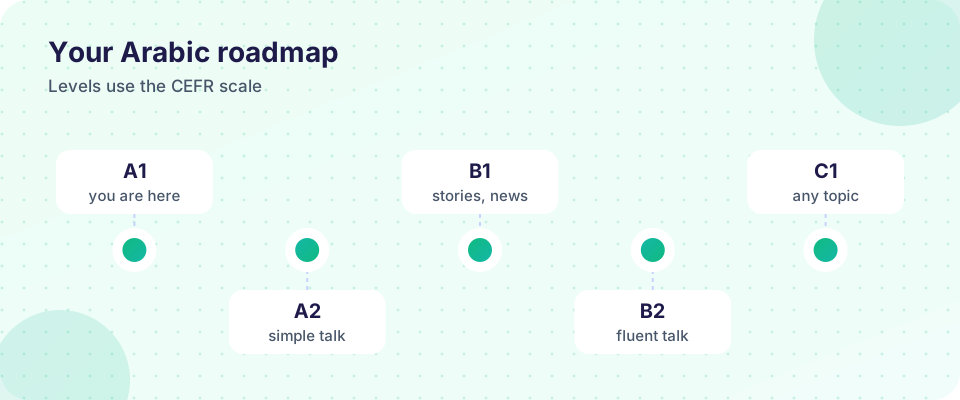
Language learning is a long game, and Arabic more than most. Language-training institutes rank Arabic among the more time-consuming languages for English speakers, and typical estimates for reaching professional working proficiency run well over a thousand hours of study. That sounds big, but it is built from small, regular sessions, and every session shows results long before the end.
What you will learn
- The grammar topics that come next
- A balanced weekly routine for reading, listening, speaking and writing
- How to choose a dialect and where to find real Arabic to read and hear
- How this course connects to other tracks on this site
Key terms
Graded reader: a book written with limited vocabulary and simple grammar for learners.
Spaced repetition: reviewing items at growing intervals (a day, three days, a week...) just before you would forget them.
Immersion: surrounding yourself with the language through media, people and daily habits.
CEFR: the Common European Framework of Reference, with levels A1 to C2, widely used to describe language ability.
Grammar to learn next
Your beginner foundation covers the essentials. The next layer of Arabic grammar is where the language starts to feel truly Arabic:
- Case endings (إِعْرَاب, iʿrāb): the short vowels at the ends of words that mark subject, object and possession, which this course mostly left out of nouns.
- The idafa (الإِضَافَة): the possessive construction between nouns, as in كِتَابُ الطَّالِبِ (the student's book).
- Adjective agreement and broken plurals: the many irregular plural patterns of nouns.
- Derived verb forms (I to X): the system that builds meanings like to make someone do or to ask for from the same root.
- The imperative and the passive: commands, and sentences where the doer is not named.
- Relative clauses and conditional sentences.
Study them in small bites, with examples and exercises, and always connect each new rule to words you already know.
A balanced weekly routine
A good plan trains all four skills. For example, with 70 minutes a day for six days:
| Skill | Daily share | Ideas |
|---|---|---|
| Vocabulary (flash cards) | 15 min | Spaced repetition; learn verbs as pairs and nouns with their plurals |
| Grammar and reading | 20 min | A textbook chapter; vowelled short texts and children's stories |
| Listening | 20 min | Slow learner podcasts, short videos with subtitles, news headlines |
| Speaking or writing | 15 min | Read aloud, record yourself, write a short diary entry, talk to a tutor |
Consistency matters more than length. Twenty minutes every day beats a three-hour weekend marathon. Aim to say something aloud in Arabic every day, even if it is only your three-sentence introduction.
Reading, listening and speaking resources
- Reading: begin with vowelled texts, children's books, simple stories and graded readers. Move on to unvowelled news headlines, then short articles. A good Arabic-English dictionary that orders words by root (the classic is the Hans Wehr dictionary) is a lifelong companion.
- Listening: start with material made for learners, then slow, clear news broadcasts in Standard Arabic, and then songs, series and films in the dialect you care about.
- Speaking: book regular sessions with a tutor, find a language partner for exchange, or join a conversation group. Speaking with real people is the single best accelerator.
- Writing: text a friend, keep a diary, or write the three-sentence stories you practiced in Chapter 7.
Choosing a dialect
As you learned in the culture lesson, fuṣḥā gets you reading and writing, and a dialect gets you chatting. Pick one dialect based on your goal: Egyptian for the widest media, Levantine for friends and family there, Gulf or Maghrebi for work or travel. Add it after your foundation is solid, and keep it light at first: learn the 100 most common dialect words and listen a lot.
How this connects to other tracks
Language learning overlaps with several other subjects on this site:
- The language learning methods track explores strategies, memory and motivation.
- The psychology of learning track explains why spaced repetition and retrieval work.
- Study skills and exam technique offers planning and revision habits you can reuse.
- Linguistics shows how languages are structured: roots, morphology and sound systems.
- If you enjoy learning languages, compare how other beginner courses on the site are built: Spanish for beginners and French for beginners.
Keeping motivation alive
- Set a concrete goal, such as "hold a ten-minute conversation in three months".
- Track small wins: a new phrase, a paragraph read, a conversation completed.
- Make it social: study with a friend or join a community.
- Expect plateaus. Everyone has them. Change your routine, not your goal.
- Enjoy the culture: food, music, calligraphy, film and travel make the language come alive.
A sample twelve-week plan
Here is one way to organize the next three months, assuming about an hour a day on most days. Adjust it to your life.
- Weeks 1 to 4: consolidate. Review all the verbs from this course with flash cards. Read the dialogues aloud every day. Write a five-sentence diary entry in the present and past tense each evening.
- Weeks 5 to 8: expand. Learn case endings and the idafa construction. Read short vowelled texts, one per day. Start a listening routine with ten minutes of slow Arabic audio.
- Weeks 9 to 12: use. Book a weekly session with a tutor or language partner. Prepare a two-minute talk about your week and give it. Choose a dialect and learn its fifty most common words.
At the end of twelve weeks, test yourself again with the practice sets in this course and compare your score with the first attempt.
Plateaus and how to get through them
Everyone meets plateaus: weeks where nothing seems to improve. They happen because the easy gains are over and the brain is consolidating. Do not quit. Change one thing: try a new type of material (a podcast instead of a textbook), set a small public goal (give a talk to a friend), or spend a week focusing on only one skill, such as listening. Improvement usually returns after a change, and you will often look back and notice that you have gained more than you realized.
Carrying on with confidence
You now have a foundation that many learners never reach: a working understanding of the script, the sounds, the root system, two tenses, questions and real conversation. The next steps are a matter of regular practice. Stay curious about the culture, enjoy the music and the food, and speak whenever you can. Every conversation, however short, is progress.
Try it
This tool simulates how many cards you must review each day under a simple spaced-repetition schedule. Move the slider to see how adding more new words each day increases your review load. It is a simplified model; real apps adapt to your answers.
The next program is a study-time planner. It is a calculator that does plain arithmetic on your plan. Edit the minutes and days and run it to see how long a target takes at your pace.
Press Run (or Ctrl + Enter) to see the result here.
Program input · what you'd type while the program runs
Type the answers before you press Run, one per line. Each time the program reads a line (with input()), it gets the next line from this box.
Check your understanding
Quick check · 4 questions
of 4 answered You scored / 4 · perfect!
-
1. What is spaced repetition?
Reviewing just before you would forget strengthens memory with fewer reviews. -
2. Which grammar topic builds meanings such as "to make someone do" from the same root?
Derived forms add patterns to the root to change its meaning. -
3. What is a good first step into Arabic reading after this course?
Vowelled, simple texts keep reading enjoyable and build your confidence. -
4. What is the best single accelerator for speaking?
Real conversation gives practice, feedback and motivation.
Summary
- Keep learning grammar in small bites: case endings, the idafa, plurals, derived verb forms and more.
- Train reading, listening, speaking and writing every week with a steady routine.
- Add a dialect after your foundation is solid, and speak with real people as soon as you can.
- Use related tracks on this site to deepen your study skills.
Back to the course: Arabic for Beginners
Track your progress
Create a free account to tick off lessons and pick up where you left off on any device.
of Arabic for Beginners lessons completed