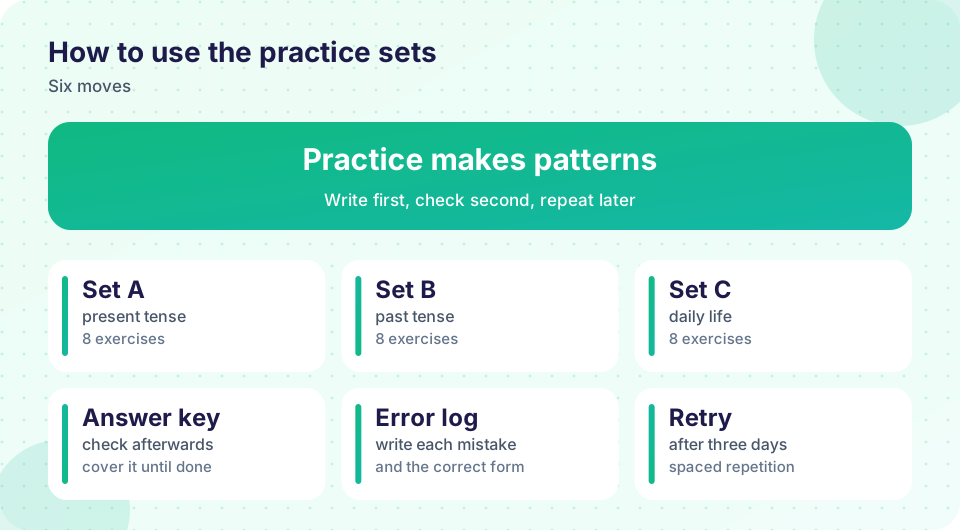
Reading about a language is not the same as using it. This lesson gives you three sets of written exercises, an answer key, and two interactive drills. Do the sets on paper first, writing the Arabic by hand with its vowels, and only then check the key. Writing slows you down just enough to make the patterns stick.
Work in a quiet place, set a timer for 20 minutes, and cover the answer key. Where you get stuck, make a note, then look up the lesson in the chapter that covers it.
Write first, check second, repeat later. What you will learn#
Which of the chapter's patterns you can produce on your own
Where your weak spots are, so you know what to review
How to use written practice together with interactive drills
Key terms#
Retrieval practice : trying to recall an answer before checking it. It strengthens memory more than rereading.
Answer key : the list of correct answers you check after you finish.
Error log : a short list of your mistakes, with the correct form beside each.
Set A: Present tense#
Write the form asked for.
شَرِبَ → I drink دَرَسَ → you (f.) study ذَهَبَ → they (m.) go فَتَحَ → we open جَلَسَ → they (f.) sit Make negative: هِيَ تَفْهَمُ
I want to read (use قَرَأَ )He will not go
Set B: Past tense#
كَتَبَ → I wrote فَهِمَ → you (m.) understood سَمِعَ → she heard ذَهَبَ → we went شَرِبَ → they (m.) drank قَالَ → I said I did not write (use لَمْ )I was a student (a man speaking)
Set C: Daily life#
How much is this? Where do you (m.) live? three boys (وَلَد , plural أَوْلَاد )three girls (بِنْت , plural بَنَات )my sister (أُخْت )his book (كِتَاب )half past three I have two brothers
Answer key#
Check your answers only after finishing all three sets.
Set
#
Answer
Transliteration
A
1
أَشْرَبُ ʾashrabu
A
2
تَدْرُسِينَ tadrusīna
A
3
يَذْهَبُونَ yadhhabūna
A
4
نَفْتَحُ naftaḥu
A
5
يَجْلِسْنَ yajlisna
A
6
هِيَ لَا تَفْهَمُ hiya lā tafhamu
A
7
أُرِيدُ أَنْ أَقْرَأَ ʾurīdu ʾan ʾaqraʾa
A
8
لَنْ يَذْهَبَ lan yadhhaba
B
1
كَتَبْتُ katabtu
B
2
فَهِمْتَ fahimta
B
3
سَمِعَتْ samiʿat
B
4
ذَهَبْنَا dhahabnā
B
5
شَرِبُوا sharibū
B
6
قُلْتُ qultu
B
7
لَمْ أَكْتُبْ lam ʾaktub
B
8
كُنْتُ طَالِبًا kuntu ṭāliban
C
1
بِكَمْ هَذَا؟ bi-kam hādhā?
C
2
أَيْنَ تَسْكُنُ؟ ʾayna taskunu?
C
3
ثَلَاثَة أَوْلَاد thalāthat ʾawlād
C
4
ثَلَاث بَنَات thalāth banāt
C
5
أُخْتِي ʾukhtī
C
6
كِتَابُهُ kitābuhu
C
7
السَّاعَة الثَّالِثَة وَالنِّصْف as-sāʿa ath-thālitha wa-n-niṣf
C
8
عِنْدِي أَخَوَان ʿindī ʾakhawān
Scoring guide#
21 to 24 correct: excellent. Move on to real conversation and reading.15 to 20 correct: solid. Review the two or three items you missed.Below 15: go back to the review lessons of Chapters 5 to 7 and redo the sets after a few days.
Keep an error log . Write each mistake and its correct form, and reread the log before the next session. The same two or three errors usually account for most of your mistakes.
Why each answer is what it is#
The answer key tells you what ; this section tells you why . Reading the reasoning is especially useful for the items you missed.
Set A: present tense#
A1, A2, A3, A4, A5: each answer uses the recipe prefix + stem + ending. I drink uses أَـ and -u (أَشْرَبُ ). You (f.) study uses تَـ and -īna (تَدْرُسِينَ ), because the feminine singular "you" has its own ending. They (m.) go uses يَـ and -ūna (يَذْهَبُونَ ). We open uses نَـ and -u (نَفْتَحُ ). They (f.) sit uses يَـ and a sukun plus -na (يَجْلِسْنَ ), with the stem vowel i that belongs to this verb.A6: negation is لَا in front of the unchanged verb: هِيَ لَا تَفْهَمُ .A7: the wish verb comes first and the second verb takes the subjunctive: أُرِيدُ أَنْ أَقْرَأَ . The final damma of أَقْرَأُ becomes a fatha.A8: the negative future is لَنْ plus the subjunctive: لَنْ يَذْهَبَ .
Set B: past tense#
B1 to B5: these use the ten-ending table. I wrote is كَتَبْتُ (-tu); you (m.) understood is فَهِمْتَ (-ta, with the kasra of this verb); she heard is سَمِعَتْ (-at); we went is ذَهَبْنَا (-nā); they (m.) drank is شَرِبُوا (-ū with a silent alif).B6: قَالَ is a weak verb, so the long ā shortens before -tu : قُلْتُ .B7: past negation uses لَمْ and the jussive: لَمْ أَكْتُبْ . A common mistake is writing لَمْ كَتَبْتُ .B8: كَانَ gives كُنْتُ , and the description takes a tanwin fatha: طَالِبًا .
Set C: daily life#
C1 and C2: بِكَمْ هَذَا؟ is the price question; أَيْنَ تَسْكُنُ؟ uses the question word first and a present-tense verb in the you (m.) form.C3 and C4: the opposite-gender rule. وَلَد is masculine, so three takes the ة : ثَلَاثَة أَوْلَاد . بِنْت is feminine, so three loses it: ثَلَاث بَنَات .C5 and C6: possessive endings, no ال : أُخْتِي (my sister), كِتَابُهُ (his book).C7: time uses the feminine ordinal and وَالنِّصْف : السَّاعَة الثَّالِثَة وَالنِّصْف .C8: عِنْدِي plus the dual of brother , أَخَوَان .
How to turn mistakes into progress#
Pick the two kinds of mistake you made most often and write a sentence in your error log explaining the rule in your own words, for example: "After أَنْ , the verb loses its final damma and becomes fatha." Then write three new examples of that rule. Explaining a rule in your own words, and then using it, moves it from short-term memory to long-term memory far more effectively than rereading the textbook.
Finally, schedule your next attempt. Do the sets again in three days, and again in a week. If you answer a question correctly three times in a row at those intervals, you can retire it from your error log and treat it as learned.
A plan for using all three sets over a week#
You will get the most out of these sets if you spread them across the week, not do them all at once. On day one do Set A and check it. On day three do Set B and check it. On day five do Set C and check it. On day seven redo only the items you missed, without looking at the key, and then record yourself saying the correct answers aloud. This pattern gives each set a gap of two days before you return to it, which is exactly the spacing that helps memory.
If you study with a partner or a teacher, exchange sets and mark each other's work. Explaining why an answer is right to another person is one of the strongest ways to learn it, and you will often notice mistakes in someone else's work that you would never spot in your own. If you study alone, read your answers aloud and listen carefully: an ending that looks right on paper sometimes sounds wrong, and your ear can catch what your eye missed.
Try it#
First, a mixed drill that combines tenses, numbers, time and questions.
Mixed drill
Reset
< divstyle = " max-width : 620px; margin : 0 auto" > < divclass = " row" style = " justify-content : space-between; margin : 0 0 10px" > < spanclass = " mut" id = " prog" > </ span> < spanclass = " mut" id = " score" > </ span> </ div> < divclass = " card" style = " text-align : center" > < divclass = " ar" lang = " ar" dir = " rtl" id = " q" style = " font-size : 34px; line-height : 1.6" > </ div> < divid = " tr" class = " mut" style = " margin-top : 4px" > </ div> < divid = " en" style = " margin-top : 4px; color : #475569" > </ div> < divclass = " row" id = " opts" > </ div> < divid = " fb" style = " margin-top : 10px; font-weight : 600; min-height : 24px" > </ div> < divclass = " row" > < buttonclass = " go" id = " next" style = " display : none" > </ button> </ div> </ div> </ div> < style>
* { box-sizing : border-box}
body { margin : 0; padding : 14px; font-family : system-ui, 'Segoe UI' , sans-serif; background : linear-gradient ( 135deg, #faf5ff, #eff6ff) ; color : #1e1b4b}
.ar { font-family : 'Noto Naskh Arabic' , 'Segoe UI' , 'Traditional Arabic' , Amiri, serif}
button { font : inherit; font-size : 15px; border : 0; border-radius : 999px; padding : 8px 16px; cursor : pointer; background : #fff; color : #1e1b4b; box-shadow : 0 2px 8px rgba ( 67, 56, 202, .18) }
button:hover { transform : translateY ( -1px) }
button.yes { background : linear-gradient ( 135deg, #10b981, #14b8a6) ; color : #fff}
button.no { background : linear-gradient ( 135deg, #f59e0b, #ef4444) ; color : #fff}
button.go { background : linear-gradient ( 135deg, #6366f1, #a78bfa) ; color : #fff}
.card { background : #fff; border-radius : 20px; box-shadow : 0 10px 24px rgba ( 67, 56, 202, .16) ; padding : 18px}
.row { display : flex; gap : 10px; flex-wrap : wrap; align-items : center; justify-content : center; margin-top : 12px}
.mut { color : #475569; font-size : 14px}
</ style> < script>
const items = [ { "q" : "هِيَ ___ الشَّاي" , "en" : "She drinks tea." , "options" : [ "يَشْرَبُ" , "تَشْرَبُ" , "أَشْرَبُ" ] , "answer" : 1 , "tr" : "hiya tashrabu sh-shāy" , "note" : "ta- marks she." } , { "q" : "أَنَا ___ المَاء أَمْسِ" , "en" : "I drank water yesterday." , "options" : [ "شَرِبْتُ" , "أَشْرَبُ" , "شَرِبَتْ" ] , "answer" : 0 , "tr" : "ʾanā sharibtu l-māʾ ʾamsi" , "note" : "Past tense with -tu." } , { "q" : "لَنْ ___ غَدًا" , "en" : "We will not travel tomorrow." , "options" : [ "نُسَافِرُ" , "نُسَافِرَ" , "يُسَافِرُونَ" ] , "answer" : 1 , "tr" : "lan nusāfira ghadan" , "note" : "lan + subjunctive." } , { "q" : "___ ثَلَاث بَنَات" , "en" : "I have three daughters." , "options" : [ "عِنْدَهُ" , "عِنْدِي" , "عِنْدَكِ" ] , "answer" : 1 , "tr" : "ʿindī thalāth banāt" , "note" : "ʿindī = I have." } , { "q" : "السَّاعَة ___ وَالنِّصْف" , "en" : "It is half past two." , "options" : [ "الثَّانِيَة" , "الثَّالِثَة" , "الثَّامِنَة" ] , "answer" : 0 , "tr" : "as-sāʿa ath-thāniya wa-n-niṣf" , "note" : "Two o'clock is ath-thāniya." } , { "q" : "___ يَذْهَبُونَ؟" , "en" : "Where do they go?" , "options" : [ "مَنْ" , "كَمْ" , "أَيْنَ" ] , "answer" : 2 , "tr" : "ʾayna yadhhabūna?" , "note" : "ʾayna = where." } , { "q" : "هُمْ ___ الرِّسَالَة" , "en" : "They (m.) wrote the letter." , "options" : [ "كَتَبُوا" , "كَتَبْنَ" , "كَتَبَتْ" ] , "answer" : 0 , "tr" : "hum katabū r-risāla" , "note" : "-ū marks they (m.) in the past." } , { "q" : "لَمْ ___ الدَّرْس" , "en" : "She did not understand the lesson." , "options" : [ "تَفْهَمْ" , "فَهِمَتْ" , "تَفْهَمُ" ] , "answer" : 0 , "tr" : "lam tafham ad-dars" , "note" : "lam takes the jussive." } ] ;
const $ = id => document. getElementById ( id) ;
let i = 0 , score = 0 , answered = false ;
function show ( ) {
const it = items[ i] ; answered = false ;
if ( ! it) { $ ( 'q' ) . textContent = '' ; $ ( 'tr' ) . textContent = '' ; $ ( 'en' ) . textContent = 'Finished: ' + score + ' of ' + items. length + ' correct.' ; $ ( 'opts' ) . innerHTML = '' ; $ ( 'fb' ) . textContent = '' ; $ ( 'next' ) . style. display = 'none' ; $ ( 'prog' ) . textContent = '' ; return ; }
$ ( 'prog' ) . textContent = 'Question ' + ( i + 1 ) + ' of ' + items. length; $ ( 'score' ) . textContent = 'Score ' + score;
$ ( 'q' ) . textContent = it. q; $ ( 'tr' ) . textContent = '' ; $ ( 'en' ) . textContent = it. en; $ ( 'fb' ) . textContent = '' ; $ ( 'next' ) . style. display = 'none' ;
$ ( 'opts' ) . innerHTML = '' ;
it. options. forEach ( ( o, k ) => { const b = document. createElement ( 'button' ) ; b. className = 'ar' ; b. lang = 'ar' ; b. dir = 'rtl' ; b. style. fontSize = '24px' ; b. textContent = o; b. onclick = ( ) => pick ( k, b) ; $ ( 'opts' ) . appendChild ( b) ; } ) ;
}
function pick ( k, b ) {
if ( answered) return ; answered = true ; const it = items[ i] ;
if ( k === it. answer) { score++ ; b. className += ' yes' ; $ ( 'fb' ) . style. color = '#059669' ; $ ( 'fb' ) . textContent = 'Correct. ' + ( it. note || '' ) ; }
else { b. className += ' no' ; $ ( 'fb' ) . style. color = '#dc2626' ; $ ( 'fb' ) . textContent = 'Not quite. The answer is ' + it. options[ it. answer] + '. ' + ( it. note || '' ) ; }
$ ( 'tr' ) . textContent = it. tr || '' ; $ ( 'score' ) . textContent = 'Score ' + score; $ ( 'next' ) . style. display = '' ;
}
$ ( 'next' ) . onclick = ( ) => { i++ ; show ( ) ; } ;
show ( ) ;
</ script>
And a final matching round on the chapter's vocabulary.
Vocabulary round
Reset
< divstyle = " max-width : 640px; margin : 0 auto" > < divclass = " row" style = " justify-content : space-between; margin : 0 0 10px" > < spanclass = " mut" > </ span> < spanclass = " mut" id = " score" > </ span> </ div> < divstyle = " display : grid; grid-template-columns : 1fr 1fr; gap : 10px" > < divid = " L" style = " display : grid; gap : 8px" > </ div> < divid = " R" style = " display : grid; gap : 8px" > </ div> </ div> < divclass = " row" > < buttonclass = " go" id = " re" > </ button> </ div> </ div> < style>
* { box-sizing : border-box}
body { margin : 0; padding : 14px; font-family : system-ui, 'Segoe UI' , sans-serif; background : linear-gradient ( 135deg, #faf5ff, #eff6ff) ; color : #1e1b4b}
.ar { font-family : 'Noto Naskh Arabic' , 'Segoe UI' , 'Traditional Arabic' , Amiri, serif}
button { font : inherit; font-size : 15px; border : 0; border-radius : 999px; padding : 8px 16px; cursor : pointer; background : #fff; color : #1e1b4b; box-shadow : 0 2px 8px rgba ( 67, 56, 202, .18) }
button:hover { transform : translateY ( -1px) }
button.yes { background : linear-gradient ( 135deg, #10b981, #14b8a6) ; color : #fff}
button.no { background : linear-gradient ( 135deg, #f59e0b, #ef4444) ; color : #fff}
button.go { background : linear-gradient ( 135deg, #6366f1, #a78bfa) ; color : #fff}
.card { background : #fff; border-radius : 20px; box-shadow : 0 10px 24px rgba ( 67, 56, 202, .16) ; padding : 18px}
.row { display : flex; gap : 10px; flex-wrap : wrap; align-items : center; justify-content : center; margin-top : 12px}
.mut { color : #475569; font-size : 14px}
</ style> < style> .it { padding : 10px 12px; border-radius : 14px; background : #fff; box-shadow : 0 2px 8px rgba ( 67, 56, 202, .18) ; cursor : pointer; text-align : center; min-height : 44px; display : flex; align-items : center; justify-content : center; border : 2px solid transparent} .it.sel { border-color : #6366f1; background : #eef2ff} .it.ok { background : #d1fae5; border-color : #10b981; cursor : default} .it.bad { background : #fee2e2; border-color : #ef4444} </ style> < script>
const pairs = [ [ "أَيْنَ" , "where" ] , [ "غَدًا" , "tomorrow" ] , [ "عِنْدِي" , "I have" ] , [ "لَمْ" , "did not" ] , [ "الجُمُعَة" , "Friday" ] , [ "لِأَنَّ" , "because" ] ] ;
const $ = id => document. getElementById ( id) ;
let sel = null , done = 0 , miss = 0 ;
function shuffle ( a ) { a = a. slice ( ) ; for ( let i = a. length - 1 ; i > 0 ; i-- ) { const j = Math. floor ( Math. random ( ) * ( i + 1 ) ) ; [ a[ i] , a[ j] ] = [ a[ j] , a[ i] ] ; } return a; }
function setup ( ) {
sel = null ; done = 0 ; miss = 0 ; $ ( 'L' ) . innerHTML = '' ; $ ( 'R' ) . innerHTML = '' ;
pairs. forEach ( ( p, i ) => { const d = document. createElement ( 'div' ) ; d. className = 'it ar' ; d. lang = 'ar' ; d. dir = 'rtl' ; d. style. fontSize = '24px' ; d. textContent = p[ 0 ] ; d. dataset. i = i; d. onclick = pick; $ ( 'L' ) . appendChild ( d) ; } ) ;
shuffle ( pairs. map ( ( p, i ) => i) ) . forEach ( i => { const d = document. createElement ( 'div' ) ; d. className = 'it' ; d. textContent = pairs[ i] [ 1 ] ; d. dataset. i = i; d. onclick = pick; $ ( 'R' ) . appendChild ( d) ; } ) ;
upd ( ) ;
}
function upd ( ) { $ ( 'score' ) . textContent = done + ' of ' + pairs. length + ' matched, ' + miss + ' misses' + ( done === pairs. length ? ' - well done!' : '' ) ; }
function pick ( e ) {
const el = e. currentTarget; if ( el. classList. contains ( 'ok' ) ) return ;
const side = el. parentElement. id;
if ( ! sel || sel. parentElement. id === side) { if ( sel) sel. classList. remove ( 'sel' ) ; sel = el; el. classList. add ( 'sel' ) ; return ; }
if ( sel. dataset. i === el. dataset. i) { sel. classList. remove ( 'sel' ) ; sel. classList. add ( 'ok' ) ; el. classList. add ( 'ok' ) ; done++ ; }
else { miss++ ; const a = sel, b = el; a. classList. add ( 'bad' ) ; b. classList. add ( 'bad' ) ; setTimeout ( ( ) => { a. classList. remove ( 'bad' , 'sel' ) ; b. classList. remove ( 'bad' ) ; } , 500 ) ; }
sel = null ; upd ( ) ;
}
$ ( 're' ) . onclick = setup; setup ( ) ;
</ script>
Check your understanding#
1. Why is written practice with an answer key useful?
A
It makes you retrieve the answer before you see it
B
It replaces speaking practice
C
It teaches pronunciation
2. What is an error log?
A
A record of your mistakes and their corrections
B
A list of new words
C
A grammar chart
3. What is "you (f.) study" in the present tense?
A
تَدْرُسُ
B
تَدْرُسِينَ
C
يَدْرُسْنَ
4. How do you say "I have two brothers"?
A
عِنْدِي أَخَوَان
B
عِنْدِي ثَلَاثَة أَخ
C
لَيْسَ عِنْدِي أَخ
Summary#
Do the written sets first, then check the key and keep an error log.
Drills on verbs, numbers, time and questions turn rules into habits.
Repeat the sets after a few days; improvement comes from spaced repetition.
Next: Glossary