


















Lesson 37 of 45 · Conversation and Culture
Greetings and Introductions
Learn how to greet people, ask how they are, thank, apologize, say goodbye and introduce yourself in Arabic, with replies and polite habits.
In Arabic-speaking cultures, a greeting is not a quick "hi." It is a small ritual. People ask about each other's health and family, they return blessings with blessings, and they take a moment to be kind before they get to business. Learning these exchanges gives you more than words: it shows respect, and it opens doors faster than perfect grammar ever could.
This lesson teaches the greetings and their replies as pairs, so you can answer as well as ask. Then you will build your own introduction from simple patterns you already know.
What you will learn
- Greetings, replies and goodbyes for different times of day
- How to ask "How are you?" and answer politely
- Polite words: please, thank you, sorry, excuse me
- How to introduce yourself: name, origin, job, age, home
Key terms
Reply formula: a fixed answer to a fixed greeting, such as صَبَاحُ النُّورِ to صَبَاحُ الخَيْرِ.
Blessing phrase: an expression that wishes good, such as إِنْ شَاءَ اللَّهُ (God willing).
Honorific: a polite way of speaking to a person, often a different word or form for men and women.
Vocative: calling someone by name, with يَا before it: يَا يُوسُف.
Greetings and their replies
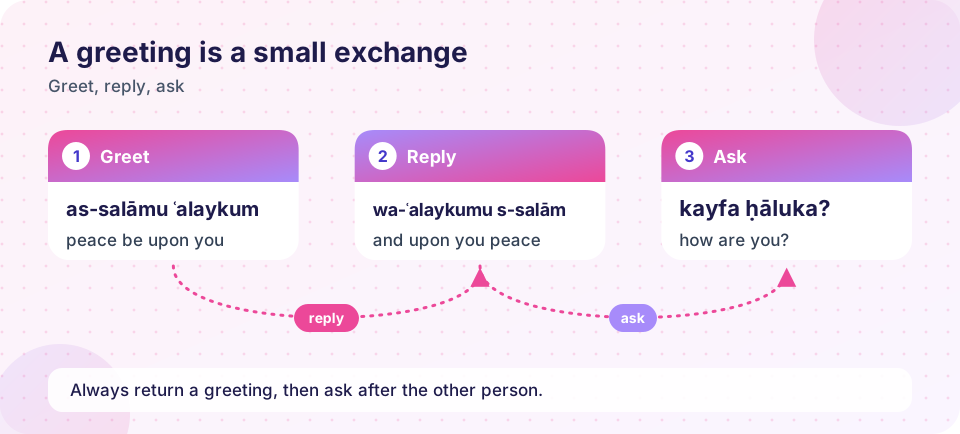
| Say this | Transliteration | Meaning | Reply | Meaning |
|---|---|---|---|---|
| السَّلَامُ عَلَيْكُمْ | as-salāmu ʿalaykum | peace be upon you | وَعَلَيْكُمُ السَّلَامُ | and upon you peace |
| صَبَاحُ الخَيْرِ | ṣabāḥ al-khayr | good morning | صَبَاحُ النُّورِ | morning of light |
| مَسَاءُ الخَيْرِ | masāʾ al-khayr | good evening | مَسَاءُ النُّورِ | evening of light |
| مَرْحَبًا | marḥaban | hello | مَرْحَبَتَيْنِ or أَهْلًا | hello (twice over) |
| أَهْلًا وَسَهْلًا | ʾahlan wa-sahlan | welcome | أَهْلًا بِكَ | welcome to you |
The pattern is lovely: the reply gives back a little more than it received ("of good" → "of light"). If someone says مَرْحَبًا, the traditional answer مَرْحَبَتَيْنِ literally means "two hellos".
A note on the first greeting. السَّلَامُ عَلَيْكُمْ is the classic greeting among Muslims and is used across the Arab world, and learners who use it are generally welcomed warmly. It carries a religious meaning, though. If you are not sure about the other person, مَرْحَبًا or صَبَاحُ الخَيْرِ is always a safe choice. Many Arabic speakers of every faith also use set expressions with the word God in daily speech, such as الحَمْدُ لِلَّهِ (thank God) and إِنْ شَاءَ اللَّهُ (God willing).
How are you?
| Arabic | Transliteration | Meaning |
|---|---|---|
| كَيْفَ حَالُكَ؟ | kayfa ḥāluka? | How are you? (to a man) |
| كَيْفَ حَالُكِ؟ | kayfa ḥāluki? | How are you? (to a woman) |
| مَا أَخْبَارُكَ؟ | mā ʾakhbāruka? | What is your news? |
| بِخَيْرٍ، الحَمْدُ لِلَّهِ. | bi-khayr, al-ḥamdu lillāh. | Fine, thank God. |
| تَمَام. | tamām. | Fine, great (very common in speech). |
| وَأَنْتَ؟ / وَأَنْتِ؟ | wa-ʾanta? / wa-ʾanti? | And you? |
The polite reply to "How are you?" is almost always positive, even if your day has been difficult. A natural follow-up is to ask back with وَأَنْتَ؟. It is normal to repeat greetings and questions about health several times in the first minute.
Polite words
| Arabic | Transliteration | Meaning |
|---|---|---|
| شُكْرًا | shukran | thank you |
| شُكْرًا جَزِيلًا | shukran jazīlan | thank you very much |
| عَفْوًا | ʿafwan | you are welcome; also "excuse me" |
| مِنْ فَضْلِكَ | min faḍlika | please (to a man; مِنْ فَضْلِكِ to a woman) |
| لَوْ سَمَحْتَ | law samaḥta | excuse me, please (to a man; سَمَحْتِ to a woman) |
| آسِف / آسِفَة | ʾāsif / ʾāsifa | sorry (man / woman speaking) |
| تَفَضَّلْ | tafaḍḍal | please, go ahead, here you are (تَفَضَّلِي to a woman) |
Note that آسِف and آسِفَة change with the gender of the speaker, not the listener.
Meeting and parting
- تَشَرَّفْنَا. (tasharrafnā.) Pleased to meet you. Reply: الشَّرَفُ لِي. (ash-sharaf lī.) The honor is mine.
- فُرْصَة سَعِيدَة. (furṣa saʿīda.) A happy opportunity: another way to say pleased to meet you.
- مَعَ السَّلَامَةِ. (maʿa s-salāma.) Goodbye ("with safety"). Reply: مَعَ السَّلَامَةِ or اللَّهُ يُسَلِّمُكَ.
- إِلَى اللِّقَاءِ. (ʾilā l-liqāʾ.) Until we meet again.
- تُصْبِحُ عَلَى خَيْرٍ. (tuṣbiḥu ʿalā khayr.) Good night (to a man; تُصْبِحِينَ to a woman). Reply: وَأَنْتَ بِخَيْرٍ.
Introducing yourself
Use short, complete sentences with patterns you already know:
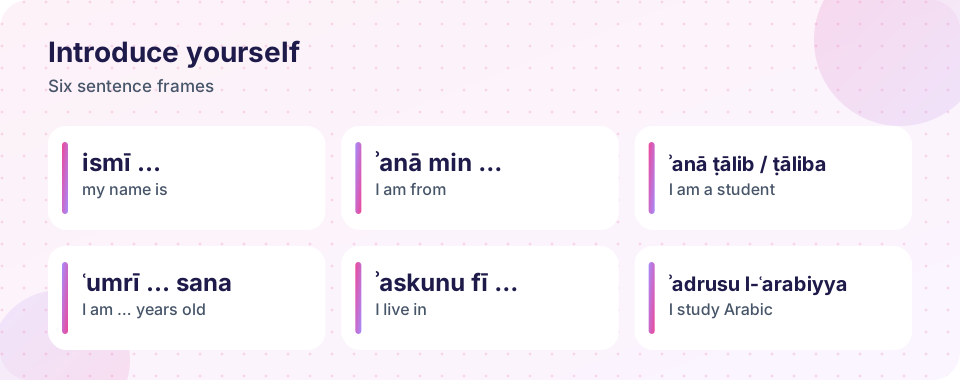
| Arabic | Transliteration | Meaning |
|---|---|---|
| اسْمِي يُوسُف. | ismī yūsuf. | My name is Yusuf. |
| أَنَا مِنْ كَنَدَا. | ʾanā min kanadā. | I am from Canada. |
| أَنَا طَالِب / طَالِبَة. | ʾanā ṭālib / ṭāliba. | I am a student (m. / f.). |
| أَنَا مُهَنْدِسَة. | ʾanā muhandisa. | I am an engineer (f.). |
| عُمْرِي عِشْرُون سَنَة. | ʿumrī ʿishrūn sana. | I am twenty years old. |
| أَسْكُنُ فِي القَاهِرَة. | ʾaskunu fī l-qāhira. | I live in Cairo. |
| أَدْرُسُ العَرَبِيَّة. | ʾadrusu l-ʿarabiyya. | I study Arabic. |
Countries are easy to recognize: كَنَدَا (kanadā), أَمْرِيكَا (ʾamrīkā), بَرِيطَانِيَا (briṭāniyā), أَلْمَانِيَا (ʾalmāniyā), فَرَنْسَا (faransā), الهِنْد (al-hind), الصِّين (aṣ-ṣīn), اليَابَان (al-yābān), مِصْر (miṣr), المَغْرِب (al-maghrib), السُّعُودِيَّة (as-suʿūdiyya). Jobs change for a woman by adding ة: مُعَلِّم / مُعَلِّمَة (teacher), طَبِيب / طَبِيبَة (doctor), مُهَنْدِس / مُهَنْدِسَة (engineer), مُمَرِّض / مُمَرِّضَة (nurse).
Why greetings are so long
To an English speaker, an Arabic greeting can seem long. A typical exchange between friends may include السَّلَامُ عَلَيْكُمْ, the reply, كَيْفَ حَالُكَ؟, كَيْفَ الأَهْلُ؟ (how is the family?), الحَمْدُ لِلَّهِ and شُكْرًا before anyone mentions the reason for the meeting. This is not wasted time. In many communities the greeting is where you show that you value the person and not only the errand. A rushed greeting can feel cold, while a warm one builds trust quickly. As a learner you do not need to produce all of it, but you should be ready to return whatever you are given, and to ask one question back.
Choosing the level of formality
The same meeting can call for different language. With a stranger, an older person, a teacher or an official, use the full forms: السَّلَامُ عَلَيْكُمْ, كَيْفَ حَالُكَ؟, تَشَرَّفْنَا. With friends of your age, a short مَرْحَبًا or أَهْلًا and a smile is perfectly natural. When you are not sure, lean towards the slightly more polite choice, because nobody is offended by extra courtesy. Also remember the gender of the person you are talking to. If you do not know, look at the situation: many learners simply watch what the other person says to them and copy the ending.
Analyzing a first meeting
Look again at the opening dialogue of this chapter. Sara greets, Yusuf replies and adds أَهْلًا وَسَهْلًا. Then each says their name, and تَشَرَّفْنَا closes the introduction. Next Sara gives her country, and the question وَأَنْتَ؟ hands the turn back to Yusuf. This structure, greet, reply, name, origin, hand over the turn, is the skeleton of almost every first meeting in any language. Learn the skeleton and you can fill it with different details every time.
When you do not understand
It is normal to be lost in a real conversation. Do not freeze: use a repair phrase. آسِف، لَمْ أَفْهَمْ (ʾāsif, lam ʾafham) means "Sorry, I did not understand". مِنْ فَضْلِكَ، أَعِدْ (min faḍlika, ʾaʿid) means "Please repeat" (to a man; to a woman, أَعِيدِي). بِبُطْءٍ مِنْ فَضْلِكَ (bi-buṭʾin min faḍlika) means "slowly, please". Using them politely will often make the other person slow down and speak more simply.
A practice routine for greetings
Each morning, greet yourself in the mirror in three ways: formal, friendly and with a new acquaintance. Say the greeting, the reply and one follow-up question. Then record one minute of introductions and listen back. Over a week you will move from recited phrases to relaxed, natural exchanges.
Common mistakes to avoid in greetings
Three small mistakes cause most of the awkward moments learners experience. The first is using the wrong gender ending when you ask كَيْفَ حَالُكَ؟ to a woman; she will understand you, but the right ending (-ki) shows care. The second is forgetting to reply to a greeting. If someone says صَبَاحُ الخَيْرِ and you only nod, it can feel cold; return the phrase with صَبَاحُ النُّورِ. The third is rushing. Take a breath, smile and give the greeting its time.
If you make a mistake, simply continue. Native speakers are usually generous with learners, and a sincere effort is valued more than perfect grammar. If someone corrects you, say شُكْرًا and try again.
Common misconceptions
"One hello is enough." In many places, a proper greeting has several steps: the greeting, the reply, a question about health, and sometimes a question about family. Do not rush it.
"Pick any form of 'you'." Always use -ka / -ki and أَنْتَ / أَنْتِ in line with who is in front of you. If you are unsure, watch what others use.
"Replies are optional." Greetings are returned. Not answering السَّلَامُ عَلَيْكُمْ is considered impolite.
Try it
Build the sentences you would use to introduce yourself.
Next, choose the correct reply or phrase.
Check your understanding
Quick check · 5 questions
of 5 answered You scored / 5 · perfect!
-
1. What does صَبَاحُ النُّورِ mean?
It is the traditional reply to ṣabāḥ al-khayr. -
2. How does a woman say "I am sorry"?
ʾāsifa: the form follows the gender of the speaker. -
3. Which phrase is the safest greeting when you do not know someone's background?
marḥaban is neutral and welcome in any setting. -
4. How do you say "I live in Cairo"?
fī means in or at: ʾaskunu fī l-qāhira. ʾilā means to and min means from. -
5. Which sentence means "My name is Sara"?
ismī + name.
Summary
- Greetings come in pairs; learn the reply with every greeting.
- Ask كَيْفَ حَالُكَ؟ (m.) or كَيْفَ حَالُكِ؟ (f.), and answer بِخَيْرٍ، الحَمْدُ لِلَّهِ.
- Polite words include شُكْرًا, عَفْوًا, مِنْ فَضْلِكَ, لَوْ سَمَحْتَ, تَفَضَّلْ.
- Introduce yourself with اسْمِي, أَنَا مِنْ, أَنَا + job, عُمْرِي, أَسْكُنُ فِي.
- Use -ka / -ki and أَنْتَ / أَنْتِ to match the person you address.
Track your progress
Create a free account to tick off lessons and pick up where you left off on any device.
of Arabic for Beginners lessons completed