


















Lesson 2 of 45 · Getting Started
Arabic Around the World: One Language, Many Voices
Learn where Arabic is spoken, how Modern Standard Arabic differs from Egyptian, Levantine, Gulf and Maghrebi dialects, and which one to study first.
When someone says "I am learning Arabic", a native speaker's first question is often "Which Arabic?" It is not a trick. Arabic is spoken across a region stretching from the Atlantic coast of Morocco to the Persian Gulf, and the everyday speech of its parts differs as much as, say, Spanish differs from Italian. Understanding this map early saves you confusion and helps you choose what to study. It also explains why a lesson in this course can show you a formal word in one line and a common spoken word in the next.
What you will learn
- Where Arabic is spoken and how its history shaped today's varieties.
- What diglossia means and why Arabic is the classic example.
- How the four main dialect families differ, with real sample words.
- Why Modern Standard Arabic is the best first target for most learners.
- How to learn some dialect later without starting over.
Key terms
Semitic languages: a language family that includes Arabic, Hebrew, Amharic and Maltese, known for consonant roots.
Diglossia: a situation where two forms of one language live side by side, a high formal one and a low everyday one.
Dialect: a regional variety of a language, with its own sounds, words and grammar habits.
Classical Arabic: the language of the Qur'an and of poetry and prose from roughly the 7th to the 9th centuries and later.
Fuṣḥā (فصحى): the Arabic word for the formal standard, covering both classical and modern forms.
A short map of the Arabic world
Arabic is an official language of more than twenty countries and is spoken by well over three hundred million people as a first language. It is also a liturgical language for more than a billion Muslims, who pray and recite the Qur'an in it. It became one of the six official languages of the United Nations in 1973, and UNESCO marks World Arabic Language Day on 18 December.
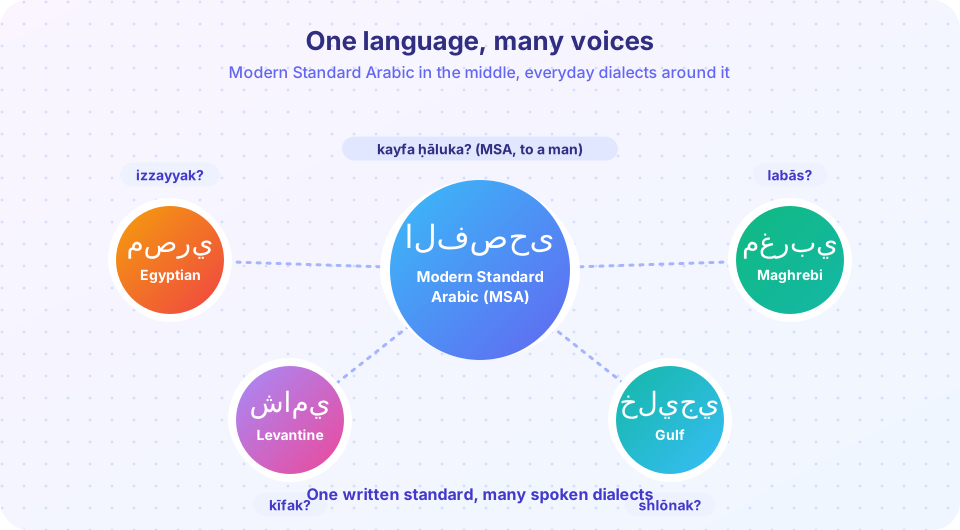
Geographers usually divide the spoken varieties into broad families:
- Maghrebi (North Africa west of Egypt): Morocco, Algeria, Tunisia, and parts of Libya and Mauritania. It borrowed heavily from Berber languages, French and Spanish, and it is the family that other Arabs usually find hardest to follow at first.
- Egyptian: spoken by the largest single national population. Because Cairo has produced movies, TV drama and songs for nearly a century, it is understood across the Arab world, and it is a common choice for learners who want one dialect.
- Levantine: Lebanon, Syria, Jordan and Palestine. Known for a soft, melodic sound; popular in music and television.
- Gulf: Saudi Arabia (with Hejazi, Najdi and other forms), Kuwait, Bahrain, Qatar, the UAE and Oman. Close in several ways to the dialect of early Arabia.
- Others: Iraqi, Sudanese, Yemeni and Hassaniya (Mauritania) are separate varieties, each with its own character.
This is a simplification. Within each family, a city, a village and even a social group may have its own way of speaking.
From the Qur'an to the newspaper
Arabic began as the language of tribes in the Arabian Peninsula, with a rich oral poetry tradition. In the 7th century the Qur'an was revealed in a form of the language that, together with the poetry that came before it, became the model of eloquence. As the Arab conquests spread the language from Spain to Central Asia, Arabic mixed with local languages and the spoken forms drifted apart, much as Latin broke into French, Spanish and Italian. The written form, however, stayed remarkably stable: scholars and religious communities treated the classical model as something to preserve.
In the 19th and 20th centuries a movement of revival called the Nahḍa ("awakening") modernized this written language for newspapers, universities and science, adding vocabulary for things like telephone, constitution and democracy. This modernized, simplified descendant of Classical Arabic is Modern Standard Arabic.
Diglossia: two Arabics in one life
The linguist Charles Ferguson introduced the word diglossia in a famous 1959 article, and Arabic was one of his main examples. A typical Arabic speaker lives in two registers. At home and with friends she speaks her dialect. When she writes a formal email, reads the news, gives a lecture or listens to a sermon, she uses MSA, which no one learns as a first language. Children meet MSA when they start school.
For you as a learner this means:
- Reading and writing: MSA works everywhere, from Marrakech to Muscat.
- Formal speaking (a talk, a news-style conversation, an interview, a meeting with people from different countries): MSA is the right tool.
- Chatting with a friend or buying vegetables: people expect dialect, but they will understand and usually appreciate your MSA. Some listeners find it slightly bookish, the way an English speaker might sound saying "I do not wish to" instead of "I don't want to".
The same idea in different dialects
The same meaning often appears in different words. Here are a few examples; treat them as common examples, not the only forms.
| Meaning | MSA | Egyptian | Levantine | Gulf (one common form) | Moroccan |
|---|---|---|---|---|---|
| now | al-ān | dilwaʾtī | hallaʾ | al-ḥīn | daba |
| I want | urīdu | ʿāyiz (m.) | biddī | abghā | bghīt |
| What? | mādhā | ēh | shū | shinu | ash / shnu |
| How are you? | kayfa ḥāluka | izzayyak | kīfak | shlōnak | labās |
Some of these changes are regular. Many dialects drop the final short vowels and case endings that MSA keeps, and the letter ق (qāf) is pronounced as a glottal stop in Cairo and Beirut, as a hard "g" in much of the Gulf and in Upper Egypt, and as a deep "q" in MSA. Once you know the rules, the differences look like a system rather than chaos.
Which Arabic should you start with?
Here is a practical decision guide.
- You want to read, write or study formal texts: MSA, no question.
- You want to talk with relatives or travel to one region: start with MSA for the script and basic grammar, then add that region's dialect. Many courses and tutors now teach both.
- You want one dialect to understand films: Egyptian and Levantine have the most media.
- You are unsure: MSA. It is the foundation, and learning a dialect on top of it takes months, not years.
The words you learn in MSA are far from wasted when you move to a dialect. Most dialect vocabulary comes from the same roots; only pronunciation, a few frequent words and some grammar change.
English words that came from Arabic
Arabic has also given English a few everyday words. Algebra comes from al-jabr (الجبر), a term in a 9th-century book by the scholar al-Khwārizmī, whose name also gave us algorithm. Coffee traces back through Turkish to qahwa (قهوة), sugar comes from sukkar (سكر), and zero reached Europe via ṣifr (صفر), "empty". Spotting these cousins is a nice way to connect with the language.
Try it
Press Run (or Ctrl + Enter) to see the result here.
Program input · what you'd type while the program runs
Type the answers before you press Run, one per line. Each time the program reads a line (with input()), it gets the next line from this box.
The table prints plain letters (no special marks) so the columns line up in the console. The point is visible in the last lines: a single idea has five different spoken forms, which is why a shared written standard is so valuable.
Common misconceptions
"There is a single Arabic that everyone speaks." There is a single written standard, but daily speech varies a great deal. Treat MSA as the shared bridge, not as the native tongue of any home.
"Dialects are just slang or mistakes." Dialects are full, rule-governed languages with long histories. They are not broken MSA. Ancient grammar and later change both shaped them.
"If I learn MSA, nobody will understand me." Educated speakers across the region understand MSA well, thanks to media and school. You may sound formal in casual settings, but you will be understood.
Check your understanding
Quick check · 5 questions
of 5 answered You scored / 5 · perfect!
-
1. What is diglossia?
Diglossia describes the split between a formal standard (like MSA) and everyday dialects used in the same community. -
2. Which dialect family is spoken in Lebanon, Syria, Jordan and Palestine?
These countries form the Levant, and their dialects are called Levantine. -
3. Why is MSA a good first choice for many learners?
MSA is the common written and formal standard, and learning it first gives you reading and a foundation for any dialect. -
4. Which English word comes from Arabic al-jabr?
Algebra comes from al-jabr, a term in al-Khwarizmi's book; algorithm comes from his name. -
5. What does the Nahda movement refer to?
The Nahda, or awakening, updated Arabic vocabulary and style for modern publishing and education.
Summary
- Arabic is spoken across more than twenty countries with big regional differences.
- MSA is the shared written and formal standard; dialects are the languages of home.
- Diglossia describes this high and low split, and it is normal for Arabic speakers.
- Four main dialect families: Maghrebi, Egyptian, Levantine and Gulf, plus others.
- Start with MSA, then add a dialect for talking with the people you care about.
- Many English words, such as algebra, coffee, sugar and zero, have Arabic roots.
Next: How Arabic Works: Script, Direction and the Root System
Track your progress
Create a free account to tick off lessons and pick up where you left off on any device.
of Arabic for Beginners lessons completed