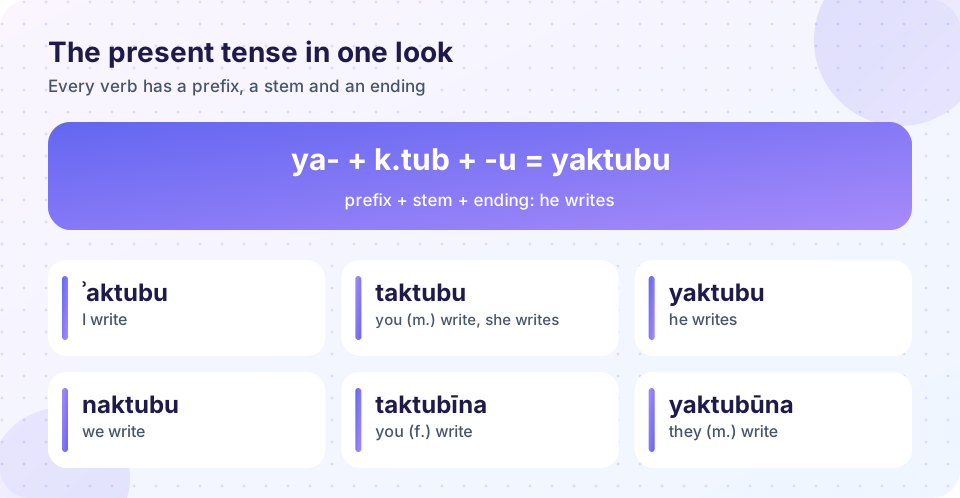
See how Arabic builds present-tense verbs from a root, a prefix and an ending, and what you will be able to say after this chapter.
So far you have learned to read letters, write words and describe things with nouns. Now your Arabic starts to move. Verbs let you say what people do: I write, she studies, we go. In this chapter you will build the Arabic present tense from three simple parts, and by the end you will be able to conjugate dozens of verbs without memorizing each form separately.
A note on conventions used in the rest of this course. Arabic is written with short vowels left out in newspapers and books, but we show them so you can read aloud with confidence. Verbs are always shown with every vowel, because the final vowel is part of the conjugation. Nouns are shown without their final case endings, which is how most people pronounce them at the end of a phrase. Transliteration (Latin letters) follows the common scholarly system: ʿ is the throat sound ʿayn, ʾ is the glottal stop hamza, ḥ is a breathy h, and macrons (ā, ī, ū) mark long vowels.
One stem, six faces: only the prefix and the ending change.
Most Arabic words belong to a family. Take the three consonants ك ت ب (k-t-b). They carry the idea of writing. Pour them into different frames and you get a whole family: كِتَاب (kitāb, book), كَاتِب (kātib, writer), مَكْتَب (maktab, office or desk), مَكْتَبَة (maktaba, library or bookshop) and the verb يَكْتُبُ (yaktubu, he writes). Once you notice roots, vocabulary stops being a pile of unrelated words and becomes a web.
The present tense is the friendliest place to meet this idea, because the frame is so regular. Every present-tense verb has the same three parts:
A prefix that says who is acting (ʾa-, ta-, ya-, na-).
A stem built from the root letters and a short vowel pattern.
An ending that fixes gender and number (-u, -īna, -ūna, -na).
Compare English, where you say I write, you write, he writes with almost no change. Arabic changes the verb for every person, so a single word like أَكْتُبُ (ʾaktubu) already means I write, with no separate "I" needed. Arabic speakers often drop the pronoun entirely and add it only for emphasis.
One Arabic form covers several English ones. يَكْتُبُ can mean he writes (a habit), he is writing (right now) or even he writes in a story told in the present. To talk about the future, you attach the small prefix سَـ (sa-) or put the word سَوْفَ (sawfa) in front: سَأَكْتُبُ (saʾaktubu, I will write). That is all the machinery you need, which is good news: there is no separate future conjugation to learn.
There is also no word for am, is, are in a simple present sentence. I am a student is just أَنَا طَالِب (ʾanā ṭālib, "I student"). Verbs are for actions, not for describing what someone is.
Warm up with ten of the verbs we will conjugate in this chapter. Each card shows the present-tense form for "he". Flip it and say the word aloud before moving on.
Ten core verbs (he form)
<divstyle="max-width:560px;margin:0 auto"><divclass="row"style="justify-content:space-between;margin:0 0 10px"><spanclass="mut"id="cnt"></span><buttonid="sp">Listen</button></div><divclass="card"id="card"tabindex="0"style="min-height:190px;text-align:center;cursor:pointer;display:flex;flex-direction:column;justify-content:center;gap:6px"></div><divclass="row"><buttonclass="no"id="again">Again</button><buttonid="flip">Flip</button><buttonclass="yes"id="know">Got it</button></div></div><style>*{box-sizing:border-box}body{margin:0;padding:14px;font-family:system-ui,'Segoe UI',sans-serif;background:linear-gradient(135deg,#faf5ff,#eff6ff);color:#1e1b4b}.ar{font-family:'Noto Naskh Arabic','Segoe UI','Traditional Arabic',Amiri,serif}button{font:inherit;font-size:15px;border:0;border-radius:999px;padding:8px 16px;cursor:pointer;background:#fff;color:#1e1b4b;box-shadow:0 2px 8px rgba(67,56,202,.18)}button:hover{transform:translateY(-1px)}button.yes{background:linear-gradient(135deg,#10b981,#14b8a6);color:#fff}button.no{background:linear-gradient(135deg,#f59e0b,#ef4444);color:#fff}button.go{background:linear-gradient(135deg,#6366f1,#a78bfa);color:#fff}.card{background:#fff;border-radius:20px;box-shadow:0 10px 24px rgba(67,56,202,.16);padding:18px}.row{display:flex;gap:10px;flex-wrap:wrap;align-items:center;justify-content:center;margin-top:12px}.mut{color:#475569;font-size:14px}</style><script>const cards =[["يَكْتُبُ","yaktubu","he writes"],["يَدْرُسُ","yadrusu","he studies"],["يَذْهَبُ","yadhhabu","he goes"],["يَجْلِسُ","yajlisu","he sits"],["يَفْتَحُ","yaftaḥu","he opens"],["يَشْرَبُ","yashrabu","he drinks"],["يَسْمَعُ","yasmaʿu","he hears, listens"],["يَفْهَمُ","yafhamu","he understands"],["يَعْرِفُ","yaʿrifu","he knows"],["يَسْكُنُ","yaskunu","he lives, resides"]];const$=id=> document.getElementById(id);let deck = cards.slice(), total = cards.length, flipped =false;functionrender(){$('cnt').textContent =(total - deck.length)+' of '+ total +' learned';const c = deck[0];if(!c){$('card').innerHTML ='<div style="font-size:20px">All '+ total +' cards learned. Reload the preview to start again.</div>';return;}$('card').innerHTML ='<div class="ar" lang="ar" dir="rtl" style="font-size:46px;line-height:1.5">'+ c[0]+'</div>'+(flipped ?'<div style="font-size:22px;font-weight:700;color:#4338ca">'+ c[1]+'</div><div style="font-size:18px;color:#475569">'+ c[2]+'</div>':'<div class="mut">Say it aloud, then click the card</div>');}$('card').onclick =$('flip').onclick=()=>{ flipped =!flipped;render();};$('know').onclick=()=>{ deck.shift(); flipped =false;render();};$('again').onclick=()=>{ deck.push(deck.shift()); flipped =false;render();};$('sp').onclick=()=>{try{const u =newSpeechSynthesisUtterance(deck[0][0]); u.lang ='ar-SA'; speechSynthesis.speak(u);}catch(e){alert('Speech is not available in this preview. Say it aloud yourself.');}};render();</script>
Now match each verb with its meaning. Notice how many you can already recognize from the flash cards.
Match verb and meaning
<divstyle="max-width:640px;margin:0 auto"><divclass="row"style="justify-content:space-between;margin:0 0 10px"><spanclass="mut">Click an Arabic item, then its meaning.</span><spanclass="mut"id="score"></span></div><divstyle="display:grid;grid-template-columns:1fr 1fr;gap:10px"><divid="L"style="display:grid;gap:8px"></div><divid="R"style="display:grid;gap:8px"></div></div><divclass="row"><buttonclass="go"id="re">Shuffle again</button></div></div><style>*{box-sizing:border-box}body{margin:0;padding:14px;font-family:system-ui,'Segoe UI',sans-serif;background:linear-gradient(135deg,#faf5ff,#eff6ff);color:#1e1b4b}.ar{font-family:'Noto Naskh Arabic','Segoe UI','Traditional Arabic',Amiri,serif}button{font:inherit;font-size:15px;border:0;border-radius:999px;padding:8px 16px;cursor:pointer;background:#fff;color:#1e1b4b;box-shadow:0 2px 8px rgba(67,56,202,.18)}button:hover{transform:translateY(-1px)}button.yes{background:linear-gradient(135deg,#10b981,#14b8a6);color:#fff}button.no{background:linear-gradient(135deg,#f59e0b,#ef4444);color:#fff}button.go{background:linear-gradient(135deg,#6366f1,#a78bfa);color:#fff}.card{background:#fff;border-radius:20px;box-shadow:0 10px 24px rgba(67,56,202,.16);padding:18px}.row{display:flex;gap:10px;flex-wrap:wrap;align-items:center;justify-content:center;margin-top:12px}.mut{color:#475569;font-size:14px}</style><style>.it{padding:10px 12px;border-radius:14px;background:#fff;box-shadow:0 2px 8px rgba(67,56,202,.18);cursor:pointer;text-align:center;min-height:44px;display:flex;align-items:center;justify-content:center;border:2px solid transparent}.it.sel{border-color:#6366f1;background:#eef2ff}.it.ok{background:#d1fae5;border-color:#10b981;cursor:default}.it.bad{background:#fee2e2;border-color:#ef4444}</style><script>const pairs =[["يَكْتُبُ","he writes"],["يَشْرَبُ","he drinks"],["يَجْلِسُ","he sits"],["يَفْهَمُ","he understands"],["يَفْتَحُ","he opens"],["يَذْهَبُ","he goes"]];const$=id=> document.getElementById(id);let sel =null, done =0, miss =0;functionshuffle(a){ a = a.slice();for(let i = a.length -1; i >0; i--){const j = Math.floor(Math.random()*(i +1));[a[i], a[j]]=[a[j], a[i]];}return a;}functionsetup(){
sel =null; done =0; miss =0;$('L').innerHTML ='';$('R').innerHTML ='';
pairs.forEach((p, i)=>{const d = document.createElement('div'); d.className ='it ar'; d.lang ='ar'; d.dir ='rtl'; d.style.fontSize ='24px'; d.textContent = p[0]; d.dataset.i = i; d.onclick = pick;$('L').appendChild(d);});shuffle(pairs.map((p, i)=> i)).forEach(i=>{const d = document.createElement('div'); d.className ='it'; d.textContent = pairs[i][1]; d.dataset.i = i; d.onclick = pick;$('R').appendChild(d);});upd();}functionupd(){$('score').textContent = done +' of '+ pairs.length +' matched, '+ miss +' misses'+(done === pairs.length ?' - well done!':'');}functionpick(e){const el = e.currentTarget;if(el.classList.contains('ok'))return;const side = el.parentElement.id;if(!sel || sel.parentElement.id === side){if(sel) sel.classList.remove('sel'); sel = el; el.classList.add('sel');return;}if(sel.dataset.i === el.dataset.i){ sel.classList.remove('sel'); sel.classList.add('ok'); el.classList.add('ok'); done++;}else{ miss++;const a = sel, b = el; a.classList.add('bad'); b.classList.add('bad');setTimeout(()=>{ a.classList.remove('bad','sel'); b.classList.remove('bad');},500);}
sel =null;upd();}$('re').onclick = setup;setup();</script>