


















Lesson 26 of 45 · Present Tense Verbs
Present Tense Review
Review Arabic present-tense verbs: prefixes, endings, negation with lā, wishes with ʾan and the future with sa- and lan, with a ten-question quiz.
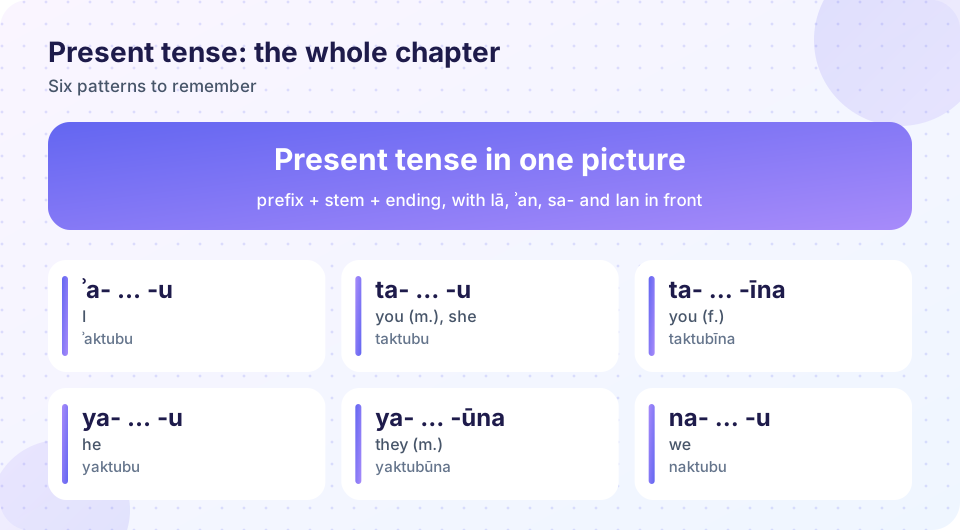
You have now seen the whole present-tense system. This review ties it into one picture, gives you a table to keep, and tests you with mixed practice. Work through the quiz without looking back first. Where you hesitate, jump to the matching lesson and reread just that part.
What you will learn
- A quick recap of every rule in the chapter
- Where each rule lives, so you can look it up fast
- How well you can use the rules together
Chapter in one table
| Idea | The rule | Example |
|---|---|---|
| Person prefixes | أَـ I, تَـ you/she, يَـ he/they, نَـ we | أَكْتُبُ, تَكْتُبُ, يَكْتُبُ, نَكْتُبُ |
| Endings | -u; -īna (you f.); -ūna (m. pl.); -na (f. pl.) | تَكْتُبِينَ, يَكْتُبُونَ, يَكْتُبْنَ |
| Stem vowel | u, a or i; learn past + present as a pair | كَتَبَ / يَكْتُبُ, جَلَسَ / يَجْلِسُ |
| Negation | لَا + ordinary verb | لَا أَعْرِفُ |
| Wish, need, ability | conjugated verb + أَنْ + subjunctive | أُرِيدُ أَنْ أَذْهَبَ |
| Future | سَـ + ordinary verb; لَنْ + subjunctive | سَأَذْهَبُ, لَنْ أَذْهَبَ |
| Special verbs | learn separately | آكُلُ, يَقُولُ, يُحِبُّ |
Habits that make the system stick
- Say the whole sentence aloud. The rhythm of prefix, stem and ending is easier to remember through sound than through a table.
- Learn verbs as pairs. When you add a new verb to your flash cards, put both كَتَبَ and يَكْتُبُ on the same card.
- Check the ending twice. After لَا and سَـ the verb ends in -u. After أَنْ and لَنْ it ends in -a. This one habit prevents most errors.
- Use roots to guess. When you meet مَدْرَسَة (madrasa, school), you can spot د-ر-س, the root of study. A school is "a place of studying". New words become friendly.
Diagnose yourself: where to go back
After the quiz, count which kinds of questions you missed, because the pattern of your mistakes tells you what to review.
- You missed the prefix questions (we, you, she). Go back to the four-prefix table in the conjugation lesson and say the ten forms of كَتَبَ aloud until the sound of each prefix is familiar. Then do the same with شَرِبَ.
- You missed endings such as -īna, -ūna and -na. These are the three "special" endings. Write the table of all ten forms from memory, with a different color for each ending, and check it against the lesson.
- You missed the subjunctive. Remember the two-second rule: after أَنْ and لَنْ, a final damma becomes fatha, and a final nūn disappears from -īna and -ūna. Do the six practice sentences in the negation lesson again.
- You missed vocabulary. Put the verbs on flash cards as pairs and review them for a week.
A complete review example
Here is how an experienced learner would conjugate a brand-new verb the first time. Take فَتَحَ / يَفْتَحُ (fataḥa / yaftaḥu, to open). Step one: copy the recipe, أَفْتَحُ، تَفْتَحُ، تَفْتَحِينَ، يَفْتَحُ، تَفْتَحُ، نَفْتَحُ، تَفْتَحُونَ، تَفْتَحْنَ، يَفْتَحُونَ، يَفْتَحْنَ. Step two: make three wish sentences, أُرِيدُ أَنْ أَفْتَحَ البَاب (I want to open the door), لَا تُرِيدُ أَنْ تَفْتَحَ النَّافِذَة (she does not want to open the window) and سَنَفْتَحُ المَتْجَر غَدًا (we will open the shop tomorrow). Step three: add a negative future, لَنْ يَفْتَحُوا الصُّنْدُوق (they will not open the box). In about three minutes you have turned one dictionary entry into a small family of sentences you can actually use.
Practice that goes beyond the quiz
A quiz measures recognition. To build real fluency you also need production, that is, creating your own sentences. For the next week, write three sentences each day using three different verbs from this chapter, one with لَا, one with أَنْ and one with سَـ. For example: لَا أَشْرَبُ القَهْوَة فِي المَسَاء, أُرِيدُ أَنْ أَدْرُسَ العَرَبِيَّة, سَأَذْهَبُ إِلَى السُّوق غَدًا. Read them aloud, then check the endings against the rules in the recap table. You will find that errors fade quickly when you check your own work.
Try it
Tap through mixed sentences. They cover prefixes, endings, لَا, أَنْ, سَـ and لَنْ.
Now match some forms with their meanings. Notice how quickly you can recognize prefix and ending now.
Check your understanding
Quick check · 10 questions
of 10 answered You scored / 10 · perfect!
-
1. Which prefix means "we"?
na- marks we: naktubu, نَكْتُبُ. -
2. Which form means "you (f.) drink"?
The feminine singular "you" ends in -īna: tashrabīna. -
3. How do you negate هُوَ يَدْرُسُ (he studies)?
Plain present negation uses lā with the ordinary verb. -
4. Which sentence means "I want to open the door"?
After ʾan the verb takes the subjunctive fatha: ʾan ʾaftaḥa. -
5. What does لَنْ يَذْهَبُوا mean?
lan + subjunctive means a negative future; the nūn of -ūna has dropped. -
6. What is the stem vowel of يَجْلِسُ?
The middle letter lām carries a kasra: yajlisu. -
7. How do you write "I eat"?
Two hamzas merge into a long ā: ʾākulu. -
8. What happens to the nūn of -ūna after أَنْ?
ʾan yaktubū: the nūn is lost and a silent alif is written. -
9. What are the root letters of يَكْتُبُونَ?
The root is k-t-b. The prefix, vowels and ending are added around it. -
10. Which means "She will not drink coffee"?
The negative future uses lan with the subjunctive.
Summary
- Every present-tense verb is prefix + stem + ending, and the stem stays constant.
- لَا negates; أَنْ links to a second verb; سَـ and لَنْ make positive and negative futures.
- Endings matter: -u after لَا and سَـ, -a after أَنْ and لَنْ.
- Learn verbs in pairs, and treat weak and hamzated verbs as special items.
Track your progress
Create a free account to tick off lessons and pick up where you left off on any device.
of Arabic for Beginners lessons completed