


















Lesson 13 of 45 · Reading and Writing
Short Vowels, Sukūn and Shadda
Read vowelled Arabic: learn fatḥa, kasra, ḍamma, sukūn and shadda, how syllables work, when marks are written and how to decode words like kataba and mudarris.
Short vowels are the quiet heart of Arabic pronunciation. They are not letters, so they do not appear in ordinary newspapers, but they decide which word you are reading, and every beginner, every child and every reciter of the Qur'an relies on them. In this lesson you learn the five marks that complete the written word: three vowel marks, the sign for "no vowel" and the sign for doubling. With these five marks, you can pronounce any fully vowelled Arabic text.
What you will learn
- The shape, position and sound of fatḥa, kasra and ḍamma.
- What the sukūn does and how consonant clusters arise.
- How the shadda doubles a consonant.
- How to read a fully vowelled word syllable by syllable.
- When vowel marks are written and when they are left out.
Key terms
Ḥarakāt (singular ḥaraka): the short-vowel marks.
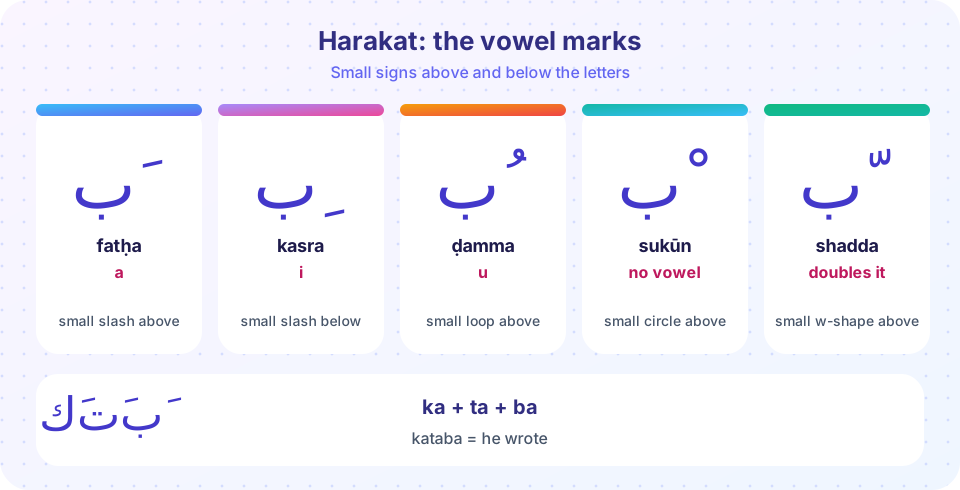
Fatḥa: a small slanted stroke above the letter; the vowel a.
Kasra: a small slanted stroke below the letter; the vowel i.
Ḍamma: a tiny loop like a small و above the letter; the vowel u.
Sukūn: a small circle above the letter; the consonant has no vowel.
Shadda: a small sign like a tiny w above the letter; the consonant is doubled.
The three vowels
Every Arabic consonant is followed by one of three short vowels, or by none. The vowel is written on the consonant it follows.
| Mark | Name | Position | Sound | With ب | Reads |
|---|---|---|---|---|---|
| ـَ | fatḥa | above | a as in cup or cat | بَ | ba |
| ـِ | kasra | below | i as in bit | بِ | bi |
| ـُ | ḍamma | above | u as in put | بُ | bu |
The three vowels shift slightly with their neighbors: fatḥa is a bright a next to plain consonants, and a darker, backer a next to emphatics (Chapter 2). The vowel in تَمْر (tamr, dates) is clear; in طَبْل (ṭabl, drum) it sounds more like the a in "father". Treat the transliteration letters a, i, u as the target and listen to real speakers for the colors.
Read the vowelled word كَتَبَ: ك + fatḥa = ka; ت + fatḥa = ta; ب + fatḥa = ba. Joined: kataba, "he wrote". The third vowel is written even though it ends the word, because this is a fully vowelled spelling.
Two more examples with other vowels: كُتُب (kutub, "books") has two ḍammas, and بِنْت (bint, "girl") has a kasra and a sukūn.
Sukūn: no vowel here
The sukūn is a small circle above a consonant. It says that the consonant is followed by no vowel, so it closes the syllable and joins the next consonant directly. Arabic words never begin with a cluster of two consonants, but clusters appear inside words. Read مَكْتَب (maktab, "office"): ma + k with a sukūn + tab. You say mak-tab, with the k belonging to the first syllable.
The sukūn also appears in two common endings:
- After a vowel plus ي or و to make the diphthongs ay and aw: بَيْت (bayt, "house"), يَوْم (yawm, "day"). The ي with sukūn is a consonant here, not a long vowel.
- At the end of a word to show that you pause: بِنْت (bint).
Shadda: a doubled consonant
The shadda (also called tashdīd) is a small sign shaped like a tiny "w" written above a letter. It means that consonant is pronounced twice: first closing a syllable, then opening the next. You hold the sound slightly longer, as in the English "book-case" or Italian pizza.
When a letter has both a shadda and a vowel, the vowel mark sits beside or just above or below the shadda. Read it as: consonant doubled, then the vowel.
| Word | Reads | Meaning |
|---|---|---|
| أُمّ | umm | mother |
| جَدّ | jadd | grandfather |
| حُبّ | ḥubb | love |
| مُدَرِّس | mudarris | teacher (in a school) |
| مُعَلِّم | muʿallim | teacher |
| دَرَّسَ | darrasa | he taught |
Take مُدَرِّس: م gives mu, د gives da and ر carries the shadda, so it is pronounced twice, once closing the syllable dar and once opening ris. The word is mu-dar-ris. Doubling can change the meaning of a word: دَرَسَ (darasa) means "he studied", while دَرَّسَ (darrasa) means "he taught". In this example, the shadda turns a basic verb into one with a causing meaning: "to make someone study".
Syllables
Arabic syllables always begin with a single consonant. Two shapes dominate:
- Short (light): consonant + short vowel: ka, ta, bi.
- Long (heavy): consonant + long vowel (kā, tī) or consonant + short vowel + consonant (bayt, bint, maktab's mak).
When you read vowelled text, you move from one consonant-plus-vowel unit to the next, and the sukūn tells you where a unit closes. For مَدْرَسَة (madrasa, "school"), you can split it as mad-ra-sa: first syllable with a sukūn, then two light syllables.
Where the marks are written
Vowel marks appear in these settings:
- The Qur'an, always fully vowelled, because exact recitation matters.
- Children's books and school textbooks, at least in the early grades.
- Dictionaries and learner materials, including this course.
- Poetry, often, so that readers get the meter right.
- Ambiguous or foreign words, such as names, where the reader cannot guess.
Newspapers, novels, websites and signs normally omit them, because readers deduce the vowels from knowledge of vocabulary and grammar, just as you read "the cat sat on the mat" even without the vowels. Typing them is possible, too: Arabic keyboards produce the marks as separate characters that sit on the previous letter, so you can see them in the Python experiment below.
When you first read unvowelled text, ask yourself "which word fits?" In the abjad system, reading is guessing with knowledge. The more words you know, the faster the guesses become accurate.
A worked reading
Let us read مُحَمَّد (the name Muḥammad) from scratch. Letters: م ح م د. The first م has a ḍamma, so it is mu. The ح has a fatḥa, so ḥa. The second م has a shadda and a fatḥa: it is doubled, so we get m-ma, the first m closing the syllable ḥam and the second opening mad. The د has no vowel, because it ends the word. Joined: mu-ḥam-mad. Now try مَكْتَبَة (maktaba): م with fatḥa gives ma; ك with a sukūn is a closing k, giving mak; ت with fatḥa gives ta; ب with fatḥa gives ba; and the ة is the feminine ending. mak-ta-ba, "library".
The vowel at the end of a word
If you look at a fully vowelled text, you will notice that many words end in a short vowel, even when the transliteration in this course drops it. Those final vowels are case endings, and they belong to formal MSA. In everyday speech, and in most speech even by educated speakers, they are not pronounced. That is why kataba is the dictionary form but you will often hear katab in a quick conversation. For now, say the final vowels while you are practicing, and drop them in casual speech once you have studied cases.
Try it
Press Run (or Ctrl + Enter) to see the result here.
Program input · what you'd type while the program runs
Type the answers before you press Run, one per line. Each time the program reads a line (with input()), it gets the next line from this box.
The Python output shows that a vowelled word is a string of letters and marks stored together: the mark follows its letter in the data, just as it sits on it on the page.
Common misconceptions
"Short vowels are optional, so I can ignore them." Not when you speak. You must pronounce them, even if the text does not show them.
"Sukūn is a vowel." It marks the absence of a vowel.
"Shadda just makes the sound longer." It doubles the consonant, which is different from lengthening a vowel. Both matter.
"A mark above always means a." Above can be fatḥa, ḍamma, sukūn or shadda; check the shape. Only kasra goes below.
Check your understanding
Quick check · 5 questions
of 5 answered You scored / 5 · perfect!
-
1. Which mark is written below the letter?
Kasra (i) is the only short vowel written below the consonant. -
2. How is بِنْت read?
Bi (kasra) + n with sukūn + t gives bint. -
3. What does the shadda do?
The shadda means the consonant is pronounced twice. -
4. What is the difference between darasa and darrasa?
Doubling the middle letter changes the meaning from 'he studied' to 'he taught'. -
5. In which texts are vowel marks usually written?
Marks appear where exact reading matters: the Qur'an, schoolbooks and learner material.
Summary
- The three short vowels are fatḥa (a), kasra (i) and ḍamma (u), written on the consonant they follow.
- The sukūn means no vowel, and it creates consonant clusters inside words.
- The shadda doubles a consonant: umm, jadd, mudarris.
- Syllables begin with one consonant; read vowelled words one unit at a time.
- Marks are written in sacred texts, schoolbooks and learner material, and left out in everyday writing.
Track your progress
Create a free account to tick off lessons and pick up where you left off on any device.
of Arabic for Beginners lessons completed