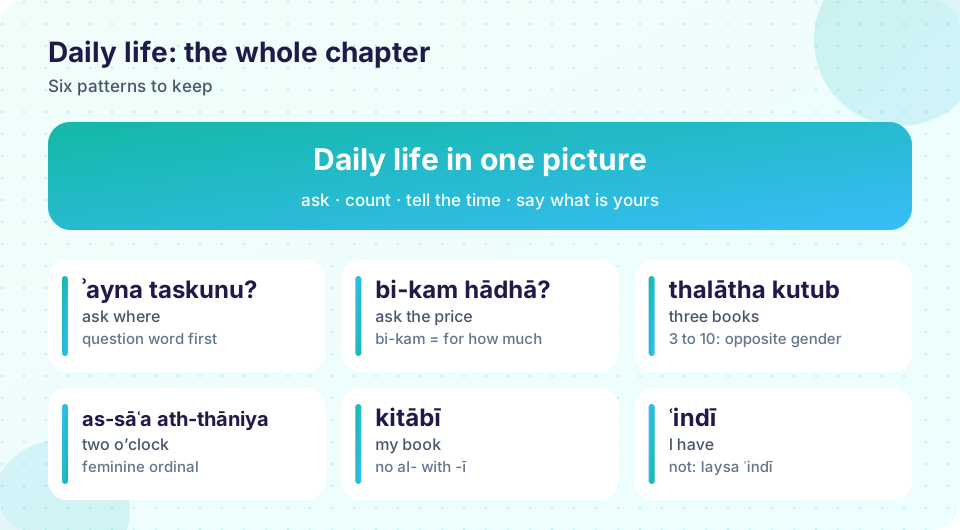
This chapter turned your Arabic into a conversation tool. You can ask who, what, where, when and how much; count and tell the time; and talk about your family, your food and your town. Use this review to find the gaps: do the quiz first, mark what you missed, then reread the matching lesson.
The chapter in one picture: ask, count, tell the time and talk about what is yours. What you will learn#
A single table that holds the whole chapter
How to combine questions, numbers and possessives in one conversation
Where to go back if a rule is still wobbly
Chapter recap#
Topic
The key rules
Examples
Question words
Put the word first; هَلْ for yes/no
أَيْنَ تَسْكُنُ؟ هَلْ تَدْرُسُ؟
Reasons
لِمَاذَا؟ answered by لِأَنَّ لِأَنِّي أُحِبُّ العَرَبِيَّة
Numbers
1 and 2 follow the noun; 3 to 10 take opposite gender; 11+ singular noun
ثَلَاثَة كُتُب , ثَلَاث بَنَات , عِشْرُون سَنَة
Days
الأَحَد to السَّبْت , الجُمُعَة is "the gathering"يَوْم الاثْنَيْن
Time
السَّاعَة + feminine ordinal; وَالنِّصْف , وَالرُّبْع , إِلَّا رُبْعًا السَّاعَة الثَّالِثَة وَالنِّصْف
Possession
Endings -ī, -ka, -ki, -hu, -hā, -nā, -kum, -hum; no ال
كِتَابِي , سَيَّارَتُهَا
Having
عِنْدِي ; negative لَيْسَ عِنْدِي عِنْدَنَا بَيْت كَبِير
Putting it together: a mini conversation#
Here is a short exchange that uses nearly everything from the chapter. Cover the English and see how much you understand.
Arabic
Transliteration
English
مَرْحَبًا! مَا اسْمُكَ؟ marḥaban! mā ismuka?
Hello! What is your name?
اسْمِي كَرِيم. وَأَنْتِ؟ ismī karīm. wa-ʾanti?
My name is Karim. And you?
اسْمِي لَيْلَى. كَمْ عُمْرُكَ؟ ismī laylā. kam ʿumruka?
My name is Layla. How old are you?
عُمْرِي عِشْرُون سَنَة. هَلْ عِنْدَكِ أَخ؟ ʿumrī ʿishrūn sana. hal ʿindaki ʾakh?
I am twenty. Do you have a brother?
نَعَمْ، عِنْدِي أَخَوَان وَأُخْت وَاحِدَة. naʿam, ʿindī ʾakhawān wa-ʾukht wāḥida.
Yes, I have two brothers and one sister.
أَيْنَ تَسْكُنُونَ؟ ʾayna taskunūna?
Where do you (all) live?
نَسْكُنُ فِي القَاهِرَة. naskunu fī l-qāhira.
We live in Cairo.
Notice how the dialogue uses the dual أَخَوَان (ʾakhawān, two brothers). The dual of brother is irregular, so it is a bonus word to remember.
Study plan for the next week#
Day 1-2: Review the question words until you can ask nine different questions without notes.Day 3: Count aloud to ten and to twenty, then say the day and the time.Day 4-5: Describe your family: three people, with names and one fact each (أَخِي يَدْرُسُ فِي الجَامِعَة , my brother studies at the university).Day 6: Write five sentences with عِنْدِي and لَيْسَ عِنْدِي .Day 7: Record yourself saying a short introduction. Listen for mistakes, then say it again.
Self-diagnosis: where to go back#
Mark each quiz question you missed and match it with the topic below.
Question words (quiz 1 to 3 and 9). Reread the lesson on question words and hal, and ask yourself nine questions aloud.Numbers and the gender rule (quiz 4). Say the pairs ثَلَاثَة أَوْلَاد / ثَلَاث بَنَات out loud ten times, then invent your own pairs.Days and time (quiz 5 and 6). Say today's day and the time in Arabic three times a day for a week.Possessives and having (quiz 7, 8 and 10). Rewrite ten English phrases (my book, her school, his father, I have two sisters ) in Arabic and check them.
If you missed more than four questions, repeat the relevant lesson, then retake this quiz after two days. Spacing your review in this way is far more effective than repeating immediately.
Three small conversations to practice#
Turn the chapter into real speech with three tiny role-plays. In the first, you meet someone: ask the name, the origin and the age, and answer the same questions yourself. In the second, you talk about family: ask whether the other person has brothers and sisters, how old they are, and where they live. In the third, you plan a day: ask when, where and with whom, and answer with a day, a time and a place. Each role-play takes two minutes and uses almost every pattern of the chapter. Record yourself and listen for places where you hesitated; those are your next study targets.
Habits to keep after this chapter#
Keep a short daily routine: one question word, one number or time, one family or food word. A learner who spends ten minutes a day for a month will beat one who studies for three hours once a week. The language you now have is already enough for a friendly first conversation, so the next step is to use it with a real person.
Try it#
Build the sentences in the right order. The last one combines a question word and a possessive.
Build the sentence
Reset
< divstyle = " max-width : 640px; margin : 0 auto" > < divclass = " row" style = " justify-content : space-between; margin : 0 0 10px" > < spanclass = " mut" id = " prog" > </ span> < spanclass = " mut" id = " score" > </ span> </ div> < divclass = " card" > < divid = " en" style = " font-size : 19px; text-align : center; margin-bottom : 10px" > </ div> < divid = " ans" class = " ar" lang = " ar" dir = " rtl" style = " min-height : 62px; border-bottom : 3px dashed #c7d2fe; display : flex; flex-wrap : wrap; gap : 8px; padding : 6px" > </ div> < divid = " pool" class = " ar" lang = " ar" dir = " rtl" style = " display : flex; flex-wrap : wrap; gap : 8px; margin-top : 12px" > </ div> < divid = " fb" style = " margin-top : 10px; font-weight : 600; min-height : 24px; text-align : center" > </ div> < divclass = " row" > < buttonclass = " go" id = " chk" > </ button> < buttonid = " rs" > </ button> < buttonid = " nx" style = " display : none" > </ button> </ div> </ div> </ div> < style>
* { box-sizing : border-box}
body { margin : 0; padding : 14px; font-family : system-ui, 'Segoe UI' , sans-serif; background : linear-gradient ( 135deg, #faf5ff, #eff6ff) ; color : #1e1b4b}
.ar { font-family : 'Noto Naskh Arabic' , 'Segoe UI' , 'Traditional Arabic' , Amiri, serif}
button { font : inherit; font-size : 15px; border : 0; border-radius : 999px; padding : 8px 16px; cursor : pointer; background : #fff; color : #1e1b4b; box-shadow : 0 2px 8px rgba ( 67, 56, 202, .18) }
button:hover { transform : translateY ( -1px) }
button.yes { background : linear-gradient ( 135deg, #10b981, #14b8a6) ; color : #fff}
button.no { background : linear-gradient ( 135deg, #f59e0b, #ef4444) ; color : #fff}
button.go { background : linear-gradient ( 135deg, #6366f1, #a78bfa) ; color : #fff}
.card { background : #fff; border-radius : 20px; box-shadow : 0 10px 24px rgba ( 67, 56, 202, .16) ; padding : 18px}
.row { display : flex; gap : 10px; flex-wrap : wrap; align-items : center; justify-content : center; margin-top : 12px}
.mut { color : #475569; font-size : 14px}
</ style> < script>
const items = [ { "en" : "What is your (f.) name?" , "words" : [ "مَا" , "اسْمُكِ" ] , "tr" : "mā ismuki?" } , { "en" : "I have one brother and one sister." , "words" : [ "عِنْدِي" , "أَخ" , "وَاحِد" , "وَأُخْت" , "وَاحِدَة" ] , "tr" : "ʿindī ʾakh wāḥid wa-ʾukht wāḥida." } , { "en" : "We live in a big city." , "words" : [ "نَسْكُنُ" , "فِي" , "مَدِينَة" , "كَبِيرَة" ] , "tr" : "naskunu fī madīna kabīra." } , { "en" : "Where is your (m.) house?" , "words" : [ "أَيْنَ" , "بَيْتُكَ" ] , "tr" : "ʾayna baytuka?" } , { "en" : "She drinks tea with her mother." , "words" : [ "هِيَ" , "تَشْرَبُ" , "الشَّاي" , "مَعَ" , "أُمِّهَا" ] , "tr" : "hiya tashrabu sh-shāy maʿa ʾummihā." } ] ;
const $ = id => document. getElementById ( id) ;
let i = 0 , score = 0 , chosen = [ ] , pool = [ ] , solved = false , tried = false ;
function shuffle ( a ) { a = a. slice ( ) ; for ( let k = a. length - 1 ; k > 0 ; k-- ) { const j = Math. floor ( Math. random ( ) * ( k + 1 ) ) ; [ a[ k] , a[ j] ] = [ a[ j] , a[ k] ] ; } return a; }
function load ( ) {
const it = items[ i] ; solved = false ; tried = false ; chosen = [ ] ; $ ( 'nx' ) . style. display = 'none' ; $ ( 'fb' ) . textContent = '' ;
if ( ! it) { $ ( 'en' ) . textContent = 'Finished: ' + score + ' of ' + items. length + ' sentences built correctly on the first check.' ; $ ( 'ans' ) . innerHTML = '' ; $ ( 'pool' ) . innerHTML = '' ; $ ( 'prog' ) . textContent = '' ; return ; }
let p = it. words. map ( ( w, k ) => k) ;
if ( p. length > 1 ) { let n = 0 ; do { p = shuffle ( p) ; n++ ; } while ( n < 20 && p. every ( ( v, k ) => v === k) ) ; }
pool = p; $ ( 'prog' ) . textContent = 'Sentence ' + ( i + 1 ) + ' of ' + items. length; $ ( 'en' ) . textContent = it. en; draw ( ) ;
}
function chip ( idx, from ) {
const b = document. createElement ( 'button' ) ; b. className = 'ar' ; b. textContent = items[ i] . words[ idx] ; b. style. fontSize = '26px' ;
b. onclick = ( ) => { if ( solved) return ; if ( from === 'pool' ) { pool = pool. filter ( x => x !== idx) ; chosen. push ( idx) ; } else { chosen = chosen. filter ( x => x !== idx) ; pool. push ( idx) ; } draw ( ) ; } ;
return b;
}
function draw ( ) { $ ( 'ans' ) . innerHTML = '' ; $ ( 'pool' ) . innerHTML = '' ; chosen. forEach ( k => $ ( 'ans' ) . appendChild ( chip ( k, 'ans' ) ) ) ; pool. forEach ( k => $ ( 'pool' ) . appendChild ( chip ( k, 'pool' ) ) ) ; $ ( 'score' ) . textContent = 'Score ' + score; }
$ ( 'chk' ) . onclick = ( ) => {
const it = items[ i] ; if ( ! it || solved) return ;
const ok = chosen. length === it. words. length && chosen. every ( ( k, n ) => k === n) ;
if ( ok) { solved = true ; if ( ! tried) score++ ; $ ( 'fb' ) . style. color = '#059669' ; $ ( 'fb' ) . textContent = 'Correct. ' + ( it. tr || '' ) ; $ ( 'nx' ) . style. display = '' ; }
else { tried = true ; $ ( 'fb' ) . style. color = '#dc2626' ; $ ( 'fb' ) . textContent = 'Not yet. Check the word order. Arabic reads from right to left.' ; }
draw ( ) ;
} ;
$ ( 'rs' ) . onclick = ( ) => { if ( solved) return ; pool = items[ i] . words. map ( ( w, k ) => k) ; chosen = [ ] ; draw ( ) ; } ;
$ ( 'nx' ) . onclick = ( ) => { i++ ; load ( ) ; } ;
load ( ) ;
</ script>
Then try a mixed round on numbers, time and possession.
Mixed practice
Reset
< divstyle = " max-width : 620px; margin : 0 auto" > < divclass = " row" style = " justify-content : space-between; margin : 0 0 10px" > < spanclass = " mut" id = " prog" > </ span> < spanclass = " mut" id = " score" > </ span> </ div> < divclass = " card" style = " text-align : center" > < divclass = " ar" lang = " ar" dir = " rtl" id = " q" style = " font-size : 34px; line-height : 1.6" > </ div> < divid = " tr" class = " mut" style = " margin-top : 4px" > </ div> < divid = " en" style = " margin-top : 4px; color : #475569" > </ div> < divclass = " row" id = " opts" > </ div> < divid = " fb" style = " margin-top : 10px; font-weight : 600; min-height : 24px" > </ div> < divclass = " row" > < buttonclass = " go" id = " next" style = " display : none" > </ button> </ div> </ div> </ div> < style>
* { box-sizing : border-box}
body { margin : 0; padding : 14px; font-family : system-ui, 'Segoe UI' , sans-serif; background : linear-gradient ( 135deg, #faf5ff, #eff6ff) ; color : #1e1b4b}
.ar { font-family : 'Noto Naskh Arabic' , 'Segoe UI' , 'Traditional Arabic' , Amiri, serif}
button { font : inherit; font-size : 15px; border : 0; border-radius : 999px; padding : 8px 16px; cursor : pointer; background : #fff; color : #1e1b4b; box-shadow : 0 2px 8px rgba ( 67, 56, 202, .18) }
button:hover { transform : translateY ( -1px) }
button.yes { background : linear-gradient ( 135deg, #10b981, #14b8a6) ; color : #fff}
button.no { background : linear-gradient ( 135deg, #f59e0b, #ef4444) ; color : #fff}
button.go { background : linear-gradient ( 135deg, #6366f1, #a78bfa) ; color : #fff}
.card { background : #fff; border-radius : 20px; box-shadow : 0 10px 24px rgba ( 67, 56, 202, .16) ; padding : 18px}
.row { display : flex; gap : 10px; flex-wrap : wrap; align-items : center; justify-content : center; margin-top : 12px}
.mut { color : #475569; font-size : 14px}
</ style> < script>
const items = [ { "q" : "عِنْدِي ___ بَنَات" , "en" : "I have four daughters." , "options" : [ "أَرْبَعَة" , "أَرْبَع" , "وَاحِدَة" ] , "answer" : 1 , "tr" : "ʿindī ʾarbaʿ banāt" , "note" : "banāt is feminine, so the number drops the ta marbuta." } , { "q" : "___ الجُمُعَة" , "en" : "On Friday (the day of ...)." , "options" : [ "يَوْم" , "سَاعَة" , "بَيْت" ] , "answer" : 0 , "tr" : "yawm al-jumuʿa" , "note" : "yawm = day." } , { "q" : "السَّاعَة ___ وَالنِّصْف" , "en" : "It is half past six." , "options" : [ "السَّادِسَة" , "السَّابِعَة" , "الخَامِسَة" ] , "answer" : 0 , "tr" : "as-sāʿa as-sādisa wa-n-niṣf" , "note" : "Six o'clock is as-sādisa." } , { "q" : "هَذِهِ ___ (our house)" , "en" : "This is our house." , "options" : [ "بَيْتِي" , "بَيْتُنَا" , "بَيْتُهُمْ" ] , "answer" : 1 , "tr" : "hādhihi baytunā" , "note" : "-nā means our." } , { "q" : "___ أَنْتَ؟" , "en" : "Where are you (m.) from?" , "options" : [ "مِنْ أَيْنَ" , "مَنْ" , "كَمْ" ] , "answer" : 0 , "tr" : "min ʾayna ʾanta?" , "note" : "min ʾayna = from where." } , { "q" : "___ تَذْهَبُ إِلَى السُّوق؟" , "en" : "Do you go to the market?" , "options" : [ "لِمَاذَا" , "هَلْ" , "مَاذَا" ] , "answer" : 1 , "tr" : "hal tadhhabu ʾilā s-sūq?" , "note" : "hal asks a yes/no question." } ] ;
const $ = id => document. getElementById ( id) ;
let i = 0 , score = 0 , answered = false ;
function show ( ) {
const it = items[ i] ; answered = false ;
if ( ! it) { $ ( 'q' ) . textContent = '' ; $ ( 'tr' ) . textContent = '' ; $ ( 'en' ) . textContent = 'Finished: ' + score + ' of ' + items. length + ' correct.' ; $ ( 'opts' ) . innerHTML = '' ; $ ( 'fb' ) . textContent = '' ; $ ( 'next' ) . style. display = 'none' ; $ ( 'prog' ) . textContent = '' ; return ; }
$ ( 'prog' ) . textContent = 'Question ' + ( i + 1 ) + ' of ' + items. length; $ ( 'score' ) . textContent = 'Score ' + score;
$ ( 'q' ) . textContent = it. q; $ ( 'tr' ) . textContent = '' ; $ ( 'en' ) . textContent = it. en; $ ( 'fb' ) . textContent = '' ; $ ( 'next' ) . style. display = 'none' ;
$ ( 'opts' ) . innerHTML = '' ;
it. options. forEach ( ( o, k ) => { const b = document. createElement ( 'button' ) ; b. className = 'ar' ; b. lang = 'ar' ; b. dir = 'rtl' ; b. style. fontSize = '24px' ; b. textContent = o; b. onclick = ( ) => pick ( k, b) ; $ ( 'opts' ) . appendChild ( b) ; } ) ;
}
function pick ( k, b ) {
if ( answered) return ; answered = true ; const it = items[ i] ;
if ( k === it. answer) { score++ ; b. className += ' yes' ; $ ( 'fb' ) . style. color = '#059669' ; $ ( 'fb' ) . textContent = 'Correct. ' + ( it. note || '' ) ; }
else { b. className += ' no' ; $ ( 'fb' ) . style. color = '#dc2626' ; $ ( 'fb' ) . textContent = 'Not quite. The answer is ' + it. options[ it. answer] + '. ' + ( it. note || '' ) ; }
$ ( 'tr' ) . textContent = it. tr || '' ; $ ( 'score' ) . textContent = 'Score ' + score; $ ( 'next' ) . style. display = '' ;
}
$ ( 'next' ) . onclick = ( ) => { i++ ; show ( ) ; } ;
show ( ) ;
</ script>
Check your understanding#
1. Which question word asks "where"?
A
مَتَى
B
أَيْنَ
C
لِمَاذَا
2. How do you ask "How much is this?"
A
بِكَمْ هَذَا؟
B
كَيْفَ هَذَا؟
C
مَنْ هَذَا؟
3. What is the job of هَلْ?
A
It means who
B
It starts a yes/no question
C
It makes a verb negative
4. How do you say "four girls" (bint is feminine)?
A
أَرْبَعَة بَنَات
B
بَنَات أَرْبَع
C
أَرْبَع بَنَات
5. Which day means "the gathering"?
A
السَّبْت
B
الجُمُعَة
C
الخَمِيس
6. How do you say a quarter to five?
A
السَّاعَة الخَامِسَة وَالرُّبْع
B
السَّاعَة الرَّابِعَة وَالنِّصْف
C
السَّاعَة الخَامِسَة إِلَّا رُبْعًا
7. How do you say "his father"?
A
أَبِيهُ
B
أَبُوهُ
C
أَبُوكَ
8. How do you say "I have two sisters"?
A
عِنْدَهَا أُخْتَان
B
عِنْدِي أُخْتَان
C
لَيْسَ عِنْدِي أُخْت
9. What does لِأَنِّي mean?
A
Where I
B
Because I
C
When I
10. Which is correct for "her school"?
A
المَدْرَسَتُهَا
B
مَدْرَسَةُهَا
C
مَدْرَسَتُهَا
Summary#
Question words, numbers, time and possession combine in everyday conversation.
Keep checking the three small rules: number-gender polarity, no ال with possessive endings and ة → ت before endings.
Review a little every day and speak aloud.
Next: Past tense and sentences: the big picture