


















Lesson 29 of 45 · Daily Life and Questions
Numbers, Days and Telling Time
Count in Arabic from zero to ten, learn the tens, the seven days of the week and how to tell the time, with the number-noun rules explained.
Numbers, days and the clock appear in every plan you will ever make: a price, an appointment, a phone number, a bus time. Arabic numbers have one famous twist, a gender rule that seems backwards at first, but the rest is gentle. You will meet two number systems, learn the seven days (each name has a nice story) and finish by saying the time out loud.
What you will learn
- The Arabic words and digits for 0 to 10, and the tens, 100 and 1,000
- How numbers behave with nouns, including the "opposite gender" rule for 3 to 10
- The seven days of the week and what they mean
- How to ask for and tell the time
Key terms
Eastern Arabic numerals (٠ ١ ٢ ٣): the digit shapes used in many Arabic-speaking countries, especially in the Middle East and Egypt.
Dual: a special noun form for exactly two things, ending in -āni.
Ordinal number: a number that gives position, like third. Hours are told with ordinals.
Gender polarity: the rule that numbers 3 to 10 take the opposite gender from the thing they count.
Numbers from zero to ten
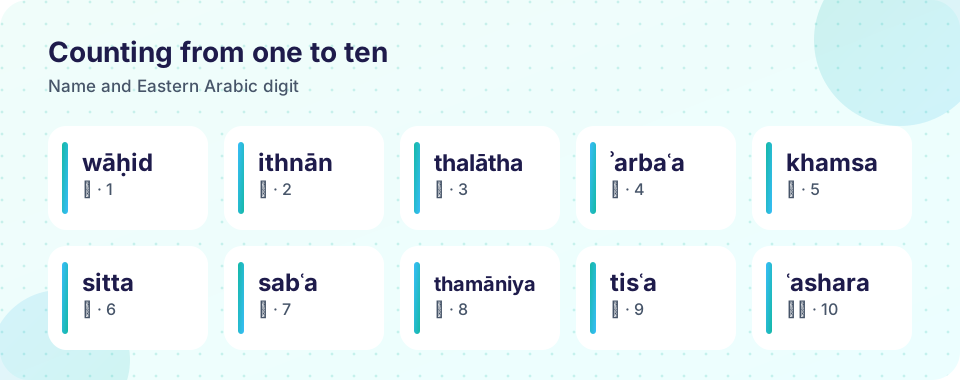
| Digit | Arabic | Transliteration | Digit | Arabic | Transliteration |
|---|---|---|---|---|---|
| ٠ 0 | صِفْر | ṣifr | ٦ 6 | سِتَّة | sitta |
| ١ 1 | وَاحِد | wāḥid | ٧ 7 | سَبْعَة | sabʿa |
| ٢ 2 | اثْنَان | ithnān | ٨ 8 | ثَمَانِيَة | thamāniya |
| ٣ 3 | ثَلَاثَة | thalātha | ٩ 9 | تِسْعَة | tisʿa |
| ٤ 4 | أَرْبَعَة | ʾarbaʿa | ١٠ 10 | عَشَرَة | ʿashara |
| ٥ 5 | خَمْسَة | khamsa |
The digits are written left to right, even though the words around them read right to left, so ١٢٣ is read one, two, three. Two traps: ٥ looks like a zero and ٠ is only a dot. Morocco, Algeria and Tunisia usually write with the digits 0 to 9 you already know, so you will meet both systems.
Beyond ten: عِشْرُون (ʿishrūn, 20), ثَلَاثُون (thalāthūn, 30), أَرْبَعُون (ʾarbaʿūn, 40), خَمْسُون (khamsūn, 50), مِائَة (miʾa, 100) and أَلْف (ʾalf, 1,000). The tens are easy to recognize: they all end in -ūn, like the masculine plural.
Numbers with nouns
Counting a noun follows three rules. Do not try to master them all at once. Learn the pattern and let examples carry you.
- One and two come after the noun and agree with it. The number two is usually shown by the dual ending: كِتَاب وَاحِد (kitāb wāḥid, one book), بِنْت وَاحِدَة (bint wāḥida, one girl), كِتَابَانِ (kitābāni, two books), بِنْتَانِ (bintāni, two girls).
- Three to ten come before a plural noun, and the number takes the opposite gender. A masculine noun uses the number with ة (the form on the chart above), while a feminine noun uses the number without it: ثَلَاثَة كُتُب (thalāthat kutub, three books; kitāb is masculine) but ثَلَاث بَنَات (thalāth banāt, three girls; bint is feminine). Four gives أَرْبَعَة أَوْلَاد (four boys) and أَرْبَع سَيَّارَات (four cars).
- Eleven and above use a singular noun: عِشْرُون سَنَة (ʿishrūn sana, twenty years), عُمْرِي عِشْرُون سَنَة (ʿumrī ʿishrūn sana, I am twenty years old).
A helpful trick: think of the feminine ة as a tag that the number wears when it counts a masculine noun. Everyday speech in many dialects drops the polarity rule, so do not worry about perfection.
The days of the week
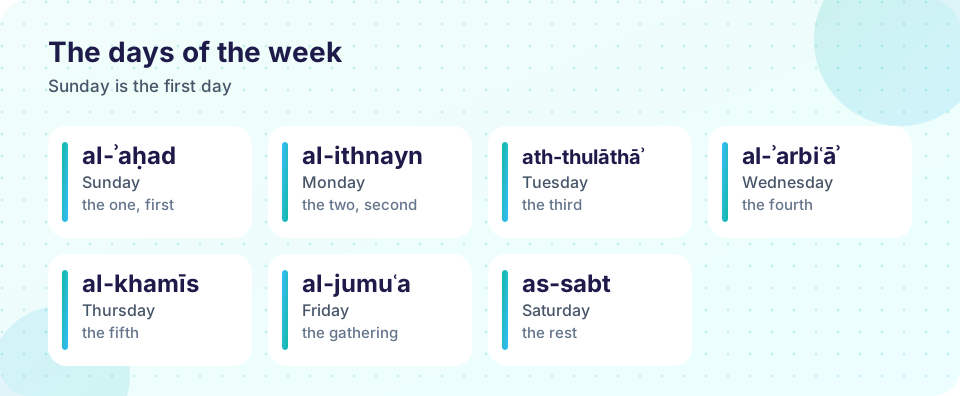
The names of most days come from numbers. الأَحَد (al-ʾaḥad) shares a root with one: the first day. الاثْنَيْن (al-ithnayn) is the second day, الثُّلَاثَاء (ath-thulāthāʾ) the third, الأَرْبِعَاء (al-ʾarbiʿāʾ) the fourth and الخَمِيس (al-khamīs) the fifth. الجُمُعَة (al-jumuʿa) means "the gathering": it is the day of the main congregational prayer for Muslims. السَّبْت (as-sabt) shares its root with the Hebrew Shabbat and means the day of rest.
The week starts on Sunday in the traditional Arabic reckoning. Weekends differ by country: many places rest on Friday, and some also on Saturday or on Thursday and Friday. If you plan something with Arabic speakers, ask which days they work.
To say on Monday, add يَوْم (yawm, day) before the name: يَوْم الاثْنَيْن (yawm al-ithnayn). To say every day, use كُلَّ يَوْم (kulla yawm). Useful time words: اليَوْم (today), غَدًا (tomorrow), أَمْسِ (ʾamsi, yesterday), الآنَ (al-ʾān, now), فِي الصَّبَاح (in the morning), فِي المَسَاء (in the evening), فِي اللَّيْل (at night).
Telling the time
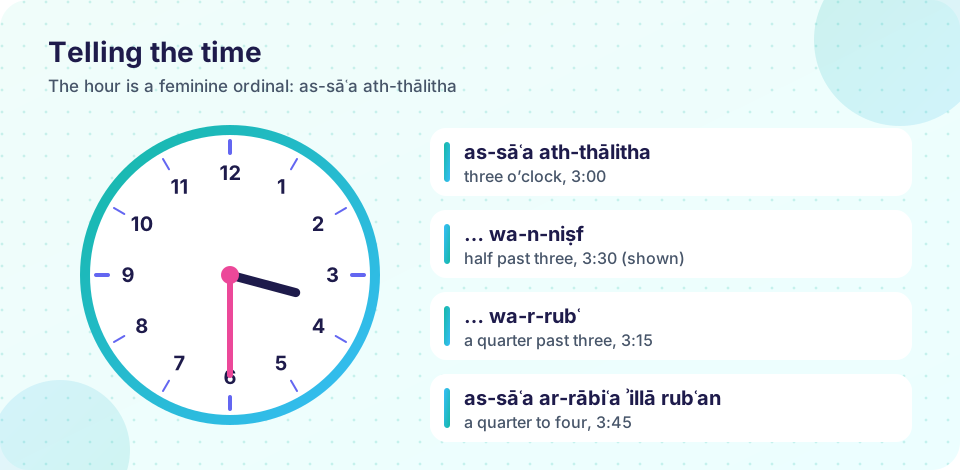
Ask with كَمِ السَّاعَة؟ (kami s-sāʿa?, what time is it?). Answer with the word السَّاعَة (as-sāʿa, the hour; also watch, clock) and a feminine ordinal number, because سَاعَة is a feminine noun:
| Hour | Arabic | Transliteration |
|---|---|---|
| 1 | الوَاحِدَة | al-wāḥida |
| 2 | الثَّانِيَة | ath-thāniya |
| 3 | الثَّالِثَة | ath-thālitha |
| 4 | الرَّابِعَة | ar-rābiʿa |
| 5 | الخَامِسَة | al-khāmisa |
| 6 | السَّادِسَة | as-sādisa |
| 7 | السَّابِعَة | as-sābiʿa |
| 8 | الثَّامِنَة | ath-thāmina |
| 9 | التَّاسِعَة | at-tāsiʿa |
| 10 | العَاشِرَة | al-ʿāshira |
Then add the extra minutes:
- السَّاعَة الثَّالِثَة. (as-sāʿa ath-thālitha.) It is three o'clock.
- السَّاعَة الثَّالِثَة وَالنِّصْف. (… wa-n-niṣf.) Half past three, 3:30.
- السَّاعَة الثَّالِثَة وَالرُّبْع. (… wa-r-rubʿ.) A quarter past three, 3:15.
- السَّاعَة الرَّابِعَة إِلَّا رُبْعًا. (… illā rubʿan.) A quarter to four, 3:45.
To say at a time, put فِي in front: أَذْهَبُ إِلَى المَدْرَسَة فِي السَّاعَة الثَّامِنَة. (ʾadhhabu ʾilā l-madrasa fī s-sāʿa ath-thāmina.) I go to school at eight.
Reading phone numbers, prices and dates
In real life you rarely count to ten; you read digits. Phone numbers are usually spoken digit by digit, and each digit is a number you already know. A price such as ٢٥ is spoken as a tens word plus a ones word joined by وَ (and): خَمْسَة وَعِشْرُون (khamsa wa-ʿishrūn, "five and twenty"). In Arabic the ones come first, like the old English five and twenty. Read the digits on shop signs and bus numbers as you walk around; every sign is free practice.
For the order of events you need ordinal numbers: first, second, third. The masculine forms are الأَوَّل (al-ʾawwal), الثَّانِي (ath-thānī), الثَّالِث (ath-thālith), الرَّابِع (ar-rābiʿ) and الخَامِس (al-khāmis). They follow the noun and take ال when the noun is definite: اليَوْم الأَوَّل (the first day). With a feminine noun they take the feminine form you saw in the clock phrases: المَرَّة الأُولَى (al-marra al-ʾūlā, the first time).
Why the number rules feel backwards
The "opposite gender" rule for three to ten puzzles nearly every learner, so here is a way to remember it. Think of the ة as a decoration that the number wears when it stands next to a masculine noun. When the noun is feminine, the number takes the decoration off. That is all: masculine noun, number with ة (ثَلَاثَة كُتُب); feminine noun, number without ة (ثَلَاث بَنَات). The rule has a historical reason, but you do not need the history to use it. What you do need is repetition. Say the six pairs in the Python helper above out loud, then invent your own: أَرْبَعَة أَقْلَام (four pens) and خَمْس سَيَّارَات (five cars).
Common beginner mistakes with numbers and time
- Using the number with the wrong gender. Fix: ask, "Is the noun masculine or feminine?" before you speak.
- Putting three to ten after the noun. Fix: remember they come before a plural noun.
- Saying the hour with a plain number instead of an ordinal. Fix: at three o'clock is السَّاعَة الثَّالِثَة, never السَّاعَة ثَلَاثَة.
- Mixing up Eastern and Western digits. Fix: practice reading ٣ and ٧ and ٨ and ٩ until they are as familiar as 3, 7, 8 and 9.
A good drill is to narrate your day. Each time you look at a clock, say the time in Arabic. Each time you take a bus, read the number. In a week your numbers will be much faster.
Common misconceptions
"Arabic digits are written right to left." Digits inside a number read left to right, exactly like ours. Only the letters of words read right to left.
"٥ is 0." It only looks like one. The number zero is ٠, a small dot.
"Three to ten agree with the noun's gender." They take the opposite gender. A masculine noun uses the number with ة, a feminine noun the number without it.
Try it
First, a flash-card round with the numbers and the days.
The next program is a stand-in clock phrase generator. It applies the rules above to build time phrases. Change hour and minute to try your own times (minute 0, 15, 30 or 45).
Press Run (or Ctrl + Enter) to see the result here.
Program input · what you'd type while the program runs
Type the answers before you press Run, one per line. Each time the program reads a line (with input()), it gets the next line from this box.
And a counting helper: it picks the right number form for a masculine or feminine noun.
Press Run (or Ctrl + Enter) to see the result here.
Program input · what you'd type while the program runs
Type the answers before you press Run, one per line. Each time the program reads a line (with input()), it gets the next line from this box.
Check your understanding
Quick check · 5 questions
of 5 answered You scored / 5 · perfect!
-
1. How do you write "three books" (kitāb is masculine)?
Three to ten take the opposite gender: a masculine noun uses the number with ة, so thalātha kutub. -
2. What does الجُمُعَة mean literally?
al-jumuʿa comes from a root meaning to gather; it is the day of the congregational prayer. -
3. How do you say "half past three"?
wa-n-niṣf means "and the half", so as-sāʿa ath-thālitha wa-n-niṣf. -
4. Which number is written ٧?
٧ is seven: sabʿa, سَبْعَة. -
5. What follows numbers 11 and above?
From eleven up the counted noun is singular: ʿishrūn sana, twenty years.
Summary
- Learn the numbers 0 to 10, then the tens; digits read left to right.
- One and two follow the noun and agree with it; three to ten take the opposite gender; eleven and up take a singular noun.
- The days run from الأَحَد (first) to السَّبْت (rest); الجُمُعَة means "the gathering".
- Tell time with السَّاعَة plus a feminine ordinal, then وَالنِّصْف, وَالرُّبْع or إِلَّا رُبْعًا.
Next: Family, food and places
Track your progress
Create a free account to tick off lessons and pick up where you left off on any device.
of Arabic for Beginners lessons completed