


















Lesson 10 of 45 · Letters and Sounds
Chapter 2 Review: Letters and Sounds
Review all 28 Arabic letters: shape families, dots, plain versus emphatic sounds, throat letters and long vowels, with a speed-round game and a 10-question quiz.
You now know every letter of the Arabic alphabet by name, shape and sound, at least in the isolated form. That is a real milestone: many learners spend months on this part. The review below pulls the chapter together into one picture, a table of what to remember and a self-test. Spend most of your time on the speed round and the quiz, because retrieving letters from memory is what makes them stick.
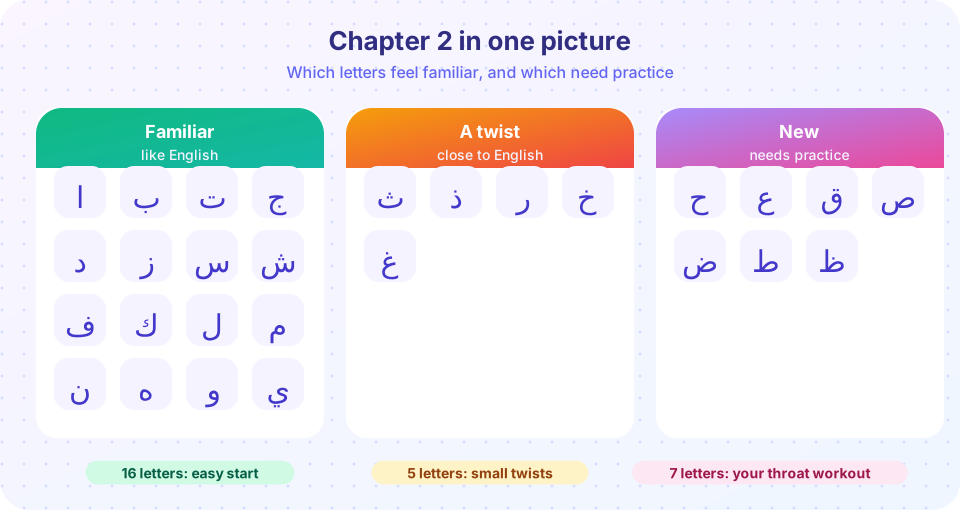
What you will learn
- A compact recap of the 28 letters, grouped by what trips learners up.
- A checklist of the sounds that cause the most errors.
- A speed round to practice recognizing all 28 letters.
- A ten-question quiz covering the whole chapter.
Key terms
Shape family: letters with a shared body, such as ب ت ث or ج ح خ.
Emphatic: ص ض ط ظ, with the tongue's back pulled toward the throat.
Pharyngeal: ح and ع, made in the throat.
Non-joiner: ا د ذ ر ز و, which never connect to the following letter.
Minimal pair: two words that differ in only one sound, like kalb and qalb.
The chapter in a table
| Group | Letters | What to remember |
|---|---|---|
| Alif and the long vowels | ا و ي | Long ā, ū, ī; و and ي are also the consonants w and y |
| The ba family | ب ت ث ن | One body; one dot below, two above, three above, one above |
| The jim family | ج ح خ | Dot inside, no dot, dot above: j, ḥ, kh |
| Dental and ridge | د ذ ت ط ن ل | Tongue at the teeth or behind them |
| Sibilants | ز س ش | z, s, sh; sīn has three teeth, shīn adds three dots |
| Emphatics | ص ض ط ظ | Plain partner plus the back of the tongue pulled back |
| The rolled r | ر | One quick tap |
| Throat and gargle | ح ع خ غ ق | ḥ whisper, ʿ squeeze, kh scrape, gh gargle, q deep k |
| Others | ف ك م ه | f, k, m, h, close to English |
The six most common mistakes
- Writing the dots wrong. The number and position of dots are part of the letter. Check them in every word you write.
- Replacing ح with ه. One is a whispered throat sound, the other a plain h. Practice ḥubb (love) versus hubb.
- Replacing ع with ا or with nothing. ʿayn is a consonant. Practice ʿarabī.
- Ignoring emphatics. sayf and ṣayf are different words.
- Pronouncing ق as ك. kalb (dog) and qalb (heart) are different words.
- Shortening long vowels. The length of ā, ī, ū is part of the word, and kataba (he wrote) is a different word from kātaba (he corresponded with).
A study plan for the next week
- Day 1 to 2: Write each letter ten times from memory, reading the sound aloud.
- Day 3: Practice only the confusable letters: ب ت ث ن ي; ج ح خ; د ذ; ر ز; س ش; ص ض; ط ظ; ع غ; ف ق.
- Day 4: Say the 15 words of Letters 18 to 28 and the example words of the two earlier letter lessons.
- Day 5: Take the speed round below until you reach 25 in a row.
- Day 6 to 7: Look for Arabic letters on packaging, apps and signs and say them silently.
How to know you are ready for Chapter 3
You are ready to move on when you can do three things without peeking. First, name every letter in the alphabet in order in under a minute. Second, say the sound of any letter on a flashcard in a second or two, including the throat letters. Third, tell apart the look-alike families, for example by pointing to which of ب ت ث has two dots above. If you cannot do this yet, spend a few more days with the speed round before you continue; the joining rules of the next chapter assume that you recognize the base shapes quickly.
Try it
Press Run (or Ctrl + Enter) to see the result here.
Program input · what you'd type while the program runs
Type the answers before you press Run, one per line. Each time the program reads a line (with input()), it gets the next line from this box.
If the Python block prints Complete alphabet: True, the groups above cover every letter exactly once. You can reorganize the families in your own flashcards: grouping by shape is the fastest way to learn Arabic letters.
Common misconceptions
"Once I know the isolated letters, I can read." Letters change shape when they join, as you will see in Chapter 3. You also need the vowel marks.
"Transliteration is accurate enough." It is a rough guide. The emphatics, ح, ع and ق have no clean Latin spelling; train your ear.
"I must get every sound perfect before moving on." No. Keep practicing the hard sounds each day, but progress to reading while you do.
Check your understanding
Quick check · 10 questions
of 10 answered You scored / 10 · perfect!
-
1. Which letters make up the emphatic set?
ص ض ط ظ are the emphatics, paired with س د ت ذ. -
2. Which letter is a voiced throat squeeze?
ʿayn (ع) is voiced; ḥā' (ح) is its whispered partner. -
3. How many letters never join to the next letter?
Alif, dāl, dhāl, rā', zāy and wāw: six in total. -
4. Which pair of words is a minimal pair for ك versus ق?
Kalb (dog) and qalb (heart) differ only in the first letter. -
5. Which letter has two dots above?
Tā' has two dots above; yā' has two dots below; thā' has three above; nūn has one. -
6. What does the letter ث sound like?
Thā' is the voiceless th of 'think'; dhāl is the voiced th of 'this'. -
7. Which letter is a tapped or rolled r?
Rā' (ر) is tapped; zāy (ز) is a z. -
8. In which letter family do ج ح خ belong?
They share one hook-shaped body, differing only in the dot. -
9. Which letter is the plain h, without any throat squeeze?
Hā' (ه) is a simple breath; ḥā' (ح) is the throat sound. -
10. Which three letters can stand for long vowels?
Alif (ā), wāw (ū) and yā' (ī) double as long vowels.
Summary
- The 28 letters group into shape families, with dots separating family members.
- Six letters (ا د ذ ر ز و) never join forward.
- ث/ذ are the two English th sounds; ص ض ط ظ are the emphatics; ح ع خ غ ق are the throat and gargle sounds.
- و and ي are consonants (w, y) and long vowels (ū, ī).
- Practice with daily flashcards and look for letters in real life.
Track your progress
Create a free account to tick off lessons and pick up where you left off on any device.
of Arabic for Beginners lessons completed