


















Lesson 8 of 45 · Letters and Sounds
Letters 10 to 17: Rā’ to Ẓā’
Learn Arabic letters rā', zāy, sīn, shīn, ṣād, ḍād, ṭā' and ẓā': the rolled r, the sibilants and the four emphatic consonants, with words and drills.
This lesson gives you eight letters: the rolled r, the buzzing z, the hissing s and sh, and four letters that make Arabic sound like Arabic, the emphatics. The first four are easy. The last four are the first real challenge of the alphabet, but they follow a single rule, and once you hear it you can apply it to all of them. Take your time with the emphatics and practice them out loud next to their plain partners.
What you will learn
- The names, sounds and shapes of ر ز س ش ص ض ط ظ.
- How to roll or tap the Arabic r.
- What an emphatic consonant is and how to make one.
- How emphatic letters change the vowels around them.
- Which words contrast plain and emphatic letters.
Key terms
Emphatic consonant: a consonant pronounced with the root of the tongue pulled back toward the throat, giving it a darker, heavier sound (also called pharyngealized).
Sibilant: a hissing consonant such as s, z, sh.
Tap / trill: an r made by one quick tongue flick (tap) or several (trill).
Minimal pair: two words that differ in only one sound, such as sayf and ṣayf.
Non-joiner: ر and ز do not connect to the letter that follows.
Rā’ (ر) and zāy (ز)
Both letters have the same shape, a short swoop that dips below the line, and neither joins to the next letter. The difference is a single dot: ز has one dot above, ر has none.
- ر (rā’) is a rolled or tapped r, like the Spanish pero or the Scottish r. Touch the tip of your tongue once, quickly, against the ridge behind your upper teeth. A single tap is fine; a longer trill appears when the letter is doubled. Avoid the English "r" in red, which pulls the tongue back instead of tapping.
- ز (zāy) is z as in zoo.
Examples: رَجُل (rajul, "man"), رَبِيع (rabīʿ, "spring season"), زَيْت (zayt, "oil"), زَهْرَة (zahra, "flower").
Sīn (س) and shīn (ش)
These two letters share a distinctive body: three little teeth, followed by a tail. ش has three dots above the teeth; س has none.
- س (sīn) is s as in sun (never a "z" sound).
- ش (shīn) is sh as in ship.
Examples: سَمَك (samak, "fish"), سَاعَة (sāʿa, "hour, clock, watch"), شَمْس (shams, "sun"), شَاي (shāy, "tea"). The word reached Arabic through Persian.
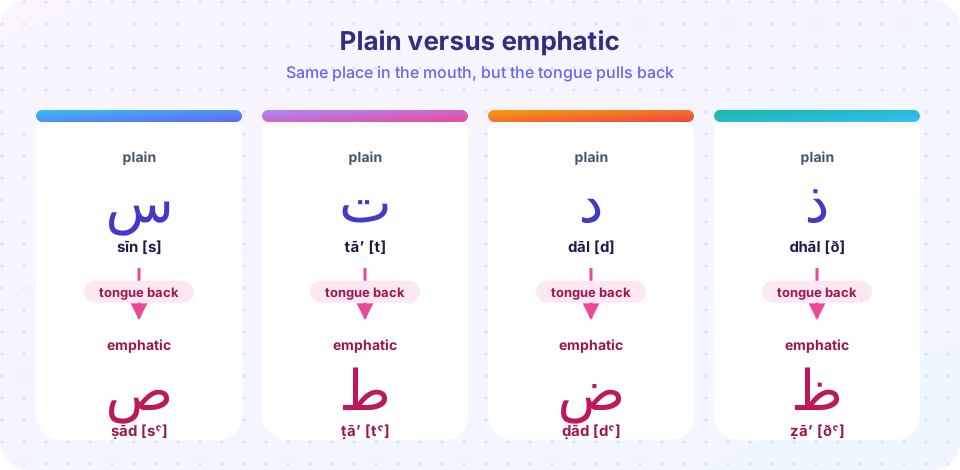
The emphatics: ص ض ط ظ
The four emphatic letters come in two shape families:
| Letter | Name | Dot | Plain partner | Rough sound |
|---|---|---|---|---|
| ص | ṣād | none | س | dark s |
| ض | ḍād | one above | د | dark d |
| ط | ṭā’ | none | ت | dark t |
| ظ | ẓā’ | one above | ذ | dark voiced th |
Shape: ص and ض begin with a closed loop sitting on the line, then a tail that curves down and to the left. ط and ظ have a closed loop at the base and a tall upright stroke through it, like a lollipop with a stick. ض and ظ are the same as ص and ط with one dot above.
Sound: for each emphatic letter, make the plain partner first (say s), then keep the tip of your tongue in place while you pull the back of your tongue back and up toward your throat, as if you were about to say "aw". You will feel your jaw drop slightly and your mouth space deepen. The sound is darker and fuller, with an echo of "ah". Linguists call this pharyngealization.
The emphatic effect on vowels
Emphatics do not just change themselves: they color the vowels next to them. The "a" sound next to a plain consonant is a bright vowel like the "a" in cat. Next to an emphatic, it becomes a darker one, nearer the "a" in father or even the "o" of "saw". The vowels i and u are also affected, though less. The effect is strong enough that a learner who ignores it will sound clearly foreign, and sometimes be misunderstood.
Practice these minimal pairs aloud. In each, only the first consonant (and the shade of the vowel) changes:
| Plain | Emphatic |
|---|---|
| سَيْف sayf (sword) | صَيْف ṣayf (summer) |
| تِين tīn (figs) | طِين ṭīn (mud) |
| دَرْب darb (path) | ضَرْب ḍarb (hitting) |
Arabic is sometimes called لُغَة الضَّاد (lughat aḍ-ḍād, "the language of the ḍād"), because ض is considered the most distinctive sound of the language.
Regional note: in Egypt and much of the Levant, ظ is often pronounced like ض or like an emphatic z, and ث and ذ may sound like t and d or like s and z. MSA keeps all the old distinctions, and you should too, though you will hear the shifts.
Example words
| Arabic | Transliteration | Meaning |
|---|---|---|
| رَجُل | rajul | man |
| زَيْت | zayt | oil |
| سَمَك | samak | fish |
| شَمْس | shams | sun |
| صَبَاح | ṣabāḥ | morning |
| ضَيْف | ḍayf | guest |
| طَالِب | ṭālib | student |
| ظِلّ | ẓill | shadow |
The mark over the last word's final consonant is a shadda, which doubles the sound: ظِلّ is read ẓill, with a long, held "l". Chapter 3 covers it.
Practice routine for the emphatics
- Say the plain letter and its partner alternately: s-ṣ, s-ṣ, d-ḍ, d-ḍ, t-ṭ, t-ṭ.
- Say them with each long vowel: sā, ṣā, sī, ṣī, sū, ṣū. Notice how ā darkens after ṣ.
- Record yourself and listen for the difference.
- Use the words above in a sentence-sized loop: "sayf, ṣayf, sayf, ṣayf".
Do not exaggerate. Native speakers do not push the sound; they just keep the back of the tongue slightly lowered and retracted. Over-stress sounds as unnatural as under-stress.
How emphasis spreads through a word
Emphatic consonants are special because their effect does not stay on one letter. In a word with an emphatic, the dark quality spreads to the nearby vowels, and in many accents to the whole syllable or even the whole word. Compare سَاعَة (sāʿa, "hour") with صَابِر (ṣābir, "patient"): the first has a bright, front ā, the second has a dark, back ā. In طَالِب (ṭālib, "student") the whole first syllable is dark; in تَالِي (tālī, "following") it is light. The i of ṭālib is slightly affected too. This is not a different vowel in the spelling, only a different color in speech, and Arabic spelling does not mark it. You absorb it by listening.
Pronouncing the rolled r
A tap is easier than a trill. Say the English word "butter" quickly, as an American would, so the middle consonant becomes a quick flap. That flap is very close to a single Arabic ر. To trill, keep the tip of your tongue loose and let the air make it flutter. Many learners find it helps to start from the sound "d" and say "dddr" with a relaxed tongue. If you cannot yet roll, a tap is accepted by everyone. Spanish speakers and Scots will have a head start.
A small recording routine
Choose five words from this lesson (for example samak, shams, ṣabāḥ, ḍayf, ṭālib). Record yourself saying each twice, then listen to a native speaker (a tutor, a language partner or a recording from a course) and compare the vowel colors. Do not try to fix everything. Pick one difference to correct per session. After a week the improvements add up.
Try it
Press Run (or Ctrl + Enter) to see the result here.
Program input · what you'd type while the program runs
Type the answers before you press Run, one per line. Each time the program reads a line (with input()), it gets the next line from this box.
Telling s, sh and ṣ apart by eye
For reading, remember that the three-tooth letters س ش have a long, low tail, while ص ض begin with a closed loop. A quick check when you are unsure: look for the loop. If there is a loop, the letter is an emphatic; if there are only teeth, it is plain.
Common misconceptions
"Emphatic just means louder." Emphasis here has nothing to do with volume. It is a tongue position that darkens the sound and the neighboring vowels.
"ر is the same as the English r." The English r is made with the tongue pulled back, without touching. The Arabic r taps the ridge behind the teeth.
"س and ص are interchangeable since they both sound like s." They are different letters, and swapping them changes words, as sayf (sword) and ṣayf (summer) show.
Check your understanding
Quick check · 6 questions
of 6 answered You scored / 6 · perfect!
-
1. Which letter is the emphatic partner of س?
ṣād (ص) is the emphatic partner of sīn (س); ḍād (ض) pairs with dāl. -
2. How many dots does ش have, and where?
Shīn has three dots above its three teeth; sīn has none. -
3. What do emphatic consonants do to nearby vowels?
Emphatics pull the tongue back, giving nearby vowels a darker quality. -
4. What is the Arabic r like?
Rā' is tapped or rolled with the tip of the tongue. -
5. Which pair is a minimal pair of plain and emphatic?
Tīn (figs) and ṭīn (mud) differ only in ت versus ط. -
6. Which letters do NOT join to the letter after them?
Rā' and zāy join only backward, like alif, dāl, dhāl and wāw.
Summary
- ر is a tapped r; ز is z, the same shape with one dot.
- س is s and ش is sh; they share three teeth, with three dots for sh.
- ص ض ط ظ are emphatic partners of س د ت ذ: same tongue tip, but the back of the tongue is pulled toward the throat.
- Emphatics darken neighboring vowels.
- Practice with minimal pairs such as sayf/ṣayf and tīn/ṭīn.
Track your progress
Create a free account to tick off lessons and pick up where you left off on any device.
of Arabic for Beginners lessons completed