


















Lesson 7 of 45 · Letters and Sounds
Letters 1 to 9: Alif to Dhāl
Learn the first nine Arabic letters (alif, ba, ta, tha, jim, ha, kha, dal, dhal) with sounds, dot patterns, writing tips, example words and practice.
Your first nine letters include the very first letter of the alphabet, two shape families and a pair of sounds that English speakers know well, the two "th" sounds. By the end of this lesson, you will recognize all nine at a glance, know how each is pronounced and be able to read your first real Arabic words. Take it slowly: say each letter's name aloud, trace its shape in the air and then write it on paper from right to left.
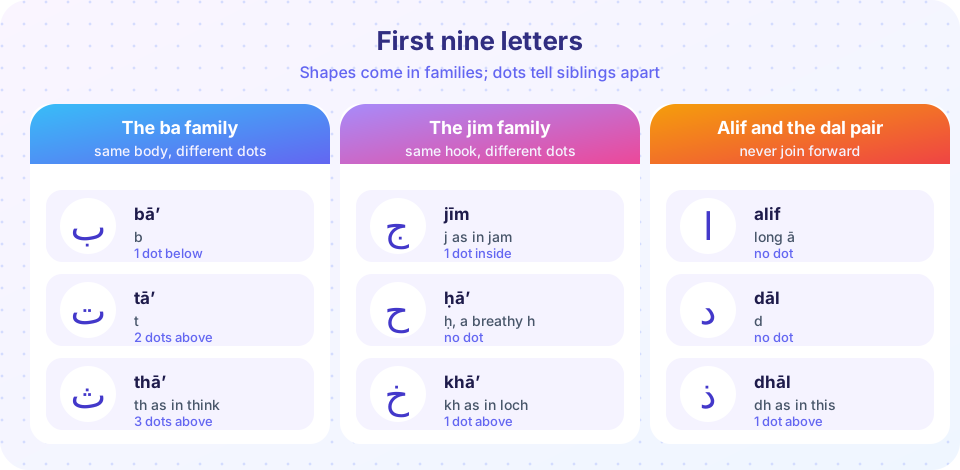
What you will learn
- The name, sound and shape of each letter from alif to dhāl.
- How dots separate ب ت ث and ج ح خ.
- How to make the throat sounds ḥ and kh.
- How to tell the voiced ذ from the unvoiced ث.
- Nine real words, and why a word's vowels are not all visible.
Key terms
Voiced / voiceless: a sound is voiced when your vocal cords vibrate (b, d, dh) and voiceless when they do not (t, th, s). Touch your throat to feel the difference.
Fricative: a consonant made by forcing air through a narrow gap, like s, f, kh or ḥ.
Dental: made with the tongue against or near the teeth, like Arabic ت د.
Skeleton: the string of consonants of a word without its short vowels.
Alif (ا): the first letter
Alif is a plain vertical stroke, drawn from the top down. It is not the letter "a" in the English sense. At the beginning of a word it is silent and merely carries other marks, and inside or at the end of a word it stands for the long vowel ā, as in the "a" of "father" held a little longer. You will meet its job as a carrier of the glottal stop in Chapter 3. For now, remember that alif is a vowel of length.
Example: بَاب (bāb, "door"). The alif is the middle letter, giving the long ā.
The ba family: ب ت ث
Three letters share one body, a shallow bowl that rests on the line. Only the dots change.
| Letter | Name | Dots | Sound |
|---|---|---|---|
| ب | bā’ | one below | b as in bat |
| ت | tā’ | two above | t, with the tongue touching the back of the upper teeth, and no puff of air |
| ث | thā’ | three above | th as in think (voiceless) |
The Arabic t is lighter than the English one. Put the tip of your tongue against the back of your upper teeth, and release the sound without the burst of air you add in English "top".
Examples: بَيْت (bayt, "house"), تِين (tīn, "figs"), ثَلْج (thalj, "snow").
The jim family: ج ح خ
Three letters share a hook shape. The body begins with a short top stroke, curves down and left and finishes in a cup.
| Letter | Name | Dot | Sound |
|---|---|---|---|
| ج | jīm | one inside the cup | j as in jam in most of the Arab world |
| ح | ḥā’ | none | ḥ, a breathy whisper from the throat |
| خ | khā’ | one above | kh, like the ch in Scottish loch or German Bach |
Jīm varies by region: it is [dʒ] in the Gulf, Iraq and in formal reading, [ʒ] (like the s in measure) in the Levant and North Africa, and a hard "g" in Egypt. For MSA, say it like the English j.
Ḥā’ is the first letter that has no English equivalent. To make it, imagine you are fogging a cold window or whispering the "h" in "hot" while squeezing the back of your throat a little. Do not scrape; keep it soft and airy. It is not the plain English h, which you will meet as ه in Chapter 2's third lesson. Many learners pronounce ح as a plain h at first, which turns ḥabb (seed) into the unrelated habb (to blow).
Khā’ is a rough, scraping sound from the back of the mouth, like clearing your throat gently.
A minimal pair to practice: خَبَر (khabar, "news") and حِبْر (ḥibr, "ink"). Say them alternately, one with a scrape and one with a whisper.
Examples: جَمَل (jamal, "camel"), حَلِيب (ḥalīb, "milk"), خُبْز (khubz, "bread").
The dāl pair: د ذ
Two small letters like a curved hook or a corner. They do not join to a following letter, like alif.
| Letter | Name | Dot | Sound |
|---|---|---|---|
| د | dāl | none | d, with the tongue at the teeth |
| ذ | dhāl | one above | dh as in this (voiced) |
The English "th" has two sounds: the unvoiced one in think (Arabic ث) and the voiced one in this (Arabic ذ). Arabic uses a different letter for each, so you already know both sounds. To feel the difference, put your fingers on your throat. For ث you feel nothing; for ذ you feel a buzz.
Examples: دَرْس (dars, "lesson"), ذَهَب (dhahab, "gold").
Writing the letters
When you write an Arabic word, your hand moves right to left, and dots are added at the end of the word. Follow these steps for each letter:
- Alif: draw a straight line from top to bottom.
- ب ت ث: draw a flat bowl from right to left, curving up at the left end. Then add the dots.
- ج ح خ: start with a short stroke from upper right, curve down and back to the left, then sweep into a cup that opens at the left. Add the dot last.
- د ذ: draw a short stroke to the left, then turn it down and to the right in a tight curve, like a little corner. Add the dot last.
Practice on lined paper by writing each letter ten times in a row, then writing the names in transliteration beside them. Check each dot's position: even one dot in the wrong place changes the letter.
Your first words
Here is every example word of this lesson. Notice that short vowels appear above and below the consonants in the vowelled spelling; in ordinary text you would see only the consonants.
| Arabic | Skeleton | Transliteration | Meaning |
|---|---|---|---|
| بَاب | باب | bāb | door |
| بَيْت | بيت | bayt | house |
| تِين | تين | tīn | figs |
| ثَلْج | ثلج | thalj | snow |
| جَمَل | جمل | jamal | camel |
| حَلِيب | حليب | ḥalīb | milk |
| خُبْز | خبز | khubz | bread |
| دَرْس | درس | dars | lesson |
| ذَهَب | ذهب | dhahab | gold |
A handful of the letters in the skeletons come from lessons later in this chapter (ي ل م ز ر س ه), so it is fine if you cannot read every letter yet. Focus on the first letter of each word.
Why do the dots exist?
The dots are not a modern invention, but they are not as old as the letter shapes. The Arabic script descends from the script of the Nabataeans, a people who wrote a form of Aramaic, and in its early form it had only about 15 distinct shapes for 28 sounds. In the earliest manuscripts, ب ت ث ن ي (and in their middle forms even more letters) looked identical, and ج ح خ were the same. Readers knew the language so well that they could guess. As the Arabic-speaking world grew and many people who did not know the language by ear began to read the Qur'an, scribes added dots to separate the look-alikes, a process that took place in the first Islamic centuries. The system of vowel marks you will study in Chapter 3 was added around the same time, traditionally credited to early grammarians, with the improved system of al-Khalīl ibn Aḥmad in the 8th century.
This history is useful to you for one reason: it explains why dots belong to the letters rather than being decoration. The base shape is old; the dot is the later invention that keeps the base shapes apart. When you write, treat the dots with the same respect as the body of the letter.
Try it
Press Run (or Ctrl + Enter) to see the result here.
Program input · what you'd type while the program runs
Type the answers before you press Run, one per line. Each time the program reads a line (with input()), it gets the next line from this box.
The Python block shows what the writing system really gives you: j-d has to be read as jadd, and d-b as dubb. The short vowels live in memory, and this is why learning words as whole units, rather than letter by letter, pays off.
Common misconceptions
"Alif is the letter A." Alif marks the long vowel ā (and carries the glottal stop at the beginning of words). Short a is never a letter.
"ح is just h." The ḥā’ is breathier and more constricted. Mixing it with ه (h) changes meanings.
"The dot positions are flexible." ب has its dot below, ت and ث above. Wrong placement means a different letter.
"ث and ذ are the same." They are the voiceless and voiced "th" sounds. English uses one spelling for both; Arabic uses two letters.
Check your understanding
Quick check · 5 questions
of 5 answered You scored / 5 · perfect!
-
1. Which letter has one dot below the bowl?
Bā' (ب) has one dot below; tā' has two above and thā' has three above. -
2. Which letter sounds like the th in 'this'?
Dhāl (ذ) is the voiced th; thā' (ث) is the voiceless th of 'think'. -
3. What does alif usually represent inside a word?
Inside or at the end of a word, alif is the long vowel ā. -
4. Which letter has no dot and is a breathy throat sound?
Ḥā' (ح) has no dot; jīm has a dot inside and khā' has one above. -
5. Which word means 'bread'?
Khubz starts with khā'; ḥalīb is milk, thalj is snow and bāb is door.
Summary
- Alif is a vertical stroke for the long vowel ā.
- ب ت ث share a bowl; ج ح خ share a hook; the dots decide the letter.
- ج is j, ح is a breathy ḥ, خ is a rough kh.
- د is d and ذ is the voiced th of this; ث is the th of think.
- Short vowels are not letters, so word skeletons show only consonants and long vowels.
Track your progress
Create a free account to tick off lessons and pick up where you left off on any device.
of Arabic for Beginners lessons completed