


















Lesson 17 of 45 · Nouns, Gender and Definiteness
Chapter 4 Overview: Nouns, Gender and Definiteness
Preview Arabic nouns: three word classes, gender, number (singular, dual, plural) and definiteness, plus a 20-word starter vocabulary and a noun explorer.
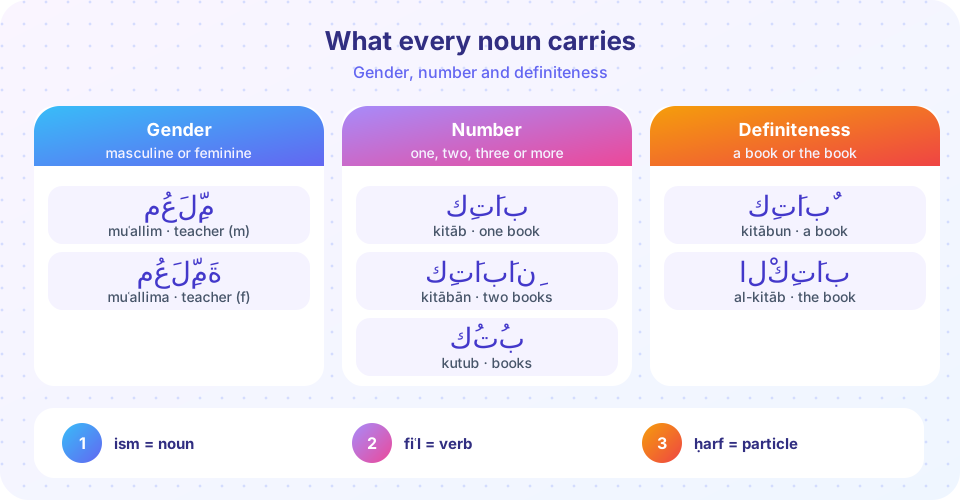
With the script behind you, you can start building real Arabic. Nouns come first because they are the names of the things around you, and because noun grammar is where Arabic differs most visibly from English. Every Arabic noun comes with three built-in properties: its gender, its number and whether it is definite. Arabic expresses these directly on the word, with endings and a prefix, instead of through separate little words like "a" and "the". This overview shows you the system; the next four lessons explain each part.
What you will learn
- The three classes of words in Arabic grammar.
- How gender, number and definiteness show up on a noun.
- Twenty basic nouns with their gender.
- How the lessons of this chapter fit together.
- How to use the noun explorer to see all the forms of a word.
Key terms
Ism (اسم): noun; in Arabic grammar the class also includes adjectives, pronouns and many more.
Fiʿl (فعل): verb.
Ḥarf (حرف): particle, a small word such as "in", "and", "to".
Gender: masculine or feminine; Arabic has no neuter.
Definite: referring to a specific thing, "the book"; indefinite: "a book".
Three kinds of words
Classical Arabic grammarians, working over a thousand years ago, divided every word in the language into three classes, and the division is still used in textbooks:
- ism (noun): names of people, places, things and ideas, plus adjectives and pronouns;
- fiʿl (verb): words of action and state with tense;
- ḥarf (particle): connecting words like fī (in), min (from), wa (and), ilā (to).
This chapter is about the first class. Verbs start in Chapter 5, and particles appear everywhere, one at a time.
The three properties
Gender. Every noun is masculine or feminine, including things that are not alive: a book (kitāb) is masculine, a car (sayyāra) is feminine. You can often tell by the ending, because a final ة usually marks the feminine. Lesson 2 explains this and the exceptions.
Number. Arabic distinguishes three numbers, not two: singular (one), dual (exactly two) and plural (three or more). The dual is a special ending, as in kitābān ("two books"), and the plural may be formed by an ending or by reshaping the whole word (kutub, "books"). Lesson 4 covers all of it.
Definiteness. English has the little words a and the. Arabic has only a the: the prefix ال (al-). A noun without it is indefinite. In vowelled text an indefinite noun usually ends in tanwīn, as you saw in Chapter 3: kitābun is "a book" and al-kitāb is "the book". Lesson 3 explains how ال works, including the sun and moon letters.
The three properties then tie together in agreement: an adjective that describes a noun must match its gender, number and definiteness. That is the topic of lesson 5.
A starter vocabulary of twenty nouns
Learn these with their gender. The gender is part of the word, just like the spelling.
| Arabic | Reads | Meaning | Gender |
|---|---|---|---|
| بَيْت | bayt | house | masculine |
| كِتَاب | kitāb | book | masculine |
| قَلَم | qalam | pen | masculine |
| بَاب | bāb | door | masculine |
| مِفْتَاح | miftāḥ | key | masculine |
| كُرْسِيّ | kursī | chair | masculine |
| وَلَد | walad | boy | masculine |
| رَجُل | rajul | man | masculine |
| طَالِب | ṭālib | student (male) | masculine |
| مُعَلِّم | muʿallim | teacher (male) | masculine |
| صَدِيق | ṣadīq | friend (male) | masculine |
| أَب | ab | father | masculine |
| أَخ | akh | brother | masculine |
| مَدْرَسَة | madrasa | school | feminine |
| سَيَّارَة | sayyāra | car | feminine |
| طَاوِلَة | ṭāwila | table | feminine |
| بِنْت | bint | girl | feminine |
| أُمّ | umm | mother | feminine |
| أُخْت | ukht | sister | feminine |
| شَمْس | shams | sun | feminine |
Notice that bint, umm, ukht and shams are feminine even though they do not end in ة. You will see why in lesson 2.
Every noun has three tags
Tags are written on the word.
Chapter 4 roadmap
Each lesson adds one tag.
The lessons in this chapter
| Lesson | What you learn |
|---|---|
| Gender: Masculine and Feminine | Spotting and forming the feminine; "this" and "he/she" |
| The Definite Article ال | "The", sun and moon letters, possession |
| Dual and Plural | Two, many, and the broken plural |
| Adjectives and Simple Sentences | Agreement and the sentence without "is" |
| Chapter 4 Review | Recap and quiz |
Try it
Press Run (or Ctrl + Enter) to see the result here.
Program input · what you'd type while the program runs
Type the answers before you press Run, one per line. Each time the program reads a line (with input()), it gets the next line from this box.
The Python rule gets most nouns right, and the exceptions list is exactly the one you will meet in the next lesson. Real Arabic is a bit larger than that list, so always learn the gender with the word.
Common misconceptions
"Only living things have gender." Every Arabic noun has a grammatical gender, including tables, doors and ideas.
"Arabic has a and the like English." Arabic has only a the; indefinite nouns simply do not have it.
"Dual is just a plural." The dual is its own number, used for exactly two. You do not say "two books" as "two" plus a plural noun.
Check your understanding
Quick check · 4 questions
of 4 answered You scored / 4 · perfect!
-
1. What are the three classes of words in traditional Arabic grammar?
Arabic grammarians divide words into ism (noun), fiʿl (verb) and ḥarf (particle). -
2. How many grammatical numbers does Arabic have?
Singular, dual and plural. -
3. Which prefix makes a noun definite?
The article ال is the Arabic 'the'. -
4. Which noun is feminine?
Sayyāra ends in tā' marbūṭa and is feminine.
Summary
- Arabic words are nouns (ism), verbs (fiʿl) or particles (ḥarf).
- Every noun is masculine or feminine, singular, dual or plural, and definite or indefinite.
- ال is "the"; no ال means "a", often with tanwīn.
- A final ة usually marks the feminine, with a small list of exceptions.
- The next lessons take each property in turn.
Track your progress
Create a free account to tick off lessons and pick up where you left off on any device.
of Arabic for Beginners lessons completed