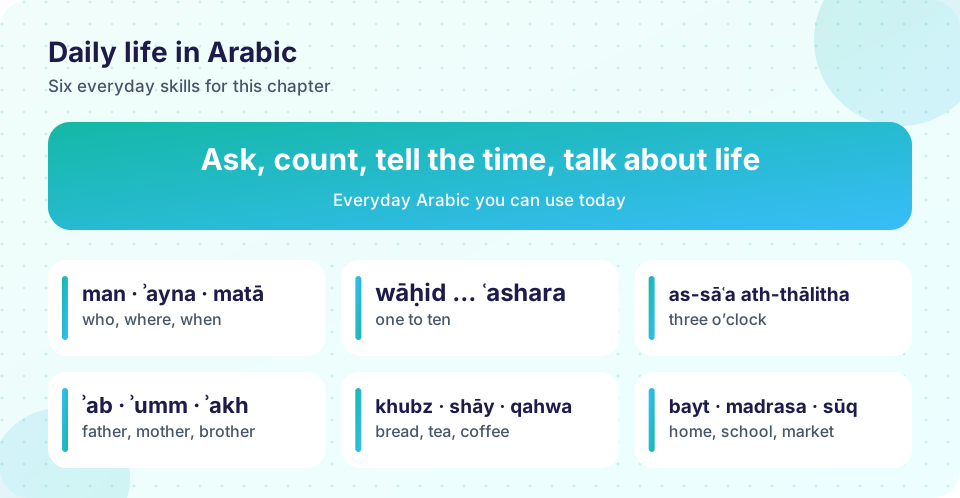
Preview the chapter on everyday Arabic: question words, numbers, days and time, family, food and places, with a first short dialogue.
Grammar becomes useful the moment you can use it to ask a real question. In this chapter you move from describing actions to living inside a conversation: Where do you live? How old are you? What time is it? Do you have a brother? These are the sentences that fill the first five minutes of almost every conversation you will ever have in Arabic.
You will pick up about eighty new words, but the real goal is a habit: ask and answer. Every lesson is organized around questions you can actually use, and every example is a short, complete sentence you can say today.
Everyday Arabic in six areas: ask, count, tell time, family, food and places.
Read this exchange twice: once with the translation, once aloud without it. Speaker A is Sami and speaker B is Layla.
Arabic
Transliteration
English
صَبَاحُ الخَيْر!
ṣabāḥ al-khayr!
Good morning!
صَبَاحُ النُّور! كَيْفَ حَالُكَ؟
ṣabāḥ an-nūr! kayfa ḥāluka?
Good morning (reply)! How are you?
بِخَيْر، الحَمْدُ لِلَّه. وَأَنْتِ؟
bi-khayr, al-ḥamdu lillāh. wa-ʾanti?
Fine, thank God. And you?
بِخَيْر، شُكْرًا. أَيْنَ تَذْهَبُ اليَوْم؟
bi-khayr, shukran. ʾayna tadhhabu al-yawm?
Fine, thanks. Where are you going today?
أَذْهَبُ إِلَى السُّوق.
ʾadhhabu ʾilā s-sūq.
I am going to the market.
Notice three things. First, كَيْفَ opens the question and the verb or noun follows. Second, words that address "you" change for a man and a woman: Layla says حَالُكَ (ḥāluka, your state) to Sami, and Sami says أَنْتِ (ʾanti, you, feminine) to Layla, just as verbs do. Third, the answer reuses the verb of the question: تَذْهَبُ becomes أَذْهَبُ.
Beginners often try to learn vocabulary in long lists and then wonder why they cannot hold a conversation. Conversation is not a list of words; it is a loop of asking and answering. A question gives you a reason to speak, a frame to fill in and a clear answer to listen for. That is why every lesson in this chapter is organized around a question you can really use: Where do you live? How much is it? What time is it? Do you have a brother? Learn the question first, and the vocabulary has somewhere to go.
There is also a practical reason. When you are lost in a foreign language, questions are the tool that gets you out. If you can ask أَيْنَ ...؟ (where?), كَمْ ...؟ (how much?) and هَلْ ...؟ (is it ...?), you can ask for help at almost any moment, and you can keep the other person talking while your ear adjusts.
Days 1 to 2: read the question-words lesson and ask yourself nine real questions aloud, one per question word.
Days 3 to 4: work through numbers, days and time. Say today's day, the time and your age in Arabic every morning.
Days 5 to 6: learn the family, food and place words in small groups of five. Use the possessive endings to describe your own life.
Day 7: take the review quiz, then repeat the weakest lesson.
Each day, speak for at least five minutes. It does not matter whether anyone listens: saying sentences aloud trains the muscles and the memory together. By the end of the chapter you should be able to run a two-minute conversation, as both the asker and the answerer, with yourself in the mirror or with a patient friend.