


















Lesson 30 of 45 · Daily Life and Questions
Family, Food and Places
Learn Arabic family, food and place words, possessive endings such as my and your, and how to say I have with ʿindī, with practice games.
Talk to anyone for more than a minute and you will talk about people, food and places: your family, what you are eating, where you live. This lesson gives you about fifty of the most useful words for those topics and then teaches the small endings that turn book into my book and his book. You will also learn how to say I have, which Arabic does without any verb.
What you will learn
- Family, food, drink and place words
- The eight possessive endings: my, your (m./f.), his, her, our, your (pl.), their
- How to say I have with عِنْدِي and I do not have with لَيْسَ عِنْدِي
- Prepositions that link places to actions: فِي, إِلَى, مِنْ, عَلَى, مَعَ
Key terms
Possessive suffix: an ending attached to a noun to show who owns it, like -ī (my).
Preposition (ḥarf jarr): a small word such as فِي (in) that links a noun to the rest of the sentence.
Ta marbuta (ة): the "tied ta" that ends many feminine nouns. It becomes a normal ت before a suffix.
Adjective: a word that describes a noun; in Arabic it follows the noun and agrees with it.
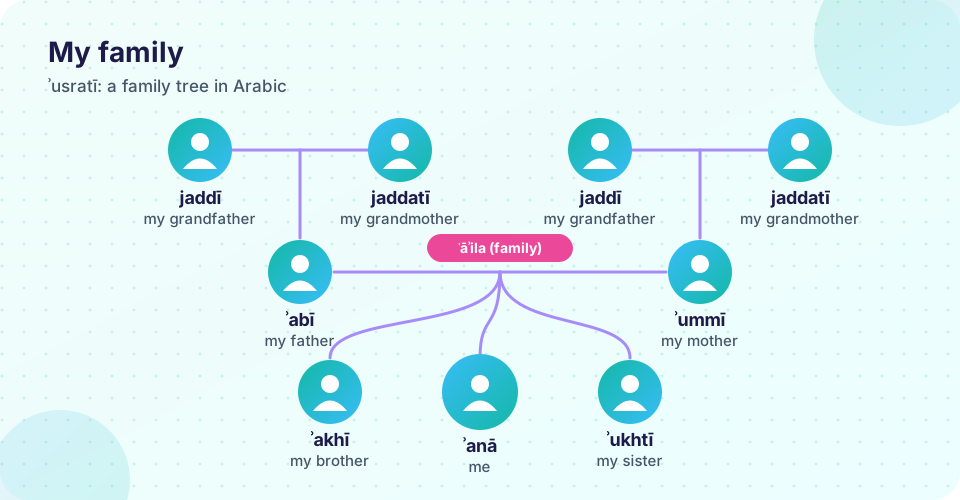
Family words
| Arabic | Transliteration | Meaning |
|---|---|---|
| أَب | ʾab | father |
| أُمّ | ʾumm | mother |
| أَخ | ʾakh | brother |
| أُخْت | ʾukht | sister |
| ابْن | ibn | son |
| بِنْت | bint | daughter, girl |
| جَدّ | jadd | grandfather |
| جَدَّة | jadda | grandmother |
| زَوْج | zawj | husband |
| زَوْجَة | zawja | wife |
| عَائِلَة | ʿāʾila | family |
Food and drink
| Arabic | Transliteration | Meaning |
|---|---|---|
| خُبْز | khubz | bread |
| مَاء | māʾ | water |
| شَاي | shāy | tea |
| قَهْوَة | qahwa | coffee |
| حَلِيب | ḥalīb | milk |
| عَصِير | ʿaṣīr | juice |
| أَرُزّ | ʾaruzz | rice |
| لَحْم | laḥm | meat |
| دَجَاج | dajāj | chicken |
| سَمَك | samak | fish |
| بَيْض | bayḍ | eggs |
| جُبْن | jubn | cheese |
| تُفَّاح | tuffāḥ | apples |
| تَمْر | tamr | dates |
Places
| Arabic | Transliteration | Meaning |
|---|---|---|
| بَيْت | bayt | house, home |
| مَدْرَسَة | madrasa | school |
| جَامِعَة | jāmiʿa | university |
| مَسْجِد | masjid | mosque |
| سُوق | sūq | market |
| مَطْعَم | maṭʿam | restaurant |
| مُسْتَشْفَى | mustashfā | hospital |
| مَطَار | maṭār | airport |
| مَحَطَّة | maḥaṭṭa | station |
| مَكْتَبَة | maktaba | library, bookshop |
| حَدِيقَة | ḥadīqa | garden, park |
| مَدِينَة | madīna | city |
| قَرْيَة | qarya | village |
| فُنْدُق | funduq | hotel |
Small words that join places and actions
| Preposition | Meaning | Example |
|---|---|---|
| فِي (fī) | in, at | أَسْكُنُ فِي القَرْيَة. (I live in the village.) |
| إِلَى (ʾilā) | to | أَذْهَبُ إِلَى المَطْعَم. (I go to the restaurant.) |
| مِنْ (min) | from | أَنَا مِنْ مَدِينَة كَبِيرَة. (I am from a big city.) |
| عَلَى (ʿalā) | on | الكِتَاب عَلَى الطَّاوِلَة. (The book is on the table.) |
| مَعَ (maʿa) | with | أَشْرَبُ الشَّاي مَعَ أُمِّي. (I drink tea with my mother.) |
Adjectives follow the noun and agree with its gender: بَيْت كَبِير (bayt kabīr, a big house) but مَدِينَة كَبِيرَة (madīna kabīra, a big city). Other useful ones are صَغِير (ṣaghīr, small) and جَمِيل / جَمِيلَة (jamīl / jamīla, beautiful).
My, your, his, her: possessive endings
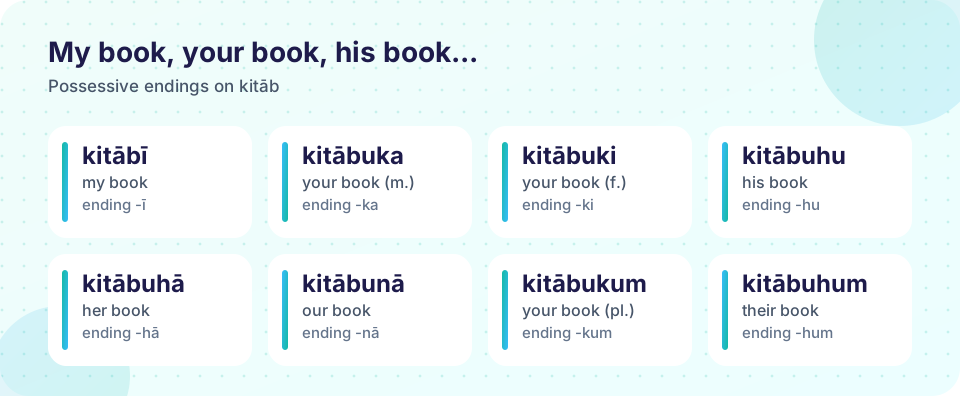
Arabic has no separate word for my. You attach a short ending to the noun, and the noun loses its ال (you cannot say the my book). Here it is with كِتَاب (book):
| Person | Ending | Example | Meaning |
|---|---|---|---|
| my | ـِي (-ī) | كِتَابِي (kitābī) | my book |
| your (m.) | ـكَ (-ka) | كِتَابُكَ (kitābuka) | your book |
| your (f.) | ـكِ (-ki) | كِتَابُكِ (kitābuki) | your book |
| his | ـهُ (-hu) | كِتَابُهُ (kitābuhu) | his book |
| her | ـهَا (-hā) | كِتَابُهَا (kitābuhā) | her book |
| our | ـنَا (-nā) | كِتَابُنَا (kitābunā) | our book |
| your (pl.) | ـكُمْ (-kum) | كِتَابُكُمْ (kitābukum) | your book |
| their | ـهُمْ (-hum) | كِتَابُهُمْ (kitābuhum) | their book |
Two spelling changes are worth knowing. A feminine noun with ة turns it into ت: سَيَّارَة (sayyāra, car) → سَيَّارَتِي (sayyāratī, my car), عَائِلَة → عَائِلَتُنَا (ʿāʾilatunā, our family). And the words father and brother stretch a long vowel before the endings: أَبِي (ʾabī, my father), أَبُوكَ (ʾabūka, your father), أَخِي (ʾakhī, my brother), أَخُوهُ (ʾakhūhu, his brother). Other family words follow the regular pattern: أُمِّي (ʾummī, my mother), أُخْتِي (ʾukhtī, my sister), جَدِّي (jaddī, my grandfather).
I have: ʿindī
Arabic says I have with the preposition عِنْد (ʿind, at, with) and the possessive endings. Literally "at me there is":
- عِنْدِي أَخ وَاحِد. (ʿindī ʾakh wāḥid.) I have one brother.
- عِنْدَكَ سَيَّارَة؟ (ʿindaka sayyāra?) Do you (m.) have a car?
- عِنْدَهَا ثَلَاث بَنَات. (ʿindahā thalāth banāt.) She has three daughters.
- عِنْدَنَا بَيْت كَبِير. (ʿindanā bayt kabīr.) We have a big house.
For the negative, put لَيْسَ (laysa, is not) in front: لَيْسَ عِنْدِي سَيَّارَة. (laysa ʿindī sayyāra.) I do not have a car. The same pattern exists with لِي (lī, to me): لِي أَخ is a little more formal. Both are correct.
How to learn these words so they stick
Fifty new words is a lot, but they do not have to be learned from a list. Link each word to a scene in your own life. Picture the family table and say the family words as you imagine each person. Picture your kitchen and name what is in it. Picture a walk through your town and name the places you pass. The brain remembers scenes better than lists, and the scenes give you ready-made sentences.
Also learn nouns in small sentences, not alone. Instead of memorizing خُبْز by itself, learn أَشْتَرِي الخُبْز مِنَ السُّوق (ʾashtarī l-khubz mina s-sūq, I buy bread from the market). That one sentence rehearses a verb, a food, a preposition and a place at the same time.
Worked example: describing your family
Here is a short description of a family, built from the pieces in this lesson. Read it, then rewrite it for your own family.
- عَائِلَتِي صَغِيرَة. (ʿāʾilatī ṣaghīra.) My family is small.
- عِنْدِي أَخ وَاحِد وَأُخْتَان. (ʿindī ʾakh wāḥid wa-ʾukhtān.) I have one brother and two sisters.
- أَبِي مُهَنْدِس وَأُمِّي مُعَلِّمَة. (ʾabī muhandis wa-ʾummī muʿallima.) My father is an engineer and my mother is a teacher.
- جَدِّي وَجَدَّتِي يَسْكُنَانِ فِي قَرْيَة. (jaddī wa-jaddatī yaskunāni fī qarya.) My grandfather and grandmother live in a village.
Look at the possessive endings: عَائِلَتِي, أَبِي, أُمِّي, جَدِّي, جَدَّتِي. Each ends in the same vowel -ī, which is why they sound like a family of words. Then look at the grammar you already know: a noun sentence with no verb for is (أَبِي مُهَنْدِس), an adjective agreeing with a feminine noun (عَائِلَتِي صَغِيرَة) and the dual for two sisters (أُخْتَان).
Using prepositions with possessives
Possessive endings also attach to prepositions, which gives you a whole new set of useful phrases. مَعِي (maʿī, with me), مَعَكَ (maʿaka, with you), مَعَهَا (maʿahā, with her). فِي بَيْتِي (fī baytī) is "in my house", and إِلَى بَيْتِكَ (ʾilā baytika) is "to your house". Notice that the preposition comes first, then the noun with its ending. You already know the same idea from عِنْدِي, which is simply the preposition عِنْد with the ending -ī.
Practice ideas
Describe five objects in your room using هَذَا (this, masculine) or هَذِهِ (this, feminine) and a possessive ending: هَذَا كِتَابِي, هَذِهِ سَيَّارَتِي. Then ask yourself questions about them: مَا هَذَا؟ (What is this?), أَيْنَ بَيْتُكَ؟ (Where is your house?). Finish by writing three sentences that start with عِنْدِي and three that start with لَيْسَ عِنْدِي.
A note on gender and plurals
Most of the nouns in this lesson are masculine (بَيْت, خُبْز, سُوق), and a few are feminine, usually those that end in ة (مَدْرَسَة, عَائِلَة, جَدَّة). A few feminine nouns do not end in ة (أُمّ, أُخْت, بِنْت are feminine by meaning). Gender matters for adjectives and numbers, so when you learn a noun, note its gender along with its meaning.
Plurals are often irregular in Arabic, and some of the most common nouns have plurals you should simply learn by heart: كِتَاب becomes كُتُب, وَلَد becomes أَوْلَاد, بِنْت becomes بَنَات, أَخ becomes إِخْوَة (brothers and siblings) and بَيْت becomes بُيُوت. These "broken plurals" change the inside of the word, like English foot and feet. For now, memorize them in pairs, singular and plural together, and you will get used to the patterns.
Common misconceptions
"I can say الكِتَاب + ي." A noun with a possessive ending never takes ال. It is كِتَابِي, not "al-kitābī".
"Arabic has a verb to have." In everyday Arabic you use عِنْد with an ending, so I have a car is "at-me a car".
"The ة always stays." Before a suffix, ة becomes ت: سَيَّارَة but سَيَّارَتِي.
Try it
Match the words with their meanings. Try to do it without peeking at the tables.
Then complete the sentences with the right possessive ending or form of عِنْد.
Check your understanding
Quick check · 5 questions
of 5 answered You scored / 5 · perfect!
-
1. How do you say "my mother"?
The ending -ī means my, and the noun does not take ال: ʾummī. -
2. What does عِنْدَهَا ثَلَاث بَنَات mean?
ʿindahā = she has; banāt is the plural of bint, a feminine noun, so the number is thalāth without ة. -
3. Which is correct for "my car" (sayyāra)?
The ta marbuta turns into an ordinary ta before the ending: sayyāratī. -
4. Which sentence means "I do not have a brother"?
laysa ʿindī is the negative of ʿindī. -
5. Which word means "school"?
madrasa comes from the root of studying: d-r-s.
Summary
- Learn family, food and place words in small groups, and always say them aloud.
- Possessive endings (-ī, -ka, -ki, -hu, -hā, -nā, -kum, -hum) attach to the noun, which loses ال.
- ة becomes ت before an ending; father and brother stretch to أَبُو- and أَخُو-.
- I have is عِنْدِي; the negative is لَيْسَ عِنْدِي.
- Adjectives follow the noun and agree in gender.
Next: Daily life review
Track your progress
Create a free account to tick off lessons and pick up where you left off on any device.
of Arabic for Beginners lessons completed