


















Lesson 22 of 45 · Nouns, Gender and Definiteness
Chapter 4 Review: Nouns, Gender and Definiteness
Review chapter 4: gender and ة, the article ال with sun and moon letters, dual and plurals, adjective agreement and verbless sentences, with a 10-question quiz.
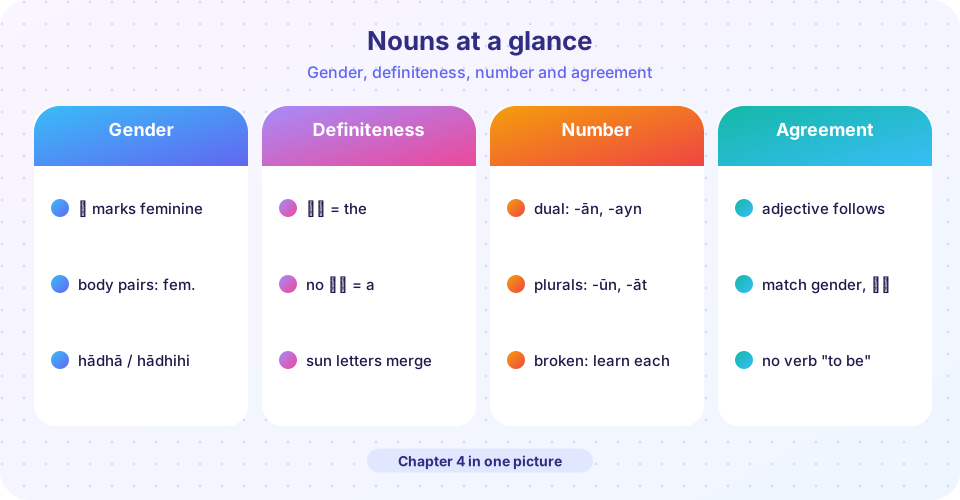
This chapter gave you the building blocks of Arabic noun phrases. You can now say whether a noun is masculine or feminine, add the right ending for the dual and the plural, make a noun definite with al- or leave it indefinite, attach an adjective that matches and build a sentence that needs no verb. The review below gathers the whole system in one table and one picture, and then tests it with a mixed quiz and two practice tools.
What you will learn
- A single table with every rule from the chapter.
- The common slips to watch for in your own sentences.
- Practice in building phrases and sentences.
- A ten-question quiz mixing all five lessons.
Key terms
Tā' marbūṭa (ة): the usual feminine ending.
ال: the definite article; sun letters assimilate it, moon letters do not.
Dual / sound plural / broken plural: three ways to count nouns beyond one.
Idāfa: two nouns side by side, "X of Y".
Nominal sentence: subject plus predicate with no verb.
The chapter in a table
| Topic | Rule | Example |
|---|---|---|
| Gender | Feminine usually adds ة; learn the exceptions | طَالِب → طَالِبَة; أُمّ, شَمْس |
| Pointing | هَٰذَا (m) / هَٰذِهِ (f), ذَٰلِكَ / تِلْكَ | هَٰذِهِ سَيَّارَة |
| Pronouns | أَنَا, أَنْتَ, أَنْتِ, هُوَ, هِيَ | هِيَ مُعَلِّمَة |
| Definiteness | ال = the; no ال = a; never both with tanwīn | كِتَاب → الْكِتَاب |
| Sun letters | 14 letters assimilate the l | ash-shams, an-nūr |
| Idāfa | first noun bare, second noun carries ال | كِتَابُ الْوَلَدِ |
| Dual | -ān / -ayn; ة becomes ت | كِتَابَانِ, مَدْرَسَتَانِ |
| Plurals | -ūn/-īn for male people, -āt for feminine, broken for many | مُعَلِّمُونَ, سَيَّارَات, كُتُب |
| Agreement | adjective follows and matches gender, number, ال | الْبَيْت الْكَبِير |
| Sentences | no "is" in the present; ال on the adjective makes a phrase | الْبَيْت كَبِير |
Checklist before you say a sentence
- Gender: is the noun masculine or feminine? Look for ة and the exceptions.
- Definite or not? Add ال, or a pronoun ending, or leave it bare.
- Sun letter? If so, double the first letter when you speak.
- Adjective: choose the form that matches the noun.
- Phrase or sentence? Put ال on the adjective only for a phrase.
- Number: one, two or more? If two, the dual. If more than two, check the plural type.
Try it with "the new car is fast": sayyāra is feminine, so the adjectives are feminine; it is a sentence, so only the noun has ال: السَّيَّارَة سَرِيعَة. And "the fast new car", a phrase: السَّيَّارَة الْجَدِيدَة السَّرِيعَة, with ال on every word.
Common slips
- Masculine adjective with a feminine noun: madrasa kabīr instead of madrasa kabīra.
- ال on the adjective of a sentence: al-bayt al-kabīr means "the big house", not "the house is big".
- ال plus tanwīn: al-kitābun is wrong; use al-kitāb(u).
- Reading a sun letter as a moon letter: al-shams should be ash-shams.
- Wrong pointing word: hādhā madrasa should be hādhihi madrasa.
- Non-human plural with a plural adjective: al-kutub judud is not the normal agreement; use al-kutub jadīda.
Putting the whole chapter into one sentence
To see how much you can now say, try building a longer sentence from everything in this chapter. "Those two new schools are big" would need the pointing word for a feminine dual, the dual noun and a dual adjective. "The teacher's new car is fast" needs an idāfa (sayyāratu l-muʿallimi, the teacher's car), an adjective that matches sayyāra and a sentence structure with no verb. Notice how many of the rules you had to use at the same time. This is the real test of the chapter: not recalling a rule on its own but combining them.
Try it
Press Run (or Ctrl + Enter) to see the result here.
Program input · what you'd type while the program runs
Type the answers before you press Run, one per line. Each time the program reads a line (with input()), it gets the next line from this box.
The table prints the profile of each noun in one row. Notice that بِنْت is feminine without ة, and its dual bintān follows the plain rule, while the plural banāt is a broken form.
Common misconceptions
"If I learn the rules I can skip learning each noun's gender and plural." The rules cover most cases, but each noun's gender and plural still has to be learned with the word.
"Arabic has too many forms to remember." The forms follow a few regular patterns; practice builds recognition faster than memorization.
"The sentence without 'is' is incomplete." It is complete and normal in the present tense.
Check your understanding
Quick check · 10 questions
of 10 answered You scored / 10 · perfect!
-
1. How do you say 'the school is new'?
Subject with ال, predicate without it, and the adjective is feminine. -
2. Which pointing word goes with بِنْت?
Bint is feminine, so you use hādhihi. -
3. How is الشَّمْس pronounced?
Shīn is a sun letter, so the l assimilates. -
4. What is the dual of مَدْرَسَة?
ة becomes ت before -ān. -
5. Which is the sound feminine plural of سَيَّارَة?
Drop ة and add -āt. -
6. Which sentence has the right agreement?
Kitāb is masculine singular, so the adjective is masculine singular. -
7. What does the first noun of an idāfa never take?
The first noun is bare; the second noun carries ال. -
8. How are the books described in 'The books are new'?
Non-human plurals take feminine singular agreement. -
9. Which pair is correctly paired for gender?
Eyes are a paired body part and are feminine. -
10. What does ال on the adjective of 'al-bayt al-kabīr' tell you?
ال on both words makes a phrase.
Summary
- Gender: ة marks most feminine nouns; learn the exceptions with the words.
- ال is "the"; sun letters assimilate it; never combine it with tanwīn.
- Counting: dual with -ān / -ayn; plurals are sound or broken.
- Adjectives follow the noun and match gender, number and definiteness.
- Present-tense sentences omit "is"; ال on the adjective makes a phrase instead.
Track your progress
Create a free account to tick off lessons and pick up where you left off on any device.
of Arabic for Beginners lessons completed