


















Lesson 14 of 45 · Reading and Writing
Long Vowels, Diphthongs and Tanwīn
Learn how Arabic writes the long vowels ā, ī, ū, the diphthongs ay and aw, and the tanwīn endings -un, -an, -in that mark indefinite nouns.
You now know the three short vowels. Arabic has the same three vowel qualities in a long version, and it also has two gliding sounds that combine a vowel and a consonant. Finally, it has a set of doubled marks at the ends of nouns that add an "n" sound. These details are the last pieces of the vowelled spelling system. Together they let you read kitābun, bayt, nūr and shukran correctly, and they open the door to the grammar of the next chapter.
What you will learn
- How ā, ī and ū are written and why length matters.
- How to read the diphthongs ay and aw.
- What the three tanwīn marks look like and sound like.
- Why tanwīn with fatḥa usually adds an alif.
- How to recognize an indefinite noun in vowelled text.
Key terms
Long vowel: a vowel held about twice as long as a short one: ā, ī, ū.
Diphthong: a vowel gliding into a semivowel in one syllable: ay as in "eye", aw as in "cow".
Tanwīn: a doubled vowel mark at the end of a noun, giving the sounds -un, -an, -in.
Indefinite: a noun meaning "a" or "some", like "a book" (as opposed to "the book").
Case ending: a final vowel that shows the grammatical job of a noun.
Long vowels: ā, ī, ū
The long vowels are formed by combining a short vowel mark with a matching letter:
| Long vowel | Written as | Example | Reads |
|---|---|---|---|
| ā | fatḥa + ا | بَا | bā |
| ī | kasra + ي | بِي | bī |
| ū | ḍamma + و | بُو | bū |
The letters ا ي و in this role carry no mark of their own; they simply lengthen the vowel before them. Compare these pairs, in which length alone changes the word:
- كَتَبَ kataba (he wrote) and كَاتِب kātib (writer)
- عَلِمَ ʿalima (he knew) and عَالِم ʿālim (scholar)
- دَرَسَ darasa (he studied) and دَارَ dāra (it turned)
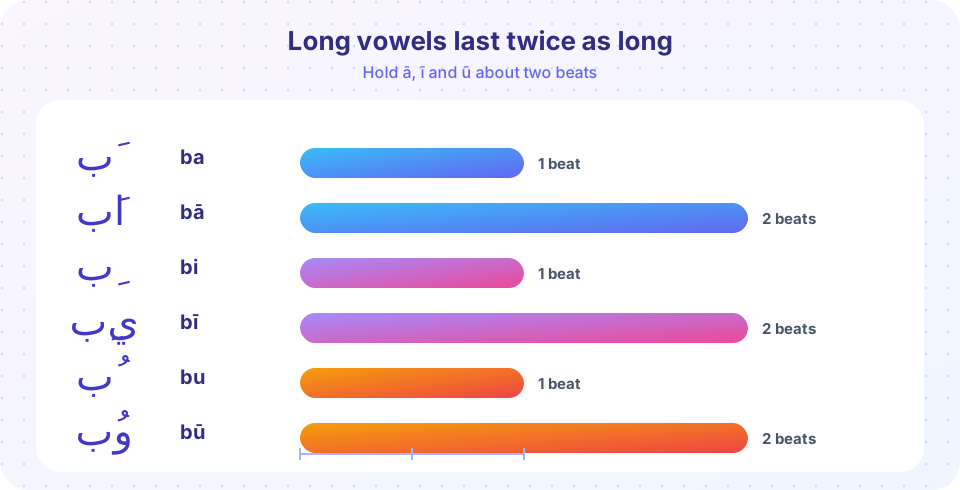
Long vowels last about two beats, short ones one. Tap your finger while you say kitāb: ki is one tap, tā two taps, b a closing sound. Learners who keep every vowel short sound strange and may be misunderstood, because the length is part of what identifies the word. The timeline above shows the proportions.
One practical point. If you see an alif, wāw or yā' with no marks beside a vowelled consonant, it is probably carrying the long vowel. If it has a fatḥa, kasra or ḍamma of its own, or a sukūn, it is a consonant (w or y) or part of a diphthong.
The diphthongs: ay and aw
A fatḥa followed by يْ (yā' with a sukūn) is read ay; a fatḥa followed by وْ (wāw with a sukūn) is read aw.
- بَيْت bayt (house): ay as in "eye" without the final "-ee".
- لَيْل layl (night)
- يَوْم yawm (day): aw as in "cow".
- لَوْن lawn (color)
Notice that in these words the ي and و with sukūn are acting as consonants closing the syllable. The long vowels, by contrast, carry no sukūn. In practice you can read them as: ay = "ah + ee glide", aw = "ah + oo glide". Arabic speakers in many dialects flatten the diphthongs (bēt and yōm in Egypt and the Levant), but MSA keeps them.
Tanwīn: the "n" endings
At the end of many nouns, Arabic doubles the vowel mark. This is tanwīn, and it adds a final n sound. It marks the noun as indefinite ("a book" or just "books"), and it also shows the noun's grammatical case.
| Mark | Name | Sound | Example (kitāb) | Reads |
|---|---|---|---|---|
| ـٌ | tanwīn ḍamm | -un | كِتَابٌ | kitābun |
| ـً | tanwīn fatḥ | -an | كِتَابًا | kitāban |
| ـٍ | tanwīn kasr | -in | كِتَابٍ | kitābin |
Three details:
- The -an form usually adds an alif after the doubled fatḥa: كِتَابًا. The alif is silent in this role, and the -an is pronounced -an. Words that end in ة (tā' marbūṭa) or in a hamza on the line take the mark without the extra alif: مَدْرَسَةً (madrasatan), مَاءً (māʾan).
- The three endings correspond to the three cases of Arabic nouns: -un (nominative, the subject), -an (accusative, the object and several special uses) and -in (genitive, after a preposition). You will meet case properly later; for now, learn to recognize and read the marks.
- In everyday speech and after a pause, these endings are often dropped. People say kitāb, not kitābun. In formal MSA reading aloud, such as news broadcasts, the endings are pronounced.
Tanwīn in everyday words
Some of the most common Arabic words are tanwīn forms that have frozen into adverbs or fixed expressions:
| Arabic | Reads | Meaning |
|---|---|---|
| شُكْرًا | shukran | thank you ("a thanks") |
| مَرْحَبًا | marḥaban | hello ("welcome") |
| أَهْلًا | ahlan | welcome |
| جِدًّا | jiddan | very |
| كَثِيرًا | kathīran | a lot |
| قَلِيلًا | qalīlan | a little |
Notice that all of these use the -an form, written with a doubled fatḥa, and in each case an alif follows. This is the single most useful tanwīn pattern to master.
Reading practice
Read each word aloud, check against the transliteration and say the meaning.
| Arabic | Reads | Meaning |
|---|---|---|
| كَبِير | kabīr | big |
| صَغِير | ṣaghīr | small |
| نُور | nūr | light |
| بَاب | bāb | door |
| سَيْف | sayf | sword |
| صَيْف | ṣayf | summer |
| قَمِيص | qamīṣ | shirt |
| وَقْت | waqt | time |
| طَوِيل | ṭawīl | long, tall |
| كِتَابٌ جَدِيدٌ | kitābun jadīdun | a new book |
The last example shows tanwīn on both words: kitābun (a book) and jadīdun (new), with -un on each because the adjective agrees with its noun.
Training your ear for length
English speakers often fail to hear vowel length at first, because English uses it differently. A useful drill is to clap or tap a steady beat while you say a word: a short vowel is one tap, a long vowel two. Try kataba (ka-ta-ba: three taps, one per syllable) against kātaba (kaa-ta-ba: the first vowel stretches over two taps). Record yourself and listen back. The length difference is easiest to hear when the vowel falls in a stressed syllable, so start with words like bāb and nūr.
Tanwīn when you pause
Tanwīn is mostly heard when a text is read aloud in formal Arabic, such as a news broadcast. When a speaker pauses at the end of a phrase, the -un and -in endings are dropped completely, so kitābun is simply kitāb. The -an ending is pronounced as a long -ā in careful speech, so kitāban is kitābā, except for words that end in ة, which end in -ah. This is why you will hear shukran as shukran in the middle of a sentence and as shukrā or shukran at the end depending on the speaker. Do not worry about the differences; the written form stays the same, and you will pick up the habits of the speakers you listen to.
Try it
Press Run (or Ctrl + Enter) to see the result here.
Program input · what you'd type while the program runs
Type the answers before you press Run, one per line. Each time the program reads a line (with input()), it gets the next line from this box.
The Python block builds all three forms from a bare word and applies the alif rule from the lesson. It is a miniature of how an Arabic text editor or a language-learning app can generate endings automatically.
Reading aloud with tanwīn
When you read a vowelled sentence aloud, treat tanwīn as part of the rhythm. Say shukran jazīlan smoothly, giving the two final syllables the same weight, and pause only at the end of the phrase. Remember that the doubled mark is one sound, not two: do not pronounce a vowel twice.
Common misconceptions
"The alif in كِتَابًا is a long ā." It is a spelling support for tanwīn, not a long vowel. The ending is pronounced -an.
"Tanwīn is the definite article." The opposite: tanwīn marks indefinite nouns. The definite article is ال (next chapter), and a noun never has both.
"ي and و in بَيْت and يَوْم are long vowels." Here they carry a sukūn and act as consonants closing a diphthong.
"I need to pronounce every tanwīn ending in everyday speech." In conversation they are usually dropped, but in formal reading they are heard.
Check your understanding
Quick check · 5 questions
of 5 answered You scored / 5 · perfect!
-
1. How is بَيْت pronounced?
Fatḥa plus ي with sukūn is the diphthong ay: bayt. -
2. Which tanwīn gives the sound -an?
The doubled fatḥa is usually written with an alif and read -an. -
3. What does tanwīn tell you about a noun?
Tanwīn marks indefinite nouns, like 'a book'. -
4. Which pair differs only by vowel length?
Kataba has a short a; kātib has a long ā. -
5. Which ending is written without an extra alif?
Words ending in tā' marbūṭa take the doubled fatḥa without an alif.
Summary
- Long vowels: fatḥa + ا = ā, kasra + ي = ī, ḍamma + و = ū; they last about twice as long as short ones.
- ي and و with sukūn after a fatḥa make the diphthongs ay and aw.
- Tanwīn adds -un, -an or -in to indefinite nouns.
- The -an ending usually gets a silent alif, except after ة.
- Shukran, marḥaban, ahlan and jiddan are frozen -an forms.
Track your progress
Create a free account to tick off lessons and pick up where you left off on any device.
of Arabic for Beginners lessons completed