


















Lesson 11 of 45 · Reading and Writing
Chapter 3 Overview: Reading and Writing Arabic
See how Arabic words are built from joined letters and vowel marks, a five-step method for reading any word and what chapter 3 teaches, with practice tools.
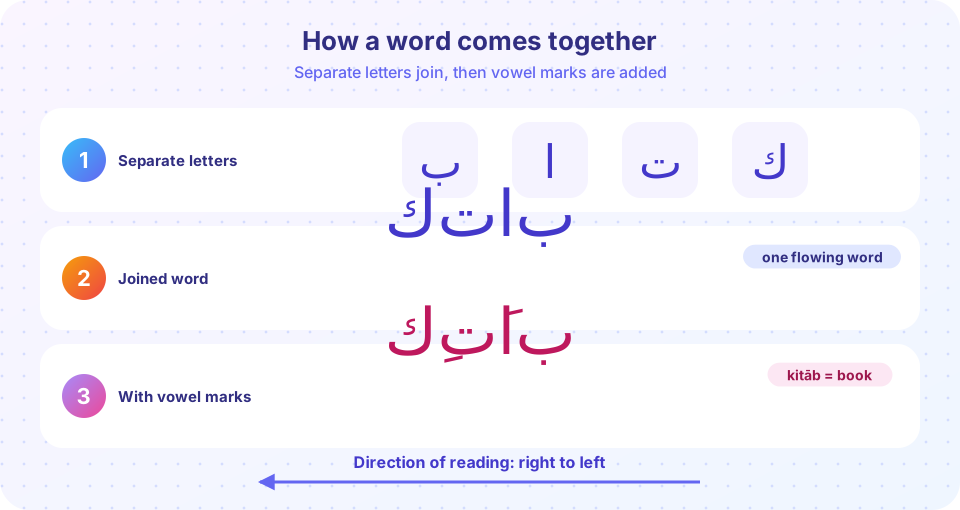
Knowing 28 separate letters is like knowing 28 puzzle pieces: you still have to see how they fit. In Arabic, the pieces fit by joining. Letters link to their neighbors in a flowing line, change shape depending on where they sit and then receive small marks that tell you the vowels. This chapter teaches that machinery in four lessons. After it, you will be able to read a vowelled Arabic word aloud, one letter at a time, and to write one yourself.
What you will learn
- Why Arabic letters change shape and how the four forms work.
- What the short-vowel marks, the sukūn and the shadda do.
- How long vowels, diphthongs and tanwīn look and sound.
- Which special letters (hamza, tā' marbūṭa, alif maqṣūra) you must know.
- A five-step method for reading any vowelled word.
Key terms
Joining: connecting a letter to the next one with a short horizontal stroke on the baseline.
Baseline: the horizontal line along which a word is written; most letters sit on it and joins run along it.
Ḥarakāt: the small vowel marks (fatḥa, kasra, ḍamma) placed above and below letters.
Tanwīn: a doubled mark at the end of some nouns that adds an "n" sound (-an, -in, -un).
Naskh: the clear, rounded style used in print and on screens.
What changes when letters meet
In English, a capital A and a lowercase a look different, but within one case a letter always has one shape. In Arabic, there are no capitals, and instead each letter can take up to four forms:
- Isolated, when the letter stands alone (as in an alphabet chart),
- Initial, at the start of a joined group,
- Medial, in the middle,
- Final, at the end.
Do not panic: the four forms of a letter are always recognizably related. The body is the same, only the connecting strokes change. The dots, which tell similar letters apart, stay where they are.
There are three consequences. First, you read by shapes in context, not by isolated letters. Second, words become more compact and elegant than the isolated letters suggest. Third, six non-joiners (ا د ذ ر ز و) break a word into visible chunks. The first lesson of this chapter covers all of this.
Vowels: the marks on top
Once the consonant skeleton is joined, short vowels are shown by small marks above or below. There are only three vowels plus two helper marks:
| Mark | Name | Sound | Example |
|---|---|---|---|
| بَ | fatḥa | a | ba |
| بِ | kasra | i | bi |
| بُ | ḍamma | u | bu |
| بْ | sukūn | no vowel | b |
| بّ | shadda | doubles the letter | bb |
Longer vowels are made with letters: ā with alif, ī with yā', ū with wāw. A doubled final mark gives "n" endings (tanwīn), as in شُكْرًا (shukran, "thanks"), and a few special letters handle the glottal stop and the feminine ending. These topics fill lessons 3 to 5 of this chapter.
Five steps to read a word
When you see an Arabic word, work through this mini-algorithm. It gets quick with practice.
- Find the letters. Locate the joins and the non-joiners. Count the dots carefully.
- Read right to left. The first letter you read is the rightmost.
- Add the short vowels. Read the marks above and below each consonant.
- Look for long vowels and special letters. An alif, wāw or yā' carrying no mark is usually a long vowel.
- Say it, then check. Pronounce the whole word and compare it with the transliteration.
For example, كِتَاب: ك with kasra gives ki; ت with fatḥa gives ta; the plain alif after it lengthens that a into ā; ب with no mark ends the word. Together: ki-tāb, "book".
Handwriting versus print
Printed Arabic and handwritten Arabic look a little different, just as printed and cursive English do. Books and screens mainly use naskh, which is the style in this course. Everyday handwriting often follows ruqʿa, a simplified, quick style in which letters are shorter and some are joined more tightly. Calligraphers practice other styles, including thuluth, dīwānī and kūfī. For now, copy the naskh shapes; your hand will find its own rhythm as you write more.
Write on lined paper so every letter sits on the same baseline. Write the whole word first, from right to left, then go back and add dots and vowel marks in one sweep.
The lessons in this chapter
| Lesson | What you learn |
|---|---|
| Joining Letters: The Four Forms | How letters connect and change shape |
| Short Vowels, Sukūn and Shadda | Reading vowelled words; doubling |
| Long Vowels, Diphthongs and Tanwīn | ā ī ū, ay aw and -an -in -un |
| Hamza, Tā' Marbūṭa and Alif Maqṣūra | The special letters |
| Chapter 3 Review | Recap and a big quiz |
Reading in four steps
Four lessons take you from letters to words.
Your reading loop
Repeat the loop until it feels automatic.
Try it
Press Run (or Ctrl + Enter) to see the result here.
Program input · what you'd type while the program runs
Type the answers before you press Run, one per line. Each time the program reads a line (with input()), it gets the next line from this box.
The Python block explains the gaps you will see inside printed words: the letters in each block are connected, and a gap appears after each non-joiner.
Common misconceptions
"Each letter has one shape, like in English." Most Arabic letters have up to four forms, depending on position.
"Joined letters are a different alphabet." They are the same letters; only the connecting strokes change.
"Handwriting must look exactly like print." Not at all. Your handwriting will be simpler, with shorter letters, and that is normal.
Check your understanding
Quick check · 4 questions
of 4 answered You scored / 4 · perfect!
-
1. How many forms can an Arabic letter have, at most?
Isolated, initial, medial and final. -
2. Which letters never join to the following letter?
These six join only to the letter before them. -
3. Which mark means 'no vowel'?
The sukūn, a small circle, shows that the consonant has no vowel after it. -
4. In which direction do you read the first step of an Arabic word?
The first letter is the rightmost one.
Summary
- Arabic letters join, and each can take four forms: isolated, initial, medial and final.
- Six non-joiners create visible breaks inside words.
- Short vowels are marks: fatḥa, kasra and ḍamma; sukūn and shadda are helper marks.
- Use the five-step method: find letters, go right to left, add vowels, spot long vowels, say it.
- The next lessons cover each part in detail.
Track your progress
Create a free account to tick off lessons and pick up where you left off on any device.
of Arabic for Beginners lessons completed