


















Lesson 5 of 45 · Getting Started
Chapter 1 Review: Getting Started
Review chapter 1 of Arabic for Beginners: Modern Standard Arabic, dialects, roots and patterns, greetings and gender endings, with a mixed 10-question quiz.
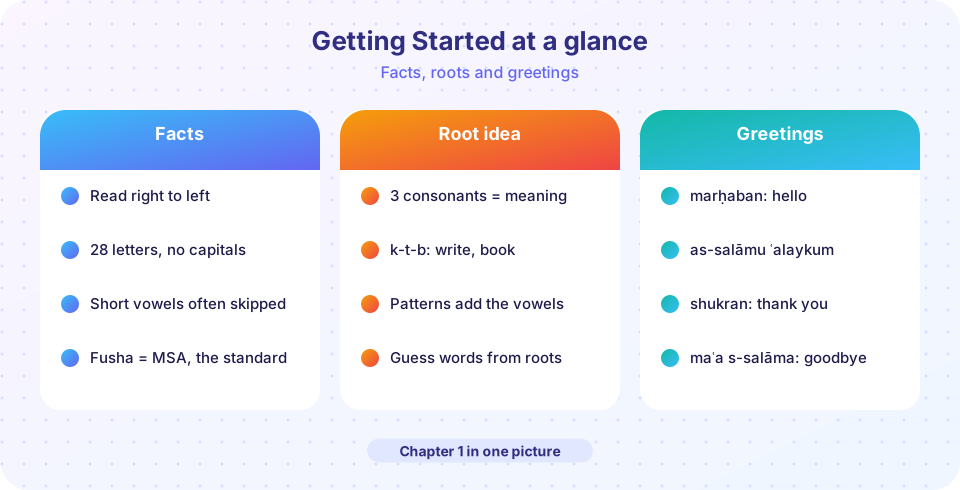
You have finished the first chapter, which set up the frame for everything else. You now know what kind of Arabic you are learning, how the script is organized, how words grow from roots, and how to greet people politely. Take a few minutes to see the whole chapter at once, then test yourself. If a question surprises you, go back to the lesson named in the table and re-read the relevant section.
What you will learn
- A one-page recap of the four lessons in this chapter.
- Which ideas to revisit before you start the alphabet.
- How well you remember the key facts, through a ten-question quiz.
- A small matching game that tests the root idea.
Key terms
MSA (al-fuṣḥā): the shared standard form of Arabic for writing and formal speech.
Diglossia: a formal standard and everyday dialects used side by side.
Abjad: a script that mainly writes consonants.
Root and pattern: three consonants carrying a meaning, combined with a vowel template.
Masculine/feminine address: endings such as -ka and -ki that match the listener.
The chapter at a glance
| Lesson | The big idea | One fact to remember |
|---|---|---|
| Course Map | You are learning MSA in nine steps, with daily practice | Writing by hand and speaking aloud help memory |
| Arabic Around the World | One written standard, many spoken dialects | Diglossia: formal MSA and everyday dialect |
| How Arabic Works | Right to left, joined letters, roots and patterns | Short vowels are usually not written |
| First Greetings | Greetings come in pairs, and "you" has gender endings | as-salāmu ʿalaykum is answered by wa ʿalaykumu s-salām |
Three connections worth making
First, the script and the root system fit together. Because short vowels are usually left out, the consonant skeleton carries most of the information, and the consonant skeleton is exactly what a root is. That is why Arabic can be written in such a compact way and still be read.
Second, MSA and the dialects share the same roots. When you learn that kataba means "he wrote", you will recognize the same three consonants in a Cairo or a Casablanca street sign. The dialect changes the vowels, a few high-frequency words and some grammar, but the roots stay.
Third, politeness is built into the grammar. The gender ending in kayfa ḥāluka / ḥāluki is a tiny example of something Arabic does constantly: it makes you choose a form for the person you address. You will meet the same pattern again in verbs, in adjectives and in pronouns.
How to prepare for Chapter 2
The next chapter teaches the alphabet. You will get much more out of it if you do the following now.
- Find a pen with a smooth line and a notebook with plain or lightly ruled paper.
- Practice saying the phrases from lesson 4 aloud until they feel automatic.
- Decide on a daily time slot, even 15 minutes, and put it in your calendar.
- Pick a sample of Arabic text you care about, such as a song title, a restaurant name or a name in your family. Try to guess which letters you recognize by the end of the next chapter.
What to do with a wrong answer
If you missed a question in the quiz, find the lesson in the table above and re-read only the relevant section. Then write one sentence in your notebook that says in your own words what the right answer is and why. The act of putting the rule in your own words is one of the strongest ways to fix it in memory, and it takes less than a minute. If you missed more than three, give the chapter another pass tomorrow rather than the same day, since spaced review is more effective than repetition within a session.
Try it
Press Run (or Ctrl + Enter) to see the result here.
Program input · what you'd type while the program runs
Type the answers before you press Run, one per line. Each time the program reads a line (with input()), it gets the next line from this box.
Common misconceptions
"If I forget a greeting I can just use English." You can, but trying even one Arabic phrase changes how people respond. Practice the five core phrases until they are automatic.
"Roots always give the exact meaning." Roots give a core idea. Individual words can drift, so always check meanings.
"I should learn the dialect first because it is spoken." Both orders work. Starting with MSA gives you the script and grammar for every dialect, but the best choice depends on whom you want to talk to.
Check your understanding
Quick check · 10 questions
of 10 answered You scored / 10 · perfect!
-
1. Which of these is a true statement about Arabic script?
Arabic runs right to left, has 28 letters, no capitals and marks short vowels with optional signs. -
2. How many letters does the Arabic alphabet have?
The Arabic alphabet has 28 letters; three of them also stand for long vowels. -
3. What is Modern Standard Arabic mainly used for?
MSA is the shared formal standard; dialects are used at home and with friends. -
4. Which pair of words shares a root?
Kitāb (book) and maktaba (library) both come from k-t-b. -
5. Why can كتب be read in several ways?
Without vowel marks it could be kataba, kutub or kutiba; context decides. -
6. Which phrase is the usual answer to 'ṣabāḥ al-khayr'?
'Morning of light' answers 'morning of goodness'. -
7. Which ending addresses a woman in 'kayfa ḥāluk_?'
Kayfa ḥāluki? is for a woman, kayfa ḥāluka? for a man. -
8. In which direction are numbers like 2025 read in Arabic text?
Numbers are read from left to right, the same as in English. -
9. What is diglossia?
Arabic is the classic example of diglossia: MSA for formal use, dialects for daily life. -
10. Which phrase means 'please' to a man?
Min faḍlika, literally 'from your favor', is the standard way to say please.
Summary
- MSA is the shared written and formal standard; dialects are the languages of daily life.
- Arabic is an abjad: right to left, joined letters, no capitals, short vowels usually unwritten.
- Roots of three consonants plus patterns build families of words.
- Greetings come in pairs, and "you" has masculine and feminine endings.
- Use the next chapter to learn all 28 letters with their sounds.
Track your progress
Create a free account to tick off lessons and pick up where you left off on any device.
of Arabic for Beginners lessons completed