


















Lesson 38 of 45 · Conversation and Culture
Market, Café and Travel Dialogues
Practice three everyday Arabic dialogues with translations: bargaining at the market, ordering at a café and asking for directions and train tickets.
The best way to learn how a language sounds in real life is to read and rehearse short scenes. This lesson gives you three of them: shopping at a market, ordering in a café and finding your way at a station. Each scene uses grammar from the whole course, so you will notice present-tense verbs, question words, numbers, possessives and polite phrases working together.
How to use these dialogues: read them once with the translation, then read the Arabic aloud while covering everything else, then act them out with a partner or with yourself in a mirror, switching roles. The goal is not to memorize the words but to feel the rhythm of the exchange.
What you will learn
- A complete market, café and travel scene, with translations
- Useful phrases for prices, orders, directions and tickets
- A few new small words: بِدُونِ (without), حَسَنًا (okay), حَاضِر (right away)
Key terms
Seller (البَائِع, al-bāʾiʿ) and customer (الزَّبُون, az-zabūn): the two roles in a shop.
Bill (الحِسَاب, al-ḥisāb): what you ask for when you want to pay.
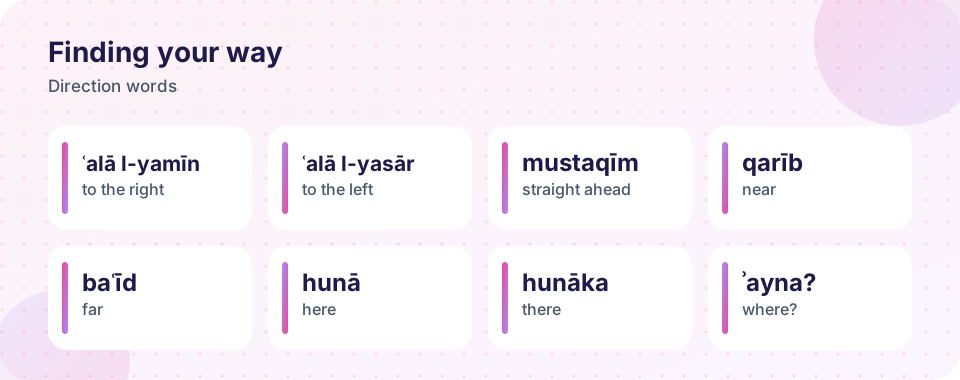
Directions: عَلَى اليَمِين (to the right), عَلَى اليَسَار (to the left), مُسْتَقِيم (straight).
Imperative: the command form. تَفَضَّلْ and اذْهَبْ are imperatives for a man.
Scene 1: At the market
| Speaker | Arabic | Transliteration | English |
|---|---|---|---|
| Seller | أَهْلًا وَسَهْلًا! تَفَضَّلْ. | ʾahlan wa-sahlan! tafaḍḍal. | Welcome! Please, go ahead. |
| Customer | مَرْحَبًا. كَمْ سِعْر التُّفَّاح؟ | marḥaban. kam siʿr at-tuffāḥ? | Hello. How much are the apples? |
| Seller | خَمْسَة دَنَانِير لِلْكِيلُو. | khamsat danānīr lil-kīlū. | Five dinars per kilo. |
| Customer | هَذَا غَالٍ. | hādhā ghālin. | That is expensive. |
| Seller | لَا، هُوَ طَازَج! | lā, huwa ṭāzaj! | No, it is fresh! |
| Customer | حَسَنًا، أُرِيدُ كِيلُو وَاحِد. | ḥasanan, ʾurīdu kīlū wāḥid. | Okay, I want one kilo. |
| Seller | تَفَضَّلْ. هَلْ تُرِيدُ شَيْئًا آخَر؟ | tafaḍḍal. hal turīdu shayʾan ʾākhar? | Here you are. Do you want anything else? |
| Customer | لَا، شُكْرًا. كَمِ الحِسَاب؟ | lā, shukran. kami l-ḥisāb? | No, thank you. How much is the bill? |
| Seller | خَمْسَة دَنَانِير. | khamsat danānīr. | Five dinars. |
Notes: كَمْ سِعْر literally means "how much (is) the price of". The number five takes دَنَانِير (the plural of dinar) because the thing counted is plural and masculine (see the number rules in Numbers, days and time). Prices and the word for money differ between countries: dinars, riyals, dirhams, pounds. Bargaining is normal in many markets, but a polite smile and a شُكْرًا matter more than a hard stance.
Scene 2: At the café
| Speaker | Arabic | Transliteration | English |
|---|---|---|---|
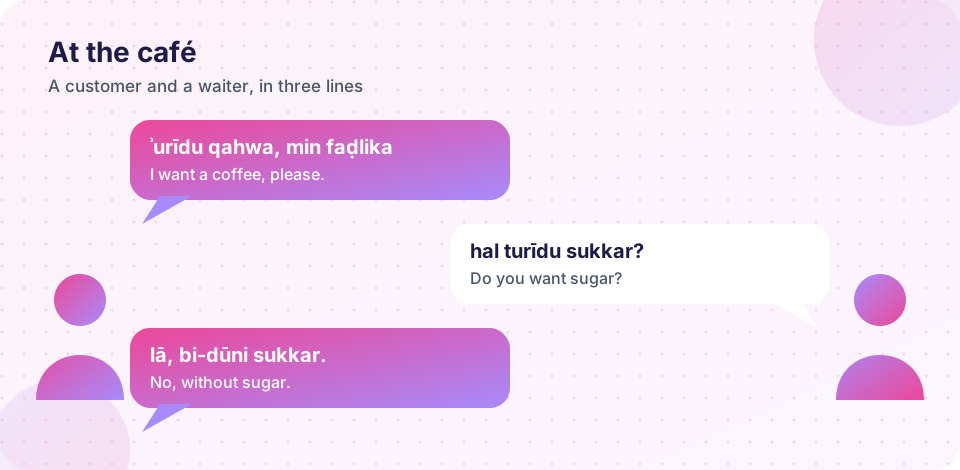
| Waiter | مَرْحَبًا! مَاذَا تُرِيدُ؟ | marḥaban! mādhā turīdu? | Hello! What would you like? |
| Customer | أُرِيدُ قَهْوَة مِنْ فَضْلِكَ. | ʾurīdu qahwa min faḍlika. | I want a coffee, please. |
| Waiter | هَلْ تُرِيدُ سُكَّر؟ | hal turīdu sukkar? | Do you want sugar? |
| Customer | لَا، بِدُونِ سُكَّر. | lā, bi-dūni sukkar. | No, without sugar. |
| Waiter | هَلْ تُرِيدُ شَيْئًا آخَر؟ | hal turīdu shayʾan ʾākhar? | Do you want anything else? |
| Customer | نَعَمْ، أُرِيدُ كَعْكَة. | naʿam, ʾurīdu kaʿka. | Yes, I want a piece of cake. |
| Waiter | حَاضِر. | ḥāḍir. | Right away. |
| Customer | الحِسَاب مِنْ فَضْلِكَ. | al-ḥisāb min faḍlika. | The bill, please. |
You know almost all of this: أُرِيدُ (I want), هَلْ (do you ...?) and مِنْ فَضْلِكَ (please). Two small new pieces are بِدُونِ (without), the opposite of مَعَ (with), and حَاضِر (right away, as you wish), a common reply from a waiter or host. A woman speaking to a waiter says مِنْ فَضْلِكَ if the waiter is a man and مِنْ فَضْلِكِ if the waiter is a woman. The ending follows the person you speak to.
Scene 3: At the station
First, asking for directions:
| Speaker | Arabic | Transliteration | English |
|---|---|---|---|
| Traveler | لَوْ سَمَحْتَ، أَيْنَ المَحَطَّة؟ | law samaḥta, ʾayna l-maḥaṭṭa? | Excuse me, where is the station? |
| Local | المَحَطَّة قَرِيبَة. اذْهَبْ مُسْتَقِيمًا ثُمَّ عَلَى اليَمِين. | al-maḥaṭṭa qarība. idhhab mustaqīman thumma ʿalā l-yamīn. | The station is near. Go straight, then to the right. |
| Traveler | هَلْ هِيَ بَعِيدَة؟ | hal hiya baʿīda? | Is it far? |
| Local | لَا، خَمْس دَقَائِق مَشْيًا. | lā, khams daqāʾiq mashyan. | No, five minutes on foot. |
| Traveler | شُكْرًا جَزِيلًا. | shukran jazīlan. | Thank you very much. |
| Local | عَفْوًا. | ʿafwan. | You are welcome. |
Then, buying a ticket:
| Speaker | Arabic | Transliteration | English |
|---|---|---|---|
| Traveler | لَوْ سَمَحْتَ، أُرِيدُ تَذْكِرَة إِلَى الإِسْكَنْدَرِيَّة. | law samaḥta, ʾurīdu tadhkira ʾilā l-ʾiskandariyya. | Excuse me, I want a ticket to Alexandria. |
| Clerk | تَفَضَّلْ. | tafaḍḍal. | Here you are. |
| Traveler | مَتَى يَذْهَبُ القِطَار؟ | matā yadhhabu l-qiṭār? | When does the train leave? |
| Clerk | فِي السَّاعَة التَّاسِعَة. | fī s-sāʿa at-tāsiʿa. | At nine o'clock. |
Notice خَمْس دَقَائِق: دَقِيقَة (minute) is feminine, so the number five drops its ta marbuta, following the opposite-gender rule.
Useful phrases from the scenes
| Need | Say |
|---|---|
| Ask a price | كَمْ سِعْرُهُ؟ (kam siʿruhu?) or بِكَمْ هَذَا؟ (bi-kam hādhā?) |
| Order | أُرِيدُ ...، مِنْ فَضْلِكَ. |
| Ask for the bill | الحِسَاب مِنْ فَضْلِكَ. |
| Ask where | أَيْنَ ...؟ |
| Ask how far | هَلْ هُوَ بَعِيد؟ (hal huwa baʿīd?) |
| Say you do not understand | لَا أَفْهَمُ. (lā ʾafhamu.) |
| Ask someone to repeat | هَلْ يُمْكِنُ أَنْ تُعِيدَ؟ (could you repeat?) |
How to study a dialogue
A dialogue is a compact grammar lesson. Take the café scene and analyze it line by line. أُرِيدُ قَهْوَة مِنْ فَضْلِكَ has three parts: a verb of wanting (أُرِيدُ, present tense, first person), the thing wanted (قَهْوَة) and a politeness marker (مِنْ فَضْلِكَ). هَلْ تُرِيدُ سُكَّر؟ is a yes/no question: هَلْ plus the same verb, now in the second person (تُرِيدُ). بِدُونِ سُكَّر uses a preposition, بِدُونِ, followed by a noun. Once you see the pattern, you can produce new sentences by swapping one part: I want tea, please, Do you want milk?, without milk.
For each scene, follow four steps. First, read the Arabic with the transliteration and translation. Second, read the Arabic alone and check any word you forget. Third, say it aloud with a partner, switching roles. Fourth, rewrite the scene with different nouns: replace قَهْوَة with شَاي or عَصِير, replace التُّفَّاح with المَوْز (bananas) or التَّمْر (dates), replace الإِسْكَنْدَرِيَّة with the name of a city you would like to visit.
Pronunciation tips for these scenes
Short phrases carry the rhythm of the language, so listen to how speakers say them. Stress usually falls on the heavier syllable, not on the last one. The question أَيْنَ المَحَطَّة؟ (ʾayna l-maḥaṭṭa?) rises at the end like a question in English. The word مِنْ فَضْلِكَ is said smoothly as min fadlik, where the emphatic ḍ (ض) is a heavy, deeper sound. If you are unsure of a sound, say the word slowly three times and then at normal speed.
Role-play ideas
- At the market: you want oranges but the seller says the price is too high. Practice asking, هَلْ يُمْكِنُ أَنْ تُخَفِّضَ السِّعْر؟ (can you lower the price?), then accepting politely: حَسَنًا، شُكْرًا.
- At the café: you order for two people. Use the we form: نُرِيدُ قَهْوَتَيْن (nurīdu qahwatayn, we want two coffees), with the dual قَهْوَتَيْن.
- At the station: you ask when the next train leaves and from which platform. Practice مِنْ أَيْنَ يَذْهَبُ القِطَار؟ (from where does the train leave?).
Listening for key words
When a native speaker answers quickly, you will not catch everything, and that is fine. Listen only for the key words: a number (خَمْسَة), a direction (اليَمِين), a time (التَّاسِعَة). If you catch one, you can often reconstruct the meaning. If you do not, ask politely for a repeat. The more scenes you rehearse, the more of these key words you will recognize on the first hearing.
Making the dialogues your own
The scenes are most useful when you change them. Here is a three-step method for turning a scene into your own conversation.
- Change the nouns. In the market scene, replace التُّفَّاح with another food from the lesson on family, food and places. In the café scene, order عَصِير instead of قَهْوَة. In the station scene, name a city from your own country.
- Change the numbers and times. Ask for كِيلُو وَاحِد or كِيلُو وَنِصْف (a kilo and a half), and ask when the train leaves at a different hour: فِي السَّاعَة العَاشِرَة.
- Change the roles. Play the seller or the waiter as well. Playing the other role teaches you the phrases from the other side, so you will recognize them when you hear them.
After a week of working with each scene in this way, you will not just know the words, you will be able to run a conversation and keep it going when something unexpected happens, such as the seller saying that apples are finished. Respond with a short, polite phrase, لَا مُشْكِلَة (lā mushkila, no problem), and ask for something else.
Common misconceptions
"I must use the exact words of the scene." Real conversations vary. Treat each scene as a model and swap in your own nouns: tea instead of coffee, bread instead of apples.
"Prices are the same everywhere." Currency names, units and bargaining customs differ by country. Learn the local ones when you arrive.
"The imperative is a rude command." تَفَضَّلْ and اذْهَبْ are everyday polite forms. Tone and the added مِنْ فَضْلِكَ or لَوْ سَمَحْتَ keep them friendly.
Try it
Fill in the missing word of each line.
Now build sentences from the scenes.
Check your understanding
Quick check · 5 questions
of 5 answered You scored / 5 · perfect!
-
1. What does كَمِ الحِسَاب؟ ask?
kam asks about quantity or price; al-ḥisāb is the bill. -
2. How do you say "without sugar"?
bi-dūni means without; maʿa means with. -
3. Which phrase gives directions "to the right"?
ʿalā l-yamīn is to the right; ʿalā l-yasār is to the left. -
4. Why is it خَمْس دَقَائِق and not خَمْسَة دَقَائِق?
Numbers three to ten take the opposite gender; a feminine noun takes the number without ة. -
5. What does حَاضِر mean in a café?
ḥāḍir is a friendly way to accept a request.
Summary
- Three scenes (market, café, station) show the course vocabulary in real use.
- Key patterns: كَمْ سِعْر ...؟, أُرِيدُ ... مِنْ فَضْلِكَ, أَيْنَ ...؟, بِدُونِ ....
- Directions use عَلَى اليَمِين, عَلَى اليَسَار, مُسْتَقِيم, قَرِيب, بَعِيد.
- Replace the nouns to build your own scenes, and act them out aloud.
Next: Dialects and culture
Track your progress
Create a free account to tick off lessons and pick up where you left off on any device.
of Arabic for Beginners lessons completed