


















Lesson 43 of 45 · Projects and Practice
Glossary: Grammar Terms and Core Vocabulary
A reference glossary of Arabic grammar terms in Arabic and English, plus the verbs, numbers, days and phrases from the second half of this course.
A glossary is a map you consult when you get lost. This one has two parts: the grammar terms you will meet in Arabic textbooks and dictionaries (with their English equivalents), and the core vocabulary from this half of the course, grouped by topic. Bookmark it. When you read a grammar explanation in another book or hear a teacher say فِعْل مَاضٍ (a past verb), you can look the term up here in seconds.
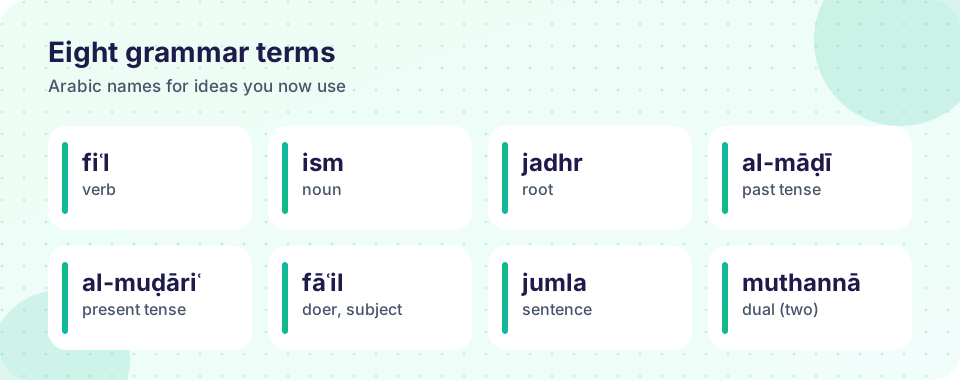
Arabic grammar has a long and distinguished tradition, and the Arabic terms are widely used in teaching. Learning a few of them early makes your later study much smoother, because Arabic-language grammar books and apps use them constantly.
What you will learn
- The most common Arabic grammar terms and their English meanings
- Where to find the verbs, numbers, days and phrases from the course
- How to use a glossary actively, not just look things up
Key terms
Glossary: an alphabetical or grouped list of terms with short definitions.
Terminology: the special words used in a field. In Arabic grammar, many terms come from the work of medieval grammarians.
Cognate: a word that shares a root or origin with another, like كِتَاب (book) and كَاتِب (writer).
Part 1: Grammar terms
| English | Arabic | Transliteration | Notes |
|---|---|---|---|
| verb | فِعْل | fiʿl | |
| noun | اسْم | ism | |
| particle | حَرْف | ḥarf | also means "letter" |
| root | جَذْر | jadhr | usually three consonants |
| past tense | المَاضِي | al-māḍī | "the past" |
| present tense | المُضَارِع | al-muḍāriʿ | the imperfect form |
| subject, doer | فَاعِل | fāʿil | |
| object | مَفْعُول بِه | mafʿūl bih | |
| sentence | جُمْلَة | jumla | |
| verbal sentence | جُمْلَة فِعْلِيَّة | jumla fiʿliyya | starts with a verb |
| nominal sentence | جُمْلَة اسْمِيَّة | jumla ismiyya | starts with a noun |
| masculine | مُذَكَّر | mudhakkar | |
| feminine | مُؤَنَّث | muʾannath | |
| singular | مُفْرَد | mufrad | |
| dual | مُثَنَّى | muthannā | exactly two |
| plural | جَمْع | jamʿ | |
| pronoun | ضَمِير | ḍamīr | |
| adjective | صِفَة | ṣifa | |
| preposition | حَرْف جَرّ | ḥarf jarr | "particle of drawing" |
| definite | مَعْرِفَة | maʿrifa | |
| indefinite | نَكِرَة | nakira | |
| negation | نَفْي | nafy | |
| question particle | أَدَاة اسْتِفْهَام | adāt istifhām | |
| indicative | مَرْفُوع | marfūʿ | the ordinary present form |
| subjunctive | مَنْصُوب | manṣūb | after أَنْ and لَنْ |
| jussive | مَجْزُوم | majzūm | after لَمْ |
| conjugation | تَصْرِيف | taṣrīf | |
| short vowel | حَرَكَة | ḥaraka | |
| fatha / damma / kasra | فَتْحَة / ضَمَّة / كَسْرَة | fatḥa / ḍamma / kasra | a / u / i |
| sukun | سُكُون | sukūn | no vowel |
| shadda | شَدَّة | shadda | doubled letter |
| tanwin | تَنْوِين | tanwīn | -un / -an / -in ending |
| hamza | هَمْزَة | hamza | glottal stop |
| Standard Arabic | الفُصْحَى | al-fuṣḥā | |
| dialect | لَهْجَة | lahja |
Part 2: Core verbs (past and present, "he")
| Past | Present | Meaning |
|---|---|---|
| كَتَبَ | يَكْتُبُ | write |
| دَرَسَ | يَدْرُسُ | study |
| ذَهَبَ | يَذْهَبُ | go |
| جَلَسَ | يَجْلِسُ | sit |
| فَتَحَ | يَفْتَحُ | open |
| شَرِبَ | يَشْرَبُ | drink |
| سَمِعَ | يَسْمَعُ | hear, listen |
| فَهِمَ | يَفْهَمُ | understand |
| عَرَفَ | يَعْرِفُ | know |
| رَجَعَ | يَرْجِعُ | return |
| سَكَنَ | يَسْكُنُ | live, reside |
| لَعِبَ | يَلْعَبُ | play |
| قَالَ | يَقُولُ | say |
| أَكَلَ | يَأْكُلُ | eat |
| قَرَأَ | يَقْرَأُ | read |
| اشْتَرَى | يَشْتَرِي | buy |
| أَرَادَ | يُرِيدُ | want |
| أَحَبَّ | يُحِبُّ | love, like |
| سَافَرَ | يُسَافِرُ | travel |
| تَكَلَّمَ | يَتَكَلَّمُ | speak |
| جَاءَ | يَجِيءُ | come |
| نَامَ | يَنَامُ | sleep |
| مَشَى | يَمْشِي | walk |
Part 3: Question words, numbers, days
| Group | Words |
|---|---|
| Questions | مَنْ who, مَا / مَاذَا what, أَيْنَ where, مَتَى when, كَيْفَ how, لِمَاذَا why, كَمْ how many, أَيُّ which, هَلْ (yes/no) |
| Numbers 1 to 10 | وَاحِد، اثْنَان، ثَلَاثَة، أَرْبَعَة، خَمْسَة، سِتَّة، سَبْعَة، ثَمَانِيَة، تِسْعَة، عَشَرَة |
| Tens and more | عِشْرُون 20, ثَلَاثُون 30, مِائَة 100, أَلْف 1,000 |
| Days | الأَحَد، الاثْنَيْن، الثُّلَاثَاء، الأَرْبِعَاء، الخَمِيس، الجُمُعَة، السَّبْت |
| Time words | اليَوْم today, غَدًا tomorrow, أَمْسِ yesterday, الآنَ now |
Part 4: Phrases
| Phrase | Meaning |
|---|---|
| السَّلَامُ عَلَيْكُمْ / وَعَلَيْكُمُ السَّلَامُ | hello / reply |
| صَبَاحُ الخَيْرِ / صَبَاحُ النُّورِ | good morning / reply |
| كَيْفَ حَالُكَ؟ | how are you? |
| شُكْرًا / عَفْوًا | thank you / you are welcome |
| مِنْ فَضْلِكَ / لَوْ سَمَحْتَ | please / excuse me |
| تَشَرَّفْنَا | pleased to meet you |
| مَعَ السَّلَامَةِ | goodbye |
| بِكَمْ هَذَا؟ | how much is this? |
How to use a glossary actively
- Cover one column. Read the English and try to say the Arabic, then flip.
- Add examples. Next to each new term, write a short sentence of your own.
- Group by root. Add related words you meet: كَتَبَ, كِتَاب, كَاتِب, مَكْتَب.
How Arabic grammarians divide words
Traditional Arabic grammar sorts every word into one of three classes, and knowing them makes the glossary above easier to use. An اسْم (ism) is a noun, adjective or pronoun: a word that names a thing, a person or a quality. A فِعْل (fiʿl) is a verb: a word that tells an action or event and is tied to a time. A حَرْف (ḥarf) is a particle: a small word with little meaning on its own, such as فِي (in) or هَلْ (the yes/no question word), which changes how other words work. When you meet a new word, ask which of the three it is, and you already know a great deal about how it behaves.
Root and pattern in practice
The most important idea behind the glossary is the root. A root (جَذْر) is a set of consonants that carries a core meaning. The same root appears in many words, shaped by patterns of vowels and extra letters: from ك-ت-ب come كَتَبَ (he wrote), كِتَاب (book), كَاتِب (writer), مَكْتَب (office) and مَكْتَبَة (library). From د-ر-س come دَرَسَ (he studied), مَدْرَسَة (school), دَرْس (lesson) and مُدَرِّس (teacher). Recognizing roots lets you guess the meaning of new words and remember them in families rather than one by one.
Looking words up in a dictionary
Printed and online Arabic dictionaries often order words by root, not by their spelling. To look up مَكْتَبَة, you first strip off the extra letters (the prefix مَـ and the ending ة) to find the root ك-ت-ب, and then search under that root. At first this feels slow, but it quickly becomes natural, and it trains you to see the family behind each word. Many learner dictionaries and apps accept the word as written and find the root for you, so use whichever suits you, but practice spotting the root yourself.
Making the glossary your own
A glossary is most useful when you personalize it. Add the words you meet in your reading and conversations, with an example sentence for each. Group them by root and by topic. Mark the ones you keep forgetting, and review those first. After a month, your own glossary will be more valuable than any published list, because it is built from the words you actually need.
Try it
Learn the grammar terms with flash cards, then match them with their meanings.
Check your understanding
Quick check · 4 questions
of 4 answered You scored / 4 · perfect!
-
1. What does المُضَارِع mean in grammar?
al-muḍāriʿ is the present (imperfect) tense. -
2. What is a جُمْلَة فِعْلِيَّة?
jumla fiʿliyya = verbal sentence; a noun-first sentence is jumla ismiyya. -
3. What does مُثَنَّى refer to?
muthannā is the dual number. -
4. Which term describes the form of the verb after لَمْ?
lam takes the jussive, majzūm.
Summary
- Many Arabic textbooks use Arabic grammar terms: فِعْل, اسْم, جَذْر, المَاضِي, المُضَارِع.
- Keep this glossary open while you read other resources.
- Use it actively: cover, recall, add examples and group by root.
Next: Cheat sheet
Track your progress
Create a free account to tick off lessons and pick up where you left off on any device.
of Arabic for Beginners lessons completed